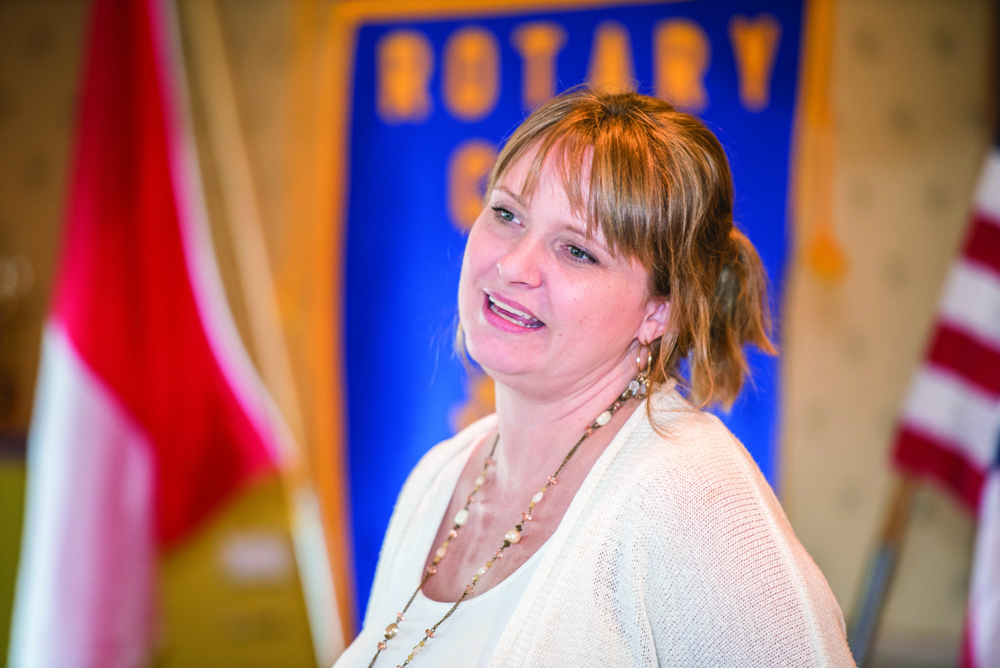
Shannon Jolley of the Canadian Cancer Society spoke last Thursday at the meeting of the Rotary Club of Osoyoos. She announced the society’s annual Relay for Life event is being cancelled and replaced with a more modest Daffodil Dash, set for April 26. Richard McGuire Photo.
A more modest Daffodil Dash is replacing the Relay for Life cancer fundraiser this year in Osoyoos in April.
Shannon Jolley, of the Canadian Cancer Society, announced the change at last Thursday’s lunch meeting of the Rotary Club of Osoyoos.
Jolley, who is team lead of annual giving for the Southern Interior Region, said the change is being made because the relays are expensive to operate and because the event is too long for some people.
“We couldn’t hit that magic number that we needed in order to make it sustainable, so that we’re actually making enough money,” she said, adding that too much money was going to running the event and not enough to the causes the Canadian Cancer Society supports.
The new event will be held April 26 at 10 a.m. during the society’s April daffodil fundraising month. Relay for Life was held in June when people were busy with other activities, Jolley noted.
Participants in the Daffodil Dash will have the option of running one, five or 10 kilometres. They are encouraged to find sponsors.
Participants also pay a fee to enter which is $20 for adults and $10 for youths before March 1 and $30 for adults and $15 for youths after that date.
“We need to be sensitive to what people in the communities need and want,” said Jolley. “The Daffodil Dash is a really nice alternative. It’s a much shorter event, it requires less in terms of people and time and our costs on it are significantly lower. So the money that we’re raising doesn’t go to cover the cost of the event. It actually goes to the Cancer Society.”
Funds raised by Relay for Life have diminished in recent years. Last year the Osoyoos relay raised just over $16,000 despite a target of $50,000.
Jolley also told the Rotarians about how the Canadian Cancer Society uses the money it raises.
In the 2013-14 fiscal year, the society raised more than $35 million in B.C. and the Yukon. Of that, it spends about 30 per cent on support programs for people with cancer and their families, 20 per cent on cancer research and 15 per cent for cancer prevention and advocacy.
Administrative costs are 3 per cent and fundraising costs are 32 per cent.
Jolley said she manages a staff of three for the Southern Interior Region and also has about 1,500 volunteers.
Jolley told the Rotarians she was looking for someone to handle daffodil sales from boxes in businesses in April as well as someone to run a one-weekend event selling cut daffodils.
Rotarian Jeff Duguid volunteered his White Kennedy accounting office to run the daffodil boxes, noting that his business has hundreds of people visiting in the month before the tax deadline.
No one immediately offered to run the cut flower program, which was done in past years by former Destination Osoyoos manager Jo Knight.
Jolley pointed to the strides made in cancer research. In the 1930s, when the society was formed, the survival rate for cancer was about 28 per cent. Today, taking all cancers into account, average survival rates are 63 per cent, she said.
There are more than 200 different types of cancer, she noted, and much more progress has been made in fighting some cancers than others.
Targeted investments in breast cancer research and better screening programs have improved survival rates dramatically, she said. Currently the survival rate is around 88 per cent.
Prostate cancer also now has a high survival rate at around 96 per cent, she said.
While the causes of lung cancer are now well known, allowing it to be prevented, it’s a more difficult one to treat, she said.
Other cancers such as brain cancer and pancreatic cancer have much lower survival rates, Jolley said.
“We don’t have a survivor to stand here and talk about their experience because there are not very many of them,” she said.
The goal is to increase the average survival rate to 80 per cent from the current 63 per cent, with the ultimate goal of eradicating cancer completely, Jolley said.
In terms of prevention, the Canadian Cancer Society is trying to raise awareness about how a sedentary lifestyle can contribute to cancer as well as other diseases.
“A lot of new research is suggesting that sitting is the new smoking,” she said. “It’s increasing our chances of getting cancer and it increases the intensity of cancers.”
Other research is looking into the role of diet and genetics as contributing factors.
The Canadian Cancer Society also runs programs to support those with cancer and their families.
This includes subsidizing a stay in a lodge in Kelowna for people who need to stay there to undergo treatment.
For more information, visit the Canadian Cancer Society website at www.cancer.ca.
RICHARD McGUIRE
Osoyoos Times