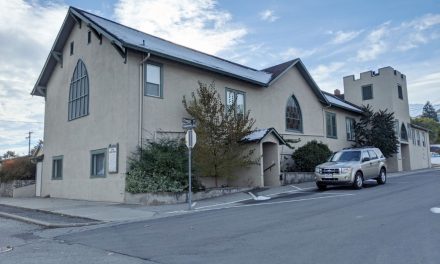

Jim Dinwoodie, director of operational services with the Town of Osoyoos, spoke recently at the Rotary Club of Osoyoos about how the town’s water and sewage systems work. (Richard McGuire photo)
There’s no reason for people in Osoyoos to choose bottled water over tap water, says Jim Dinwoodie, director of operational services with the Town of Osoyoos.
That’s because water in Osoyoos is supplied from three aquifers that filter out harmful materials, including organic matter than can give water elsewhere an unpleasant odour.
The natural filtration also gets rid of any turbidity, the suspension of rock particles, that can cause water problems elsewhere.
Dinwoodie gave an overview of the town’s water and sewer system in a recent presentation to the Rotary Club of Osoyoos.
Asked afterwards if he thinks people buying bottled water are wasting their money, he replied, “I think so.”
But he added that it’s an individual choice.
“If you think that bottled water from Nanton (Alberta) is better than water from Osoyoos, there’s nothing I can do to change your mind,” Dinwoodie said.
“I think by buying bottled water, all you’re doing is causing more pollution because you’re buying the bottle. So the bottles are going to end up in our landfill or be recycled and turned into carpet or whatever they do.”
Bottled water salesmen may tell you a different story, he added.
One aquifer, 193, is on the west side of Osoyoos Lake between Gyro Park and the north end of the lake. Two more, 194 and 195, are on the east side, one above the other, close to the Nk’Mip Cellars winery.
The aquifers naturally filter the water through sand and gravel underground.
Contrary to popular misconception, it doesn’t sit in rock chambers. The water originates with rain, though Dinwoodie said it’s possible some water is filtered in from the lake.
With the exception of rural areas north and south of town during irrigation season, tap water doesn’t come directly from the lake.
The town draws its water from six wells that extend into the three aquifers and with one exception, well 6, the water is not treated in any way.
There’s no chlorination or fluoridation – just pure water.
The exception, well 6, is treated with chlorine because this water is sent to Irrigation District 8 and is fed into pipes that receive lake water during the irrigation season.
The treatment is a precaution in case there is any residual lake water from the irrigation system, Dinwoodie said.
The two areas receiving lake water during irrigation season are Irrigation District 8 and Irrigation District 9, north and south of the town, respectively.
That water is chlorinated because the province requires chlorination of any surface water for human consumption.
Although most of the water in these districts is used for crop irrigation, homes in those rural areas take their domestic water from the same lines.
The Town of Osoyoos is in the process of twinning the water systems of those areas to separate irrigation water from the lake and domestic water, which would come from wells from the aquifer year round.
Until that project is completed, the town issues boil water advisories during the changeover from well water to lake water, usually around April.
Dinwoodie noted that the City of Greenwood in the Boundary region has a reputation for its excellent water because it won an international tap water tasting competition in 2012.
“There’s nothing to say that their water is any better than ours,” he said. “I think our water is fine. It’s good quality water. When it comes to taste, it’s a very subjective thing.”
Water is tested weekly and it always passes the tests, Dinwoodie said.
Osoyoos water is much better tasting than in other communities where he’s worked such as Fernie and Nelson, which get their water from surface sources, he said.
Those communities get “mud and muck” in their water when snow melts, he said.
Water from the town’s wells is pumped to underground reservoirs near Osoyoos Golf Course.
At the other end of the equation, local residents are sometimes surprised to learn that the town’s sewage doesn’t enter the lake.
Instead it is pumped from a main lift station at Legion Beach to sewage lagoons at the golf course.
There, the wastewater is aerated where “it feeds the good bugs which then eat the bad bugs,” and the sludge settles.
The water then goes into storage ponds, before being treated with chlorine and used to irrigate the golf course, Desert Park and ball diamonds.
Water is also tested before it is used.
Dinwoodie said the sludge is removed roughly every 15 years and is stored to dry out in big long bags called Geotubes.
After sitting for several years, the dried sludge can be put into landfill or be mixed with garden waste and used as compost.
RICHARD McGUIRE
Osoyoos Times