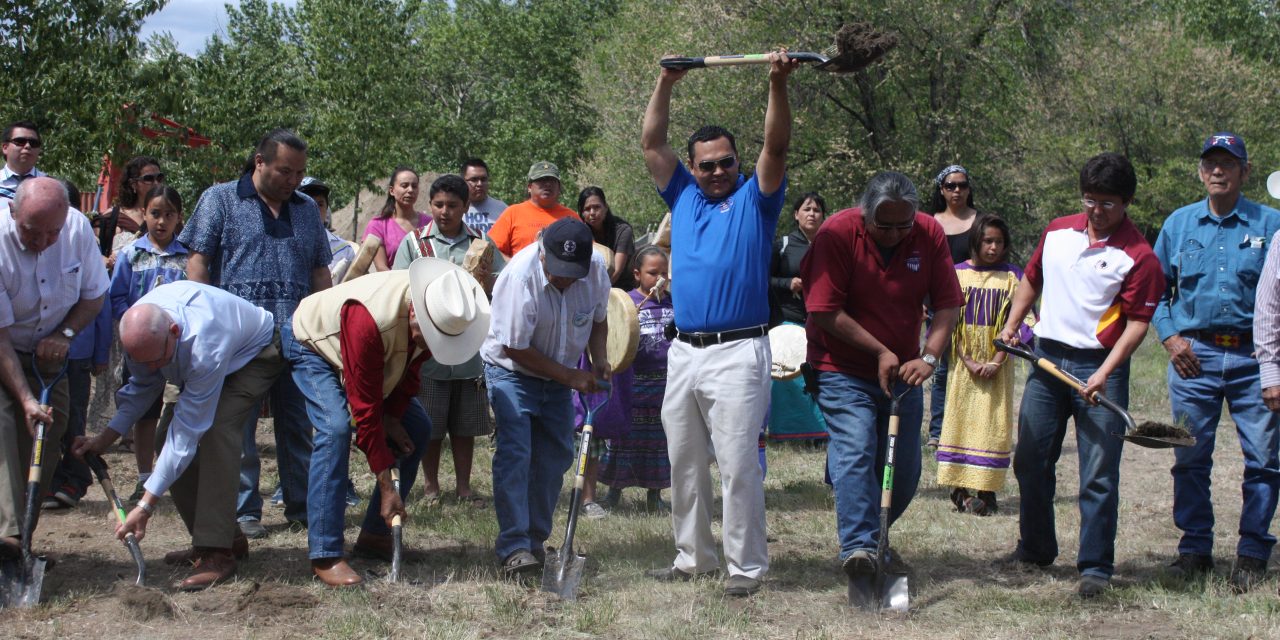
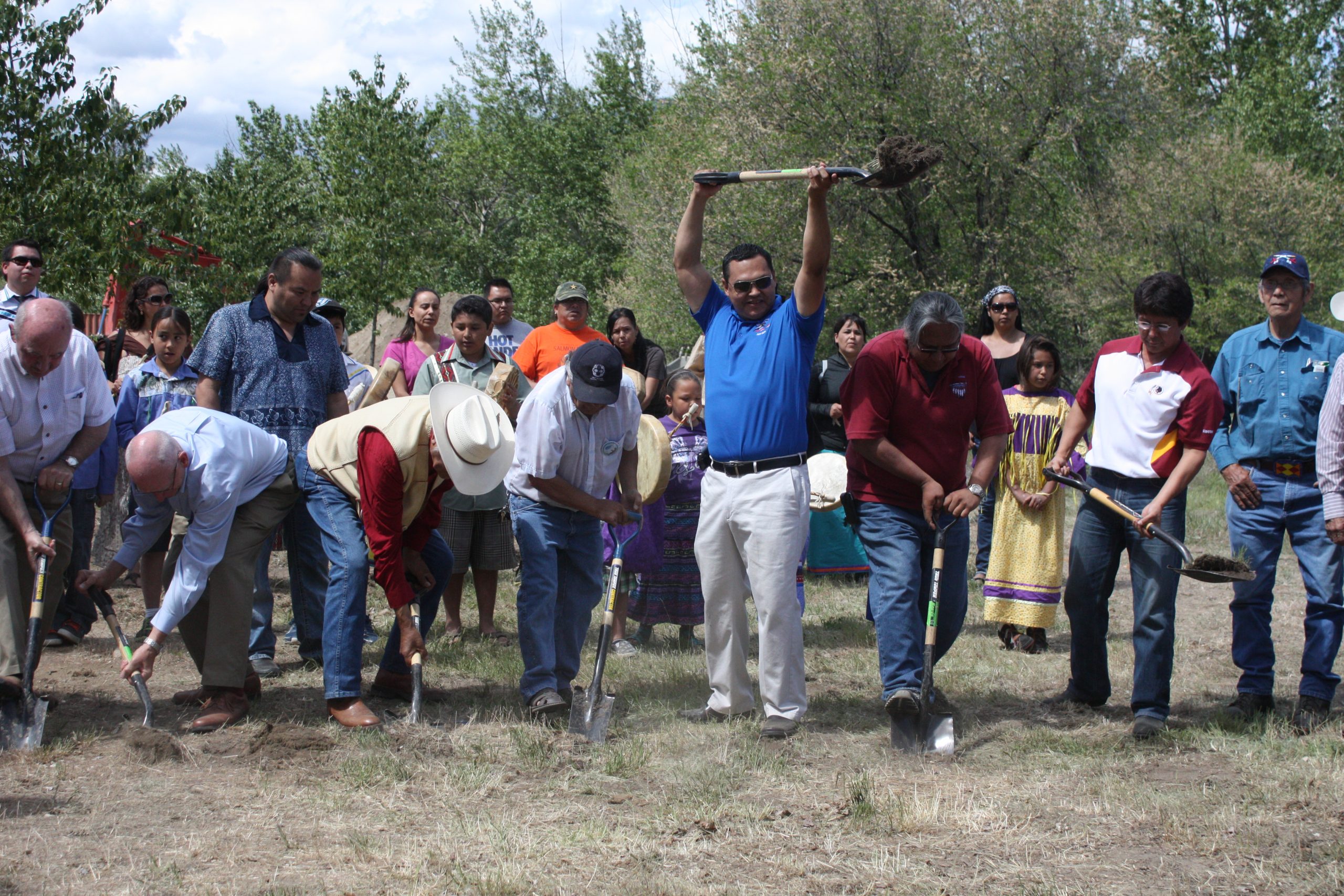
Penticton Indian Band Chief Jonathon Kruger raises a shovel to dig the first pile of dirt during a colourful groundbreaking ceremony outside the En’Owkwin Centre in Penticton last Wednesday. A new 25,000 square foot sockeye salmon hatchery will soon begin construction, with the facility expected to produce eight million fry annually for the South Okanagan watercourse system, which will run from Washington State through Osoyoos Lake and up into Skaha Lake and Okanagan Lake. Kruger was joined by several other PIB elders for the historic announcement. Photo by Keith Lacey.
The traditional sockeye salmon run that has been such a big part of First Nation life across the Okanagan Valley for generations promises to continue for many generations to come following a historic groundbreaking for a new fish hatchery to be built on Penticton Indian Band (PIB) land.
Hundreds of school children from across the South Okanagan joined PIB leaders and First Nation leaders for the new sockeye salmon hatchery during a groundbreaking ceremony on Green Mountain Road at the En’Owkin Centre on the PIB reserve last Wednesday,
“What an awesome morning,” said PIB Chief Jonathon Kruger, who was smiling ear-to-ear throughout the two-hour groundbreaking ceremony.
This groundbreaking ceremony symbolizes another pivotal milestone for the Okanagan Nation Alliance (ONA) and the tribal efforts accomplished by the eight-member communities, which includes the Osoyoos Indian Ban (OIB), that mark a tremendous achievement in this region’s collective history, said Kruger.
After more than seven years of collaborative planning and detailed preparations for a new hatchery on the Okanagan River system, the hatchery is scheduled to be open for business by the spring of 2014, said Kruger.
Once completed next May, the 25,000 square foot salmon hatchery will have the capcapacity to rear up to eight million sockeye salmon eggs that will be released annually as fry into the Okanagan watercourse system, he said.
“Bringing the salmon back has been a journey and has taken a lot of hard work and this is one more step to ensure we will always have salmon,” said Kruger.
ONA chair Grand Chief Stewart Phillip said the hatchery will ensure the annual sockeye salmon run will remain an integral part of First Nation life for many generations to come.
“The hatchery is the work of the collective effort of the Okanagan Nation and is a true demonstration of what can be done with collaboration and the creation of partnerships,” said Phillip. “This project is not only our contribution to the nation, but our contribution to the economy of the region.”
The hatchery facility is part of a long-term program to restore the historical range of sockeye salmon in the upper Okanagan watershed, Okanagan Lake and Skaha Lake systems.
It will ensure a healthy amount of sockeye salmon fry will be able to thrive and survive from the upper end of the system in Washington State, through Osoyoos Lake and moving north towards Skaha Lake and Okanagan Lake.
The ONA and its subsidiary company, Okanagan Aquatic Enterprises Ltd., have worked in close collaboration with the Grant and Chelan Public Utility Districts in Washington State, the PIB and Aboriginal Affairs and Northern Development Canada, among others, to make this project a reality, said Kruger.
The fact hundreds of school children were brought in to witness the groundbreaking ceremony was largely symbolic as the opening of this hatchery will ensure that these children and their children will be able to reap the benefits of this facility for many decades to come, said Kruger.
The amount of hard work and collaboration that went into this project over the past seven years has truly been impressive and everyone who has participated in the process should be very proud the hatchery will soon begin construction and will be operational in only a matter of months, he said.
“This has been a long, long journey,” he said smiling. “If it wasn’t for the vision and hard work of all the key people involved in this project, we wouldn’t be here today.”
Kruger also thanked all of the school children who participated in the groundbreaking ceremony as they represent those who will reap the benefits of this hatchery for many years to come.
Pauline Terbasket, executive director of the ONA, said First Nation people share a cultural wisdom and love for the land and all of the ONA members who participated in this project deserve accolades for a job well done.
She also mentioned the importance of having so many school children attend the groundbreaking ceremony.
“This is for the children … and the next generations,” she said. “It is not for us today. This ceremony is not for us who have gathered here today, but for those yet to come. We as Syilx people are responsible for ensuring future generations are taken care of.
“We must stay united … to make more of days like this possible.”
Howie Wright, the ONA Fisheries Manager, said the vision for this hatchery was first discussed more than 20 years ago in the early 1990s.
Local conservation groups worked on a small project to re-introduce sockeye salmon into Skaha Lake as far back as 2002 and the first fry were released in 2004, he said.
The federal Department of Fisheries and Oceans, the Chelan and Grand PUDs and ONA members have worked tirelessly over the past several years to make this vision of a permanent hatchery a reality, he said.
“This is a major milestone for us,” he said.
Project manager Karen Peachey said this project is a glowing example of what can be accomplished through partnerships and having people involved who share a common vision.
Randy Smith, representing the Chelan PUD, said the hatchery project “has been a labour of love” between officials from Washington State, the provincial and federal governments of Canada and First Nation leaders with the ONA.
“This is a huge initiative to ensure the historic salmon run in the Okanagan water system will continue for many years to come,” said Smith.
During the colourful and elaborate ceremony, participants, including young children and elders from the PIB, turned over at least two shovelfuls of soil before passing their shovels to the next person.