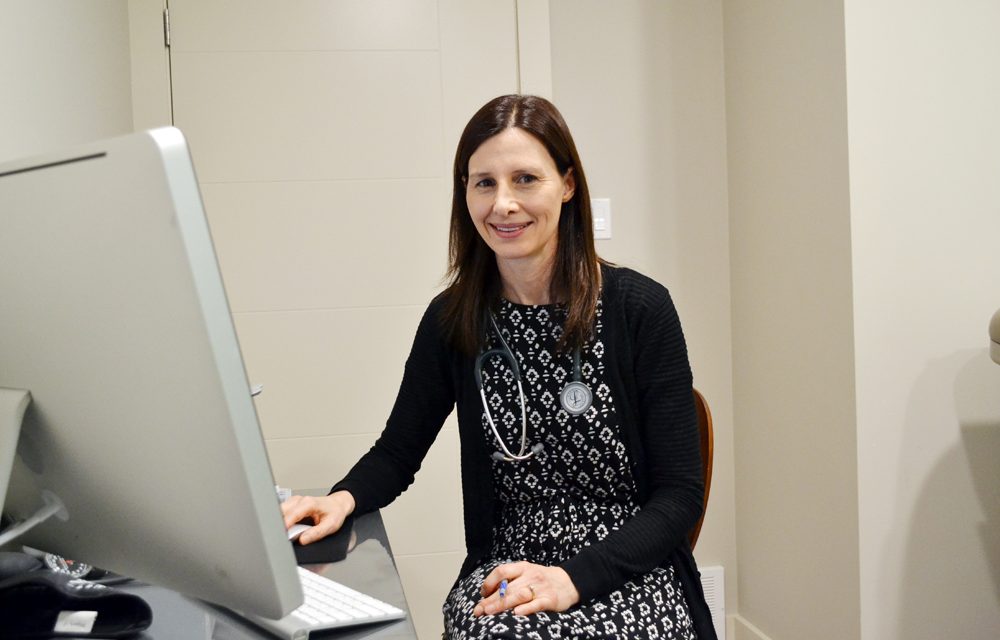

Dr. Cathy Rooke is one of the site directors for UBC’s new Okanagan South family practice residency.
More doctors are coming to the South Okanagan, thanks to a new residency program for recent University of British Columbia graduates.
Starting July 1, “Okanagan South” will be the 18th site of UBC’s family practice residency program, and will see four freshly graduated doctors arrive for two years of on-the-job training with an area family physician.
Dr. Cathy Rooke, one of the program’s site directors, says the four new residents will help alleviate some of the strain on Oliver’s emergency room.
Earlier this year, the South Okanagan General Hospital was forced to briefly scale back its emergency services—using nurses instead of doctors to assess some patients during night-time hours after “personal issues” left the already over-taxed team of doctors short.
Rooke said the hospital is already creating a weekend shift for the new residents that will “help with the waiting times and during higher volume times.”
“It will take some pressure off the ER,” she said.
In the longer term, Rooke said training new doctors in the South Okanagan means they will be more likely to set up shop here once they are out on their own.
“These residents will spend two years in the south. Studies have shown that if residents do their training in an area, they are more likely to stay there, or if they do happen to move away … they do end up often moving back.”
“In the big picture this is a really effective way to recruit doctors,” she said. “They get to know the specialists, they get to know the hospital, they get to learn how the system works—and for young doctors that are newly qualified that makes it easier to move to an area.”
Graduates entering the new residency program are fully qualified doctors doing what is essentially two years of work placement. Each will be placed with a family physician (in Penticton or Summerland), who they will spend their first week working under.
In their second year, the young doctors will go through several blocks of specialized work, including an option for an eight-week block in Oliver.
Rooke said Oliver will get preferential placement for those blocks, and she and her colleagues are already looking at other ways to bring the doctors to Oliver, such as blocks working in the ER “to get them extra time in the areas they are interested in.”
During their first year Rooke also wants to have a regular shift for the residents in Oliver, “which will help with our manpower shortage.”
“That’s something really positive for our community as a whole,” she said.
Rooke said that as the program gets established it will likely grow to incorporate more than four new doctors a year. She is excited to bring a fresh batch of young doctors to the Okanagan, and help usher them in the world of medicine.
By Trevor Nichols