
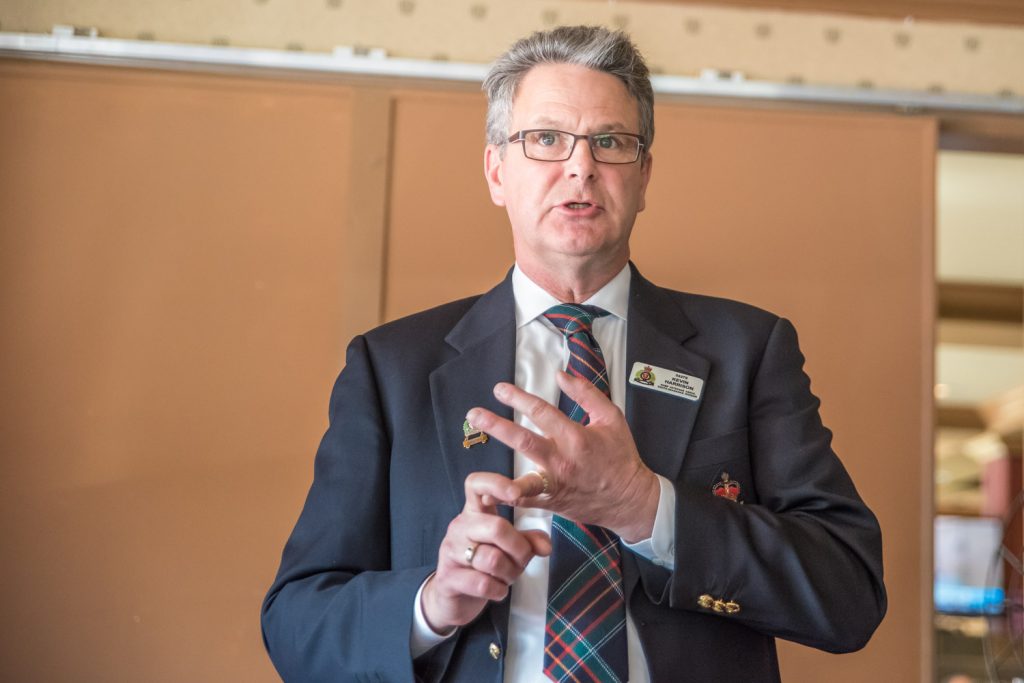
Kevin Harrison, retired from the RCMP, spoke recently at the Rotary Club of Osoyoos about RCMP Code of Conduct procedures. (Richard McGuire photo)
A new Code of Conduct for the RCMP that came into force over a year ago will make it easier to deal with the “few bad apples,” a retired RCMP superintendent told the Rotary Club of Osoyoos recently.
Kevin Harrison, who retired to Osoyoos just over a year ago, was the chief superintendent and district co-ordinator for Southern Alberta’s RCMP detachments.
He spoke at the Rotary lunch meeting March 10.
Citing the case of suspended Osoyoos Constable Amit Goyal, but not mentioning him by name, Harrison told Rotarians that three years is a long time for a member to be suspended with pay.
Goyal was suspended in June 2013 under the old RCMP Act, under regulations that came into effect in the late 1980s, and his case is proceeding under the old rules. His hearing date has been delayed three times in the past year and is now scheduled for July.
The new Enhancing RCMP Accountability Act came into force at the end of November 2014, providing a more responsive, timely and flexible approach.
“Three years is a long time,” said Harrison. “It’s that formalism and legalism that drags the process out to the extent that a member is off or suspended with pay just to try to resolve the matter. Under the new act, it’s far more flexible.”
Under the old system, officers contesting their guilt in a disciplinary matter have to go before a board consisting of three people, all of them regular RCMP members, and usually commissioned officers, Harrison said.
Accused officers have the right to be represented by lawyers.
“When you throw lawyers into the mix, that further complicates it and drags things out to go to a formal hearing,” Harrison said.
Under the new system, if an officer is accused of misconduct, a conduct meeting is held with a superior and the matter can often be resolved without a lengthy investigation if the officer admits to misconduct.
Even when they challenge allegations, the board hearing the case can be made up of one person, who doesn’t have to be a regular RCMP member.
“They can go outside instead of having to dig up three officers who are already very busy to sit on a board,” said Harrison. “You just find one person to do it. It’s more paper-based than testimony based, which will again speed up the system.”
Members’ rights are still protected, he said, but they get through the system a lot quicker.
Under the old system, members could be required to forfeit pay for up to 10 days or they could be dismissed, but there was a big gap between those two measures.
The new system provides a wide range of measures including forfeiting leave, requiring counselling, transfer, demotions and other sanctions, Harrison said.
Workplace harassment is now specifically named as a contravention of the new RCMP Code of Conduct, whereas before it was dealt with under a separate process.
Harrison cited several highly publicized recent national cases of RCMP misconduct, but argued that these “bad apples” are only a small minority of RCMP officers and aren’t representative of most.
He admitted that during a recent conversation someone joked about an RCMP issue and said, “at least he had his pants on.”
The comment flew over his head until someone mentioned it again.
“Me being the newshound that I am, I had absolutely no idea what they were talking about,” he said, only subsequently learning it was a reference to a bungled 2014 RCMP investigation into workplace allegations of unwanted sexual touching, bullying and rampant nudity at the explosives training unit at the Canadian Police College in Ottawa.
That incident came to light in February following a CBC News investigation.
“The overwhelming majority of RCMP employees are fine upstanding people who go to work every day and try to make a difference,” said Harrison. “Sometimes these good people do mess up and we need a system to deal with them appropriately and fairly when they do it.”
The “few bad apples,” he said, “create the biggest flash in the public eye and, therefore, put the biggest tarnish on the force.”
RICHARD McGUIRE
Osoyoos Times