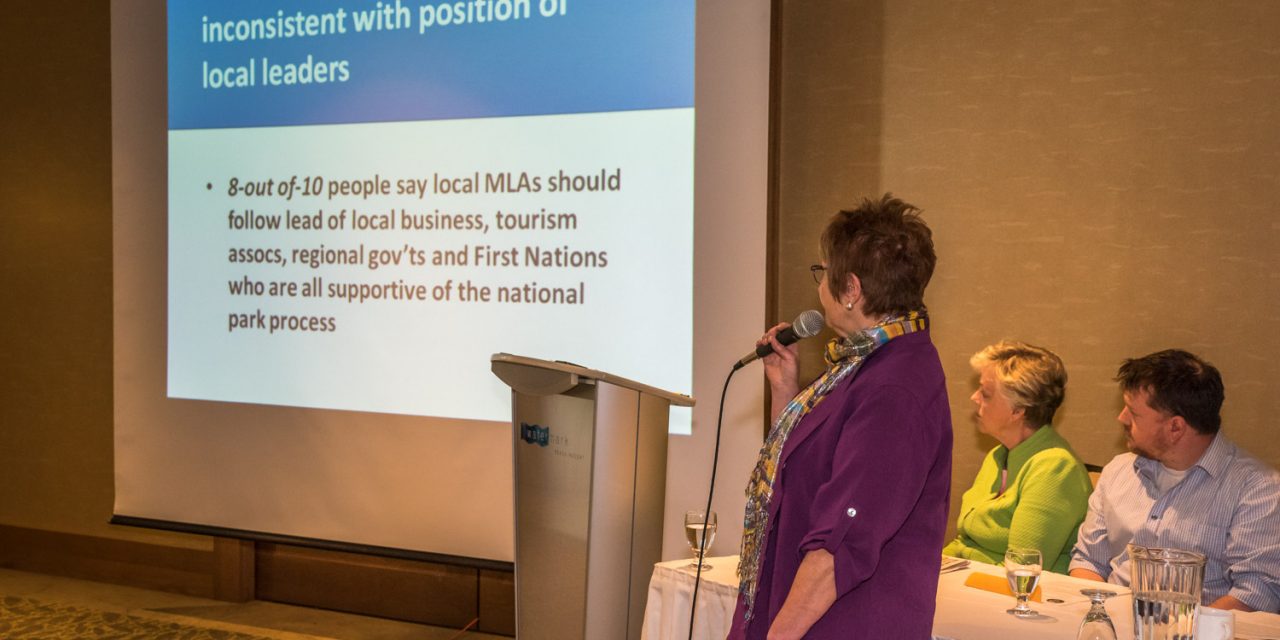
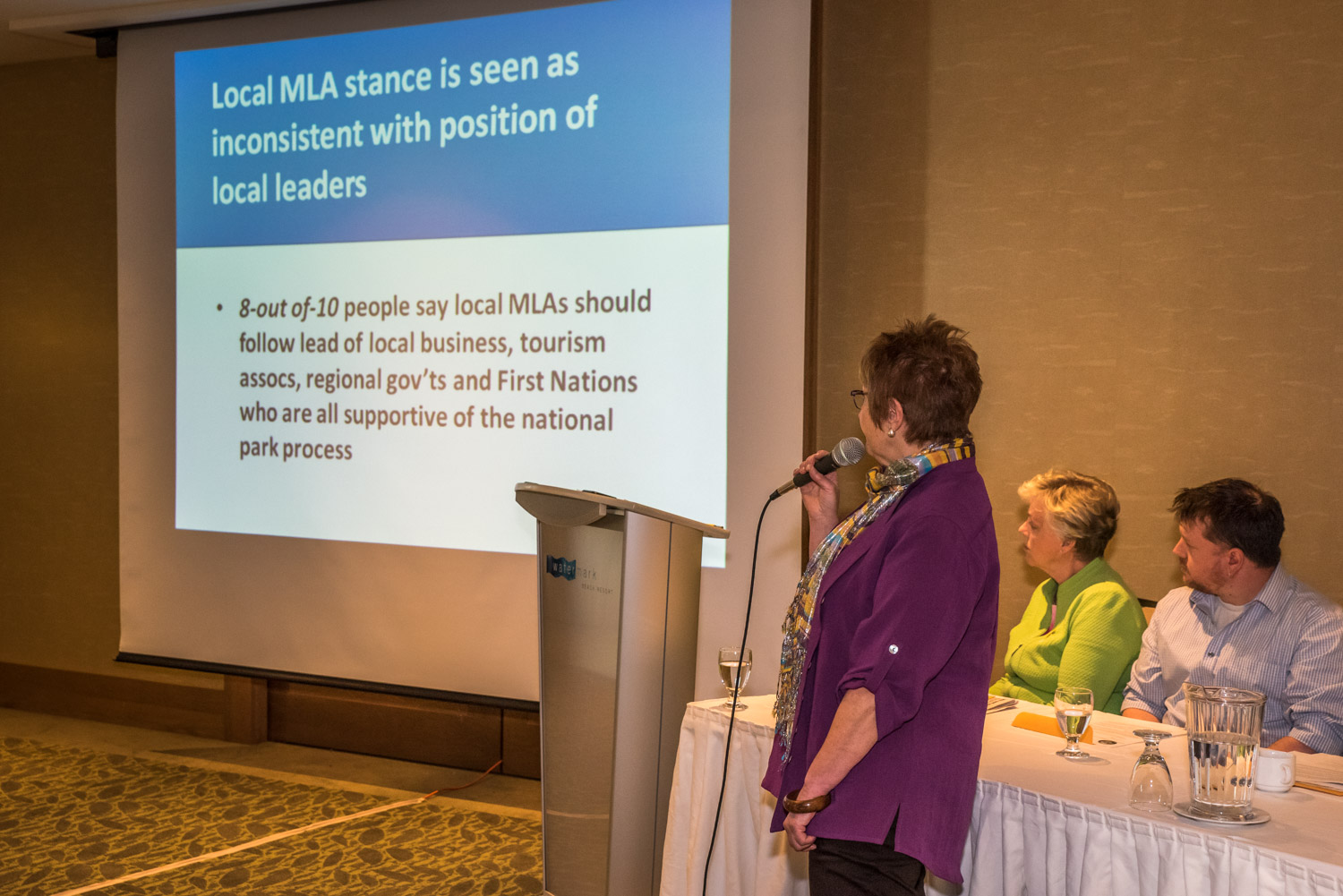
Doreen Olson, co-ordinator of the SOS National Park Network, presents the results of an opinion poll about support for a national park. The slide she’s showing suggests that MLA Linda Larson is out of step with local business, tourism associations, regional governments and first nations who support a park. Looking on are Osoyoos Mayor Sue McKortoff and Chamber of Commerce President Brian Highley, who were on a panel of individuals and organizations supporting the park. (Richard McGuire photo)
A recent independent poll showing two-to-one support for a national park reserve among residents of Boundary-Similkameen won’t change the minds of MLA Linda Larson or the provincial government that strongly oppose it.
Larson dismissed the results of the poll conducted by McAllister Opinion Research, which surveyed 501 people in the provincial ridings of Boundary-Similkameen and Penticton as well as overlapping areas A to G in the Regional District of Okanagan-Similkameen (RDOS).
Support was even higher in Penticton with three quarters of those surveyed supporting the park and only 14 per cent opposed.
The South Okanagan-Similkameen National Park Network (SOSNPN), a group in favour of a national park, commissioned the poll.
The poll was released to the public last Wednesday at a media conference in Osoyoos where representatives from the Town of Osoyoos, South Okanagan Chamber of Commerce, wine industry, Oliver town council and Thompson Okanagan Tourism Association all spoke in support of a national park.
“I could actually do a poll myself if I wanted to and depending on how I worded the question, I could get the answers that I wanted,” said Larson. “Basically, if you wanted an answer that’s in favour of what you want to do, then you word the question accordingly.”
Fellow park opponent, Greg Norton, an orchardist and spokesperson for the Grassland Park Review Coalition, agrees with the MLA.
“Polls are polls and it was bought and paid for by the pro-park people and obviously it was skewed,” said Norton. “I didn’t get a call, but I’m assuming it was skewed to elicit a positive response. It depends how you asked the questions. ‘Do you support a national park if it means increasing the risk of catastrophic wildfire?’ That’s a real good question and I’m confident that the answer wouldn’t be, ‘Oh yes, we support the park.’”
Pollster Angus McAllister, however, bristles at the suggestion that the poll was biased.
“No one is ever going to like polls that don’t concur or line up with what they’d like to see,” McAllister said. “I understand that. My job isn’t to make people happy based on the results. It’s to do accurate polls.”
While McAllister’s firm specializes in polls on environmental issues, his clients have included petroleum, chemical and automotive companies. He’s even worked with pollsters for former U.S. Vice President Dick Cheney.
McAllister himself is a hunter, angler and a member of the B.C. Wildlife Federation, a group that lobbies for the interests of anglers and hunters, though he draws the line at trophy hunting.
“I believe that if you kill something you should eat it,” he says. “But everyone has a bias.”
Most importantly, he says, he writes the polling questions himself and doesn’t allow the client to skew them.
“There’s no point in asking a skewed question,” he said. “People aren’t stupid. If you ask skewed questions, they’re not going to answer or they’ll tell you to f-off.”
His firm is an accredited member of ESOMAR, the international body for public opinion research and market intelligence.
That accreditation, he says, requires other pollsters at all ends of the political spectrum to vouch for his methodology.
That methodology involved using randomly generated telephone numbers that included both landlines and mobile phones, he said.
The demographics of respondents were compared with census data to ensure that he was getting a representative sample of the population.
The call centre made repeated calls over four days in order to catch people who weren’t at home initially and respondents were interviewed with a mix of questions from the pro-park and anti-park perspectives.
The order of statements was rotated with each respondent.
For example, one question asked whether respondents agreed or disagreed with the statement that existing B.C. government protections are sufficient to protect habitat and that federal protection isn’t needed.
Respondents disagreed by a 62 per cent to 25 per cent margin.
A random sample of 501 people should reflect the views of the larger population within 4.4 per cent 19 times out of 20. For the individual ridings, the margin of error is larger at 6.2 per cent.
Among those reached by the poll was former Osoyoos Mayor Stu Wells, a strong supporter of the national park.
“It was random,” McAllister insists. “We prefer not to reach people like that.”
Still, Wells had high praise for the fairness of the poll.
“I thought it was very, very unbiased,” Wells said. “I would like everyone to read the survey because the questions came from different angles, from a pro side and then the next question would be from the ‘no’ side. I think it was very scientifically done.”
If valid, the results would disprove the provincial government’s stated reason for withdrawing from talks with Parks Canada at the end of 2011.
Early in 2012, Premier Christy Clark stated the reason for the withdrawal.
“We do not as a province support a national park,” the premier said. “And the reason why is because the majority of people don’t want it.”
Larson, however, said the premier wasn’t actually suggesting there was majority opposition.
“When the premier said there was not public support, she meant there was not total public support,” Larson said. “She was very clear about that as well. She said that there is definitely support, but there are also too many other issues that have been raised during the process.”
Larson also says it’s time for groups like SOSNPN to move on.
“This group, unfortunately, has not bothered to become part of a larger group of people who have moved on and are looking at different things,” said Larson, suggesting the province won’t support a national park and is looking at other options to protect the environment and promote tourism.
“It’s disappointing that this very small, very well-funded group obviously continues down this path when everyone else has agreed to come to the table and come up with solutions that fit all people,” Larson said.
Asked who has moved on, Larson said she was referring to local First Nations as well as both opponents of the park and some of the pro-park groups that met with Larson and Environment Minister Mary Polak in December to look at other options.
Polak was in the area earlier this month to meet with the Okanagan Nation Alliance to look at ways to promote First Nation tourism, Larson said.
“I’m sure there will be an announcement of what those are shortly,” she said, noting that First Nations tourism is the fastest-growing tourism in Canada, “far more so than national parks.”
Another initiative Larson said she’s working on is attempting to have the Osoyoos Desert Centre nominated as a UNESCO World Heritage Site (see separate story).
Fellow park opponent Norton agrees with Larson that it’s time to move on and work together to find solutions. And he thinks the provincial government should ignore the poll.
“It’s time to put this behind us,” he said, adding that solutions should be worked out “as a community rather than as a tower in Ottawa.”
Speaker after speaker at last Wednesday’s media conference, however, argued that Larson is out of step with public opinion in her riding and with numerous provincial organizations that have called on the province to resume talks with the federal government.
Organizations that have passed such resolutions include the B.C. Chamber of Commerce, the Union of B.C. Municipalities, the Okanagan Basin Water Board, the RDOS and other regional districts in the area, the B.C. Wine Institute, Destination Osoyoos and numerous environmental organizations.
In one poll question, 79 per cent of respondents said MLAs should listen to regional governments, tourism associations, chambers of commerce and First Nations, “all of whom are supportive of the national park process.”
“I’m very fond of Linda Larson and I agree with her on so many things,” said Osoyoos Mayor Sue McKortoff. “This just happens to be one of the things I don’t agree with her on.”
Doreen Olson, co-ordinator of SOSNPN, also thinks Larson is out of step with her constituency.
“I think that Linda Larson is really not listening to us,” Olson said. “I think that she has got the wrong information from somewhere. I don’t think she’s quite aware of the benefits of this park.”
RICHARD McGUIRE
Osoyoos Times
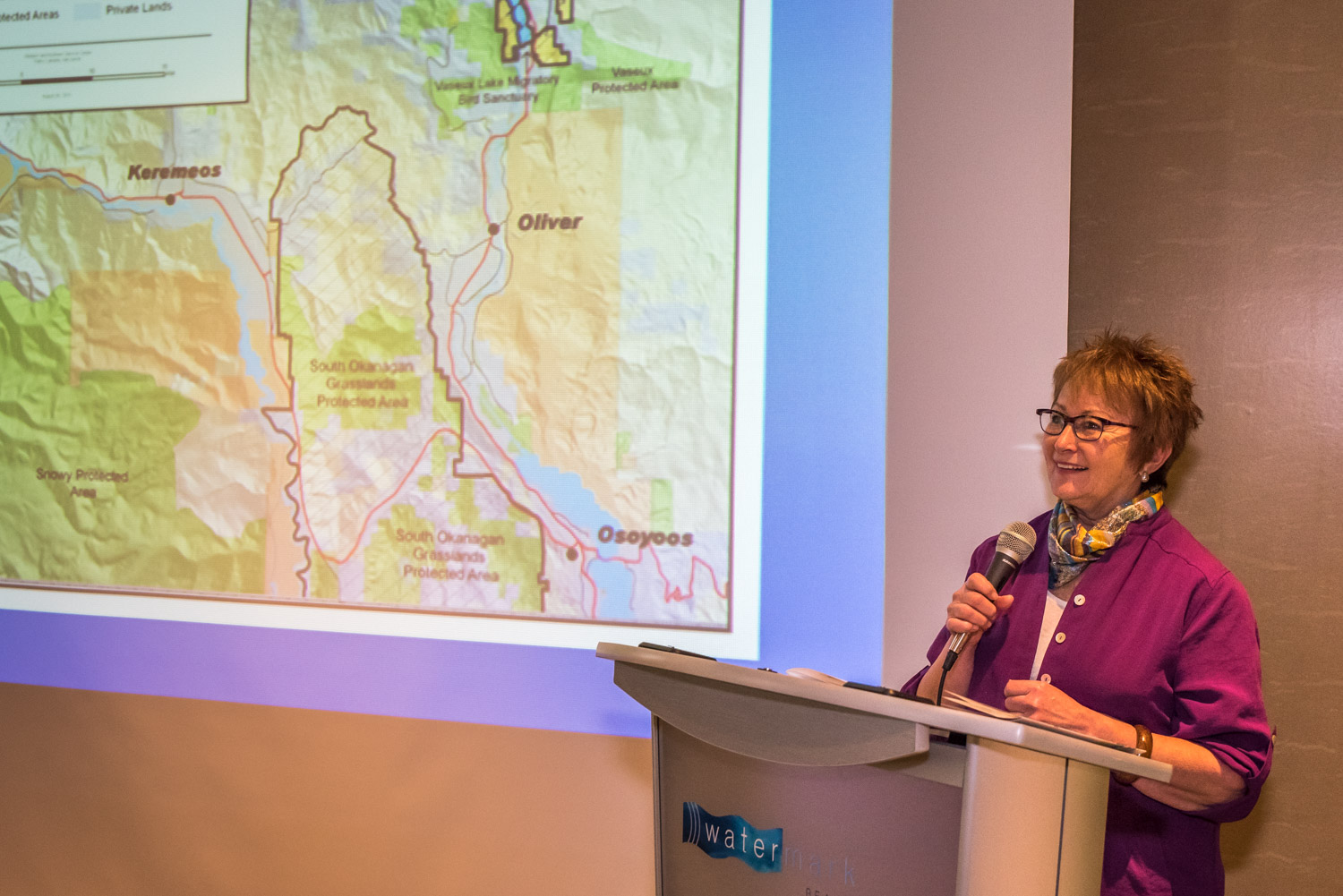
Doreen Olson, co-ordinator of the SOS National Park Network, presents the results of an opinion poll about support for a national park. The poll shows increased and overwhelming public support for a national park in South Okanagan-Lower Similkameen. (Richard McGuire photo)