By Vanessa Broadbent
Oliver Chronicle
Oliver’s history is getting a revamp, or at least the way it’s presented is.
Deep Roots, the Oliver and District Heritage Society’s new permanent exhibit opening on May 16, covers the history of Oliver, but this time around with more of the area’s indigenous history.
The society was given a grant for $79,000 as part of the federal government’s Canada 150 Community Fund, so for the first time the museum could completely redo its permanent exhibit instead of just tweaking parts of it.
Manda Maggs, the society’s executive director, said the old exhibit was in need of an update.
“It was really outdated, it was hard to read and the artifacts needed to be switched out every once in awhile or if they’re on display all the time they degrade a lot. It was really time to turn everything over and put out some new things that people haven’t seen.”
But just a revamp wasn’t enough; Maggs wanted to add a portion of Oliver’s history that the previous exhibit left out: the area’s indigenous history, specifically that of the Osoyoos Indian Band (OIB).
“First Nation’s history was largely left out of our previous exhibit,” she said. “It was really nice to be able to start from scratch and tell the story.”
With help from the OIB and the Nk’Mip Desert Cultural Centre, that history has been rediscovered.
Usually, Maggs says, when Oliver’s history is taught it starts in 1890 with the town of Fairview, or the early 1920s when Oliver was first surveyed.
“There’s an awful lot of years left out there that First Nations were definitely here. We’d like to increase the understanding of how the Osoyoos Indian Band has influenced the community of Oliver and its development.”
Oliver’s relationship with the OIB still runs strong. The band is a prominent employer in the community and features new development.
Maggs is hoping the new exhibit will help locals appreciate “just how much contribution and how much that relationship has shaped Oliver throughout the years.”
Along with indigenous history, Deep Roots will include more economic history and focus on orchards and vineyards in the area, as well as more immigrant history.
“We really wanted to make sure we encompassed all of that, not just the pioneers. There’s much more to the story,” Maggs said.
Visually, the new exhibit will look more modern. The “old-timey” wooden, Western theme has been swapped for a more sophisticated, current look. Information is displayed in bright colours with a sleek chevron design.
A TV mounted on the wall will rotate between showing three movies, all about life in the South Okanagan.
One, Confessions of a Rattle Snake Killer, talks about rattlesnake conservation in the area. Okanagan Dream is about the culture of the Quebecois fruit pickers that relocate to Oliver.
Maggs is hoping that the society can one day develop its own video content as well.
Artifacts will also be on display, including seats from the old Frank Venables Theatre, artwork from the Inkameep Day School and military uniforms.
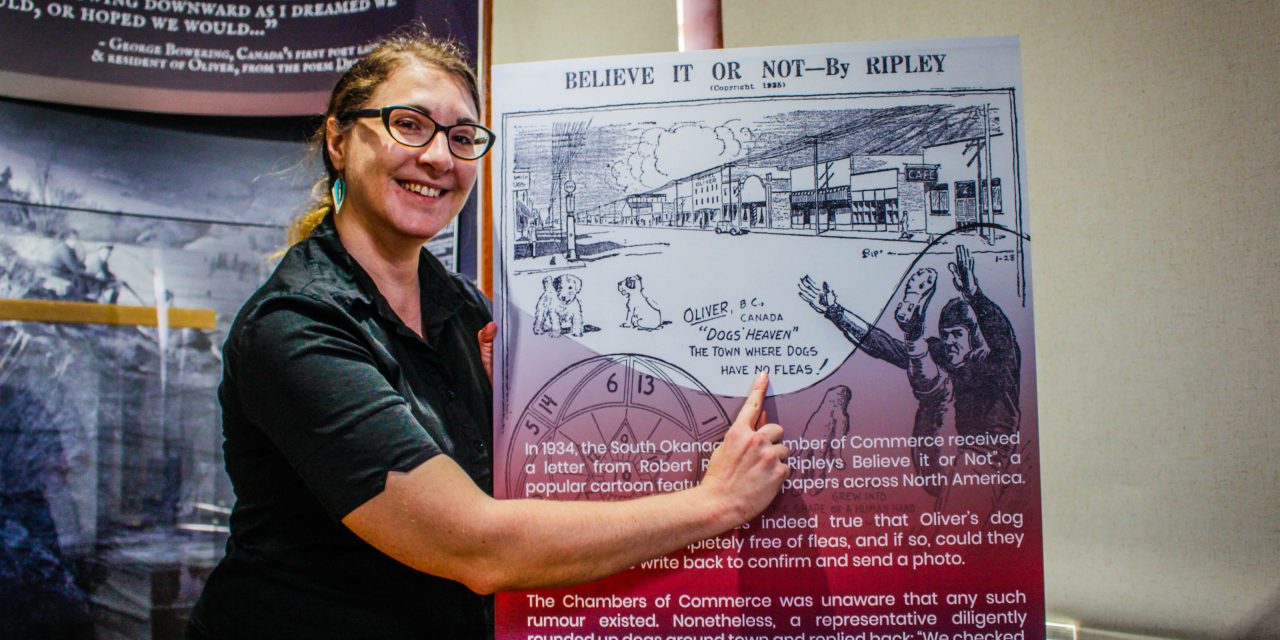
However, Maggs’ favourite part of the exhibit is a cartoon from 1935 where Oliver was featured by Ripley’s Believe It or Not for being “the town where dogs have no fleas.”
Robert Ripley had heard a rumour that in Oliver dogs had no fleas, so he wrote to the Oliver and Osoyoos Chamber of Commerce asking if it was true and if they could supply a photo for a cartoon.
“I’m guessing it’s not true,” Maggs said. “It’s still funny that in 1935 that some rumour existed about Oliver, which was only about 15 years old at the time.”
True or not, Maggs liked the cartoon so much that it’ll be memorialized on tote bags which will be available for sale in the museum’s gift shop.
Visitors will also be able to take home photos of themselves in the new selfie station, complete with props to wear and a green screen which lets them choose old photographs of Oliver to insert themselves in.
“We wanted it to be interactive. Our other exhibit was really hands-off and it only appealed to grown-ups,” Maggs said.
“My goal is to help kids coming up this generation to start thinking of museums as fun places, not just the place that their teacher dragged them to in Grade 5.”
But kids aren’t the only ones Deep Roots is aiming to appeal to. The entire exhibit will be translated into Punjabi and French, and potentially Spanish as well. Visitors will be able to take a book with translations with them while they tour the exhibit.
“There’s whole portions of the community that I feel weren’t adequately represented in the history and it would be nice to bring these people in and say ‘this is your history too, this is your community too,’ and actually do something tangible that they can directly benefit from. A translation is a really simple way of doing that.”
Deep Roots opens at the Oliver Museum located at 474 School Avenue on Wednesday, May 16 at 7:30 p.m.