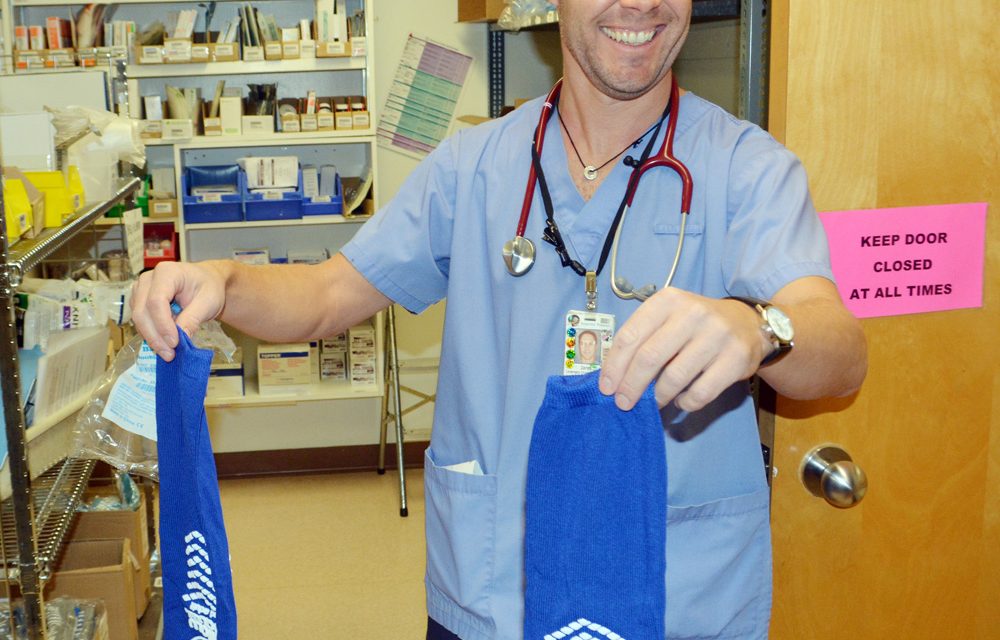

LPN Jaret Blidook shows off a pair of non-slip socks, which are part of the hospital’s fall prevention program. Photo by Lyonel Doherty
After a tour of South Okanagan General Hospital last week, Interior Health’s new boss was impressed.
President and CEO Chris Mazurkewich toured the facility and got a first-hand look at why the hospital is envied for its innovative computer system.
Mazurkewich was shown a system that eliminates the paper shuffle as well as medical errors.
Lori Motluk, acute care administrator, said the state-of-the-art system allows physicians and nurses to see the information they need instantly and respond “just in time.” She pointed out the system significantly reduces medication errors, which Mazurkewich says is the number one concern for patients.
Acute care manager Sara Evans said the days of relying on humans deciphering hand-written notes are over.
Now, doctors enter their orders on computer (the order also appears on the nurse’s computer).
The pharmacy reviews the order for appropriateness, and the nurse takes the computer to the bedside to record patient assessments.
There are real-time updates to orders and the doctor can see real-time notes from the nurse (e.g., blood pressure). There are no more delays waiting for paper to be processed or handled.
When nurses administer the medication, they take it out of an automated cabinet that talks to the computer system (it tells the nurse when the pharmacy reviewed the medication orders).
The medication is scanned (like a barcode in a grocery store) and the patient’s unique wristband is also scanned – this ensures that the right patient is getting the right drug, and the computer reminds nurses when drugs are due.
When a drug is high risk, the computer requires two nurses to check to ensure that the dose is correct.
Evans reiterated that staff are not responsible for opening the compartment where the medication is kept; that’s all done by computer.
Evans said physicians can enter medication orders from anywhere in the world.
According to Evans, SOGH is the first hospital in Canada to have a fully electronic health record on each patient.
The other initiative that staff are proud of is the hospital’s fall prevention program.
Mazurkewich said due to the age of the population in Oliver and Osoyoos, falls are of significant concern. But compared to seven or eight years ago, prevention protocols are a “thousand times better.”
Motluk explained that SOGH has a comprehensive risk assessment program for falls, and their prevention strategies include everything from proper footwear to hip protectors. They even have hip belts that activate an alarm system whenever a patient gets out of bed.
Mazurkewich said their mandate continues to be shifting care from the hospital to the community via home care.
The CEO also talked about the ongoing work in recruiting new doctors to Oliver and Osoyoos.
“I think Oliver and Osoyoos has an easier time of attracting physicians (in relation to other communities),” he said.
But he acknowledged the need for more physicians to cover emergency room (ER) shifts at SOGH.
He noted that not all of the physicians in the community can cover ER shifts; approximately six doctors do this. He stated the importance of not burning out the ones who do cover ER. Mazurkewich specifically praised Chief of Staff Dr. Peter Entwistle for doing a heroically amazing job keeping the ER department together.
Motluk expressed her anticipation for the new patient care tower at Penticton Regional Hospital. She noted the project will give them 84 private rooms for patients. In addition, she said there will be renovations to the ER department.
By Lyonel Doherty