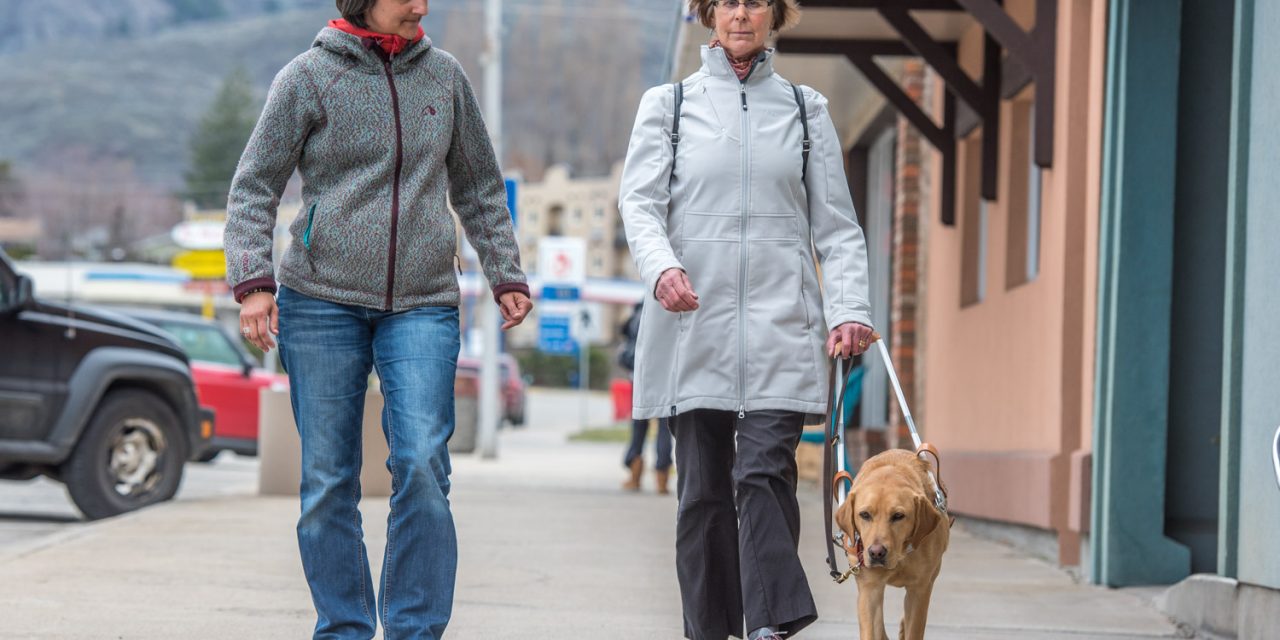
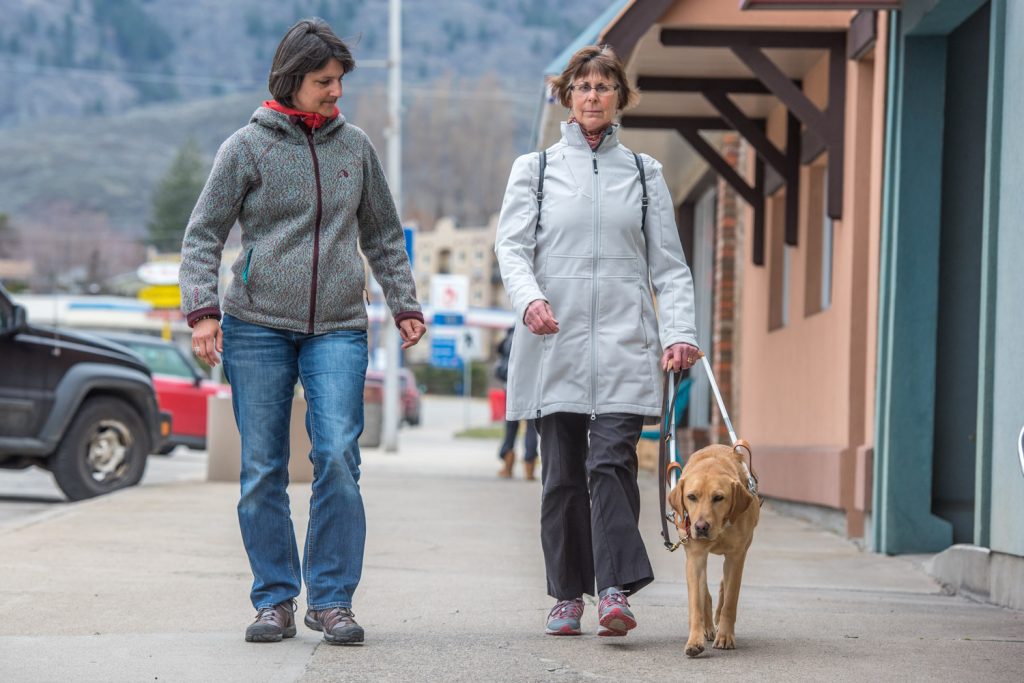
Sue Terada walks with her new guide dog, Button, while Jenny Meyer, a guide dog mobility instructor, looks on. Button will give Terada a degree of independence she hasn’t had since she had her previous dog, Pinta. (Richard McGuire photo)
With her new guide dog Button, Sue Terada says she’s regained her lost independence.
Terada and Button “graduated” recently after completing a 50-hour, one-on-one training program with Jenny Meyer, a guide dog mobility instructor with BC & Alberta Guide Dogs.
“She is the most wonderful constant companion,” Terada said of the 22-month-old yellow Labrador. “She is a loving dog, always there for you no matter what your mood is.”
Terada’s eyesight has been deteriorating throughout her life with glaucoma. Even over the past year, it’s become worse, she said. She is legally blind.
“I love to go for walks on my own,” said Terada. “I can do that again.”
Terada previously graduated with guide dog Pinta in 2004. Pinta officially retired at age 10, but Terada kept her on as a pet.
A year ago, in March of 2015, Pinta died.
Terada said she needed time to grieve the loss of Pinta, but after about three months she realized she wanted another dog.
She applied again to BC & Alberta Guide Dogs, a registered charity based in Delta, B.C.
BC & Alberta Guide Dogs breeds, raises and professionally trains guide dogs for the blind and visually impaired, as well as support dogs for children with autism. It takes two years and more than $35,000 to produce one certified dog, provided free to the recipient.
They offered Terada a dog last summer, but it coincided with the outbreak of major wildfires.
“It was smoky and we felt it wasn’t appropriate to do training at that time, so we let that doggie go,” she said. “And then the option of Button and Jen (Meyer) came up. And it’s marvelous.”
Meyer had just arrived from Switzerland when they connected in January and Terada was her first Canadian client. Meyer did an apprenticeship in guide dog training in Switzerland and spent about 11 years working with dogs there.
“Everybody said, ‘Oh, that’s a dream job, working with dogs,’” Meyer said. “I say yes it is, but you also have to like people because that’s the important part.”
Working with the clients, she said, can be more challenging than working with dogs.
Terada jokes that Button knew the routine very well when they started training. It was she who had to undergo the training.
Button had already undergone training for five months at the school and also lived with a foster family prior to that.
“It’s been awhile since I trained with Pinta and I’d forgotten some of the language,” Terada said. “You get into your own language with the dogs and I had to go back to her language so that she understands exactly.”
The training began with just getting to know Button, then moved on to some walking on a leash, recall and obedience drills.
“We have fun time,” she said. “We play with sticks and toys and retrieve them so she feels comfy with me.”
From there, they moved on to working with a harness and Meyers got Terada to go with Button to places that are part of her normal routine.
Terada would walk with Button, who wore the harness, and Meyer would walk beside her, tapping her on the shoulder if she was going to hit an obstacle.
“As we progressed, she walked a little farther away from me,” she said. “Then we’d stop to discuss what I’d done, what were the good things and what had to be improved upon or safety issues.”
The final challenge was working several days in traffic and with traffic lights in Penticton.
Because Terada and her husband Naga live on Anarchist Mountain, she still needs a ride to get into Osoyoos, but she’ll no longer need to rely on her husband or friends to get around town.
She and her husband can go off in different directions and meet up later.
“I’m independent again,” she said. “I can say to my friends, I’ll meet you at JoJo’s. If they need to go home, I’m fine. I can walk somewhere else. That ability was lost.”
And while friends were always willing to help her before she got Button, Terada said she sometimes hesitated to ask for help, not wanting to abuse their goodwill.
“I know they want to help me, but it’s hard to keep receiving,” she said. “Now I can still meet them and walk with them, but on my own terms.”
Button is trained to do such things as sit down at stairs as a warning and she’s trained not to interact with other dogs when she’s in her harness.
But there are some challenges because members of the public sometimes don’t know how to behave around guide dogs.
“It’s a hard one, because people love dogs and she looks so beautiful,” said Terada. “So they go right down to the dog before talking to me. Then I’m wondering why she is swinging around.”
As Meyer points out, distracting a working guide dog can be dangerous.
“The dog is not paying attention, so Sue is maybe walking into a post or off a curb or something,” she said. “It’s not a machine. It’s a dog.”
Even worse, some people let their dogs run loose and the dogs run up to sniff or play with the guide dog.
“The owner says, ‘Oh, my dog is friendly,’” said Terada. “That’s not the point. I don’t need your dog to be coming up to mine and sniffing her when I might be approaching some steps.”
Some people go to the other extreme.
“Sometimes people will flatten themselves against a wall and they won’t say a word,” said Terada. “I can hear them breathing. Why don’t you speak to me? I know people just want to do the right thing, so the right thing is to say, ‘Hi Sue, this is so-and-so.’ And we’ll take it from there.”
RICHARD McGUIRE
Osoyoos Times