The new NDP provincial government’s cabinet has still not been sworn in, but there is already anticipation about what will be its priorities and which policies of the former B.C. Liberal government it will keep and which it will jettison.
In this area, protection of rural schools and public healthcare will be the biggest issues. On those, the NDP have made the right noises while in opposition, but it remains to be seen how much room they’ll have to manoeuvre, given economic realities.
Both health and education eat up the largest part of the provincial budget.
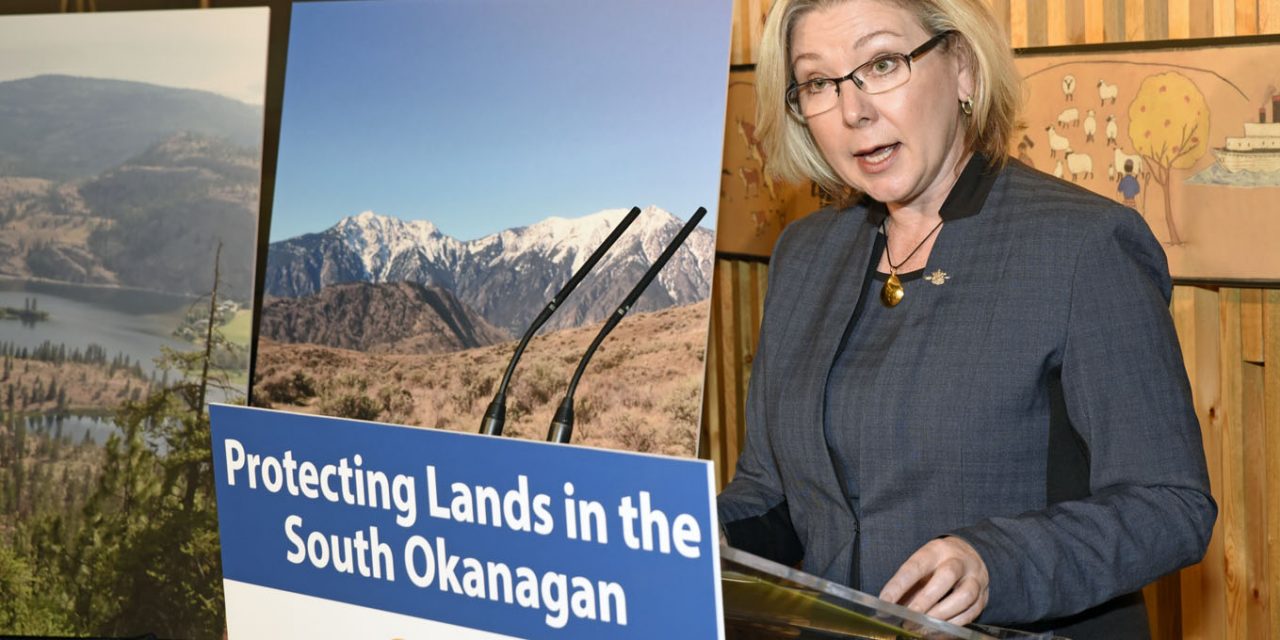
But there is another local issue we would like to see the new government engage with at the earliest possible – the proposed national park reserve in the South Okanagan-Similkameen.
The Christy Clark Liberal government badly handled this issue from the moment she became premier in early 2011 and her provincial cabinet killed the idea, waiting nearly a year to inform her federal counterparts or the public.
But in the last two years, Mary Polak, as her minister of environment, made significant progress in finding a compromise between sharply divided sections of the public.
While Polak’s efforts can probably be improved upon over time, they should be seen as a constructive starting point to get the ball rolling again.
This means reopening discussions with Parks Canada at a more formal level and allowing Parks Canada to respond to the questions and concerns the public may have.
For those in the tourism industry, a national park reserve would give eco-tourism a huge boost, providing international recognition.
But national parks have been done badly both in Canada and the United States where sometimes the goals of habitat preservation and tourism development are incompatible.
Many environmentalists point to the lack of connectivity between the northern and southern portions of national park reserve under Polak’s plan.
From the standpoint of the biology of migrating species, they are absolutely right. But from the standpoint of local politics, the ideal of connectivity may be impractical.
Cawston and Oliver contain the largest pockets of resistance to a national park and there are too many incompatible land uses in those areas.
We think the all-or-nothing approach of some may be shortsighted, and could very well result in “nothing” if the issue is made too contentious.
Although the NDP has solidly supported a national park, they won’t want to squander valuable political capital at this time when their government will be in a precarious position.
It’s better to start with Polak’s areas 1 and 3 in the north and south and leave the contentious area in the middle for future discussions after the kinks have been ironed out in a smaller park.
That’s not to suggest that Mount Kobau shouldn’t become part of a national park reserve if consensus can be reached. It is a crown jewel of the area. But any attempt to fundamentally alter the proposed boundaries once again could derail the project for years.
This week our cover story discusses the concerns of some in the hunting and off-road vehicle communities who have been among the strongest opponents of a national park.
We don’t think that hunting and off-roading should be permitted absolutely everywhere. But some of their concerns are valid, especially when it comes to conservation practices and ensuring that parks aren’t overdeveloped.
Clearly the new government will have more pressing concerns in the short term – such as surviving in a very fragile legislature where many votes will come down to a tie.
But the John Horgan NDP government would be wise to move on those issues where it can obtain not only the support of the Greens, but also the acquiescence of the Liberal opposition.
By following the roadmap that Polak laid out for the former government to reengage with the feds, hopefully a consensus can be reached with all-party support.