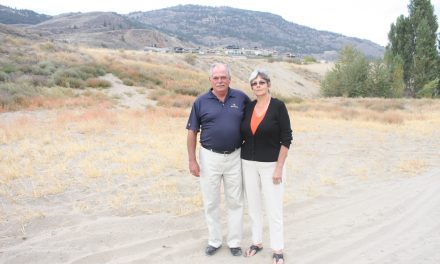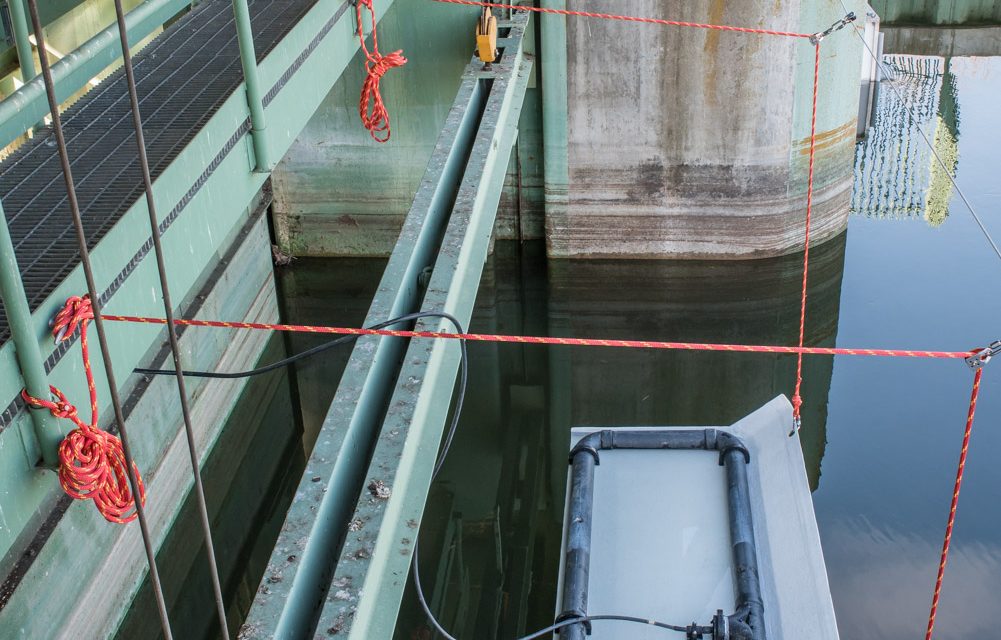
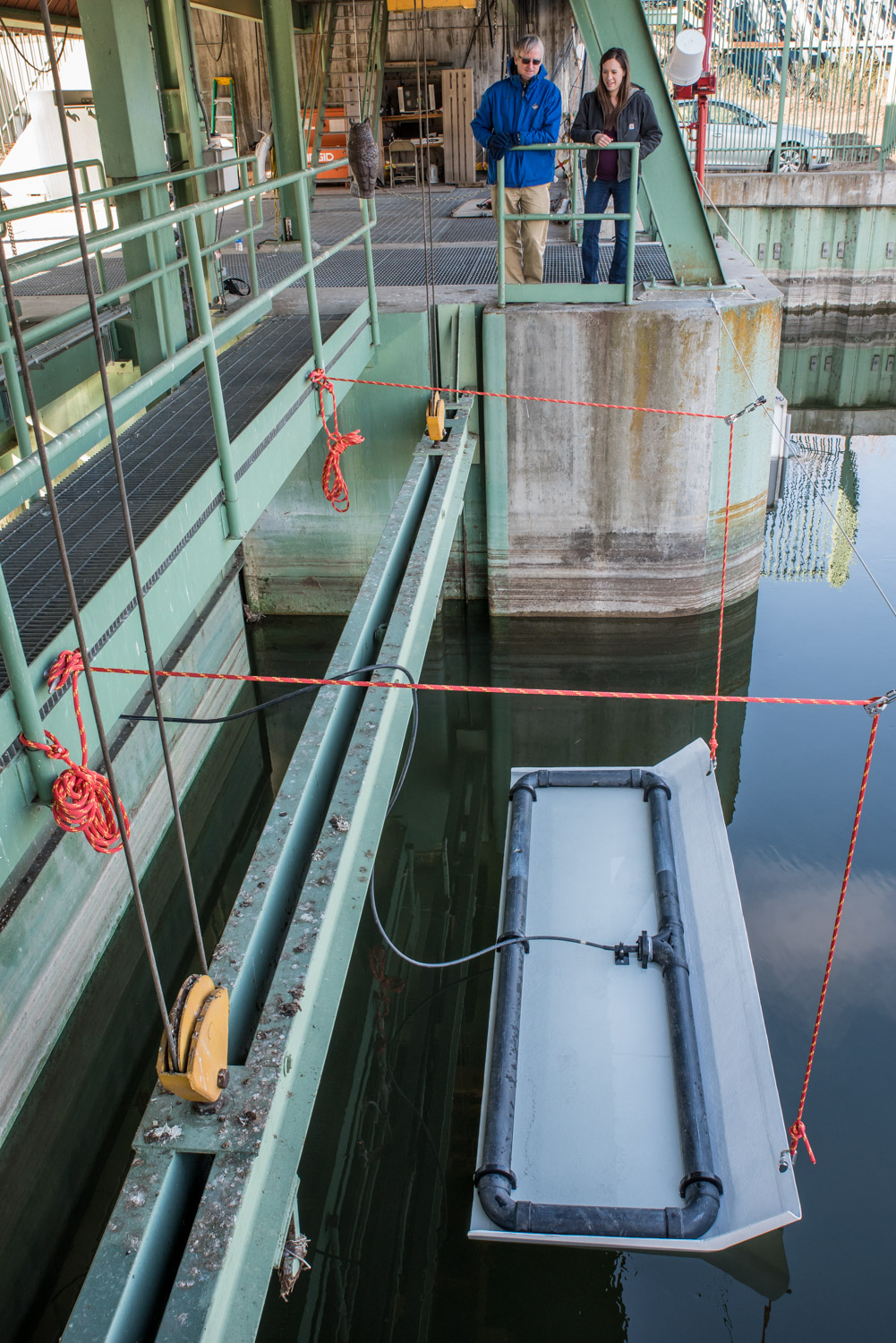
Fish biologists Jeff Fryer and Jennifer Miller stand above a floating antenna installed last week over one of the spillways at the Zosel Dam in Oroville, WA. The antenna is being tested and will read PIT tags of fish that climb the dam at the spillway instead of using the fish ladder. (Richard McGuire photo)
If a new antenna at the Zosel Dam in Oroville works, it will help to keep better track of fish migrating into Osoyoos Lake.
The floating antenna was installed last week in one of the spillways at the dam and it will read Passive Integrated Responder (PIT) tags implanted into fish.
A PIT tag is a small transponder chip implanted into a living creature, such as a fish, that uniquely identifies it.
The problem, explained fisheries scientist Jeff Fryer, is that when the water is high, many sockeye salmon leap up the spillways on the dam rather than taking the fish ladder, where the tags are read.
This meant that many fish were making it past the Zosel Dam without being recorded, said Fryer, who works for the Columbia Inter-Tribal Fish Commission and is based in Portland, Ore.
The new antenna, a flat piece of metal that hangs on the surface of the water, will also record juvenile fish as they move downstream.
Only one antenna was installed last week meaning that fish going up or down one of the other spillways at the dam will still not be recorded.
Last year three antennas of a different kind were installed on the spillways and the Okanagan Nation Alliance (ONA) also installed six upstream on the Okanagan River.
“They all got blown out by a lot of debris, so we want to test this different design to make sure that it works and that we get a decent number of detections,” said Fryer.
The project is being funded by the Bonneville Power Authority (BPA), which works with the Confederated Tribes of the Colville Reservation.
There is close collaboration with the ONA, which implants the tags in the young sockeyes.
Jennifer Miller, a fisheries biologist with the Colville Tribes, said PIT tags are also being implanted in other fish species such as steelhead and Chinook.
“We’re very interested as well in seeing steelhead or Chinook as well as other species that have PIT tags in them and see what their behaviour is and how far do they go past the dam,” she said. “Are they going up into Canada, or do they turn off into some of the tributaries?”
In addition to the PIT tags, acoustic tags are also being used to learn about fish migration and life cycle. The acoustic tags, however, are considerably more expensive, costing in the hundreds of dollars instead of around $3 for a PIT tag.
“The acoustic tag is an active tag that’s actually putting out a signal,” said Miller.
This means that depending on where you listen, it’s possible to know how long fish are holding in a certain area.
Miller said she’s pleased with the amount of cooperation between First Nations and fisheries scientists on both sides of the border.
“It’s a really great relationship where the Colville tribes and the Okanagan Nation Alliance are all collaborating to study fish that are going across the borders,” she said. “The fish don’t know there is an international border there.”
RICHARD McGUIRE
Osoyoos Times

Sockeye salmon attempt to swim up one of the spillways at the Zosel Dam in Oroville, Washington. This fish, if it had a tag, would not have been counted on this spillway last year, but this year it should pass the new antenna. The salmon migrate up the Okanogan River to Osoyoos Lake, where they wait before proceeding up tributaries in the late summer to spawn. (Richard McGuire file photo)