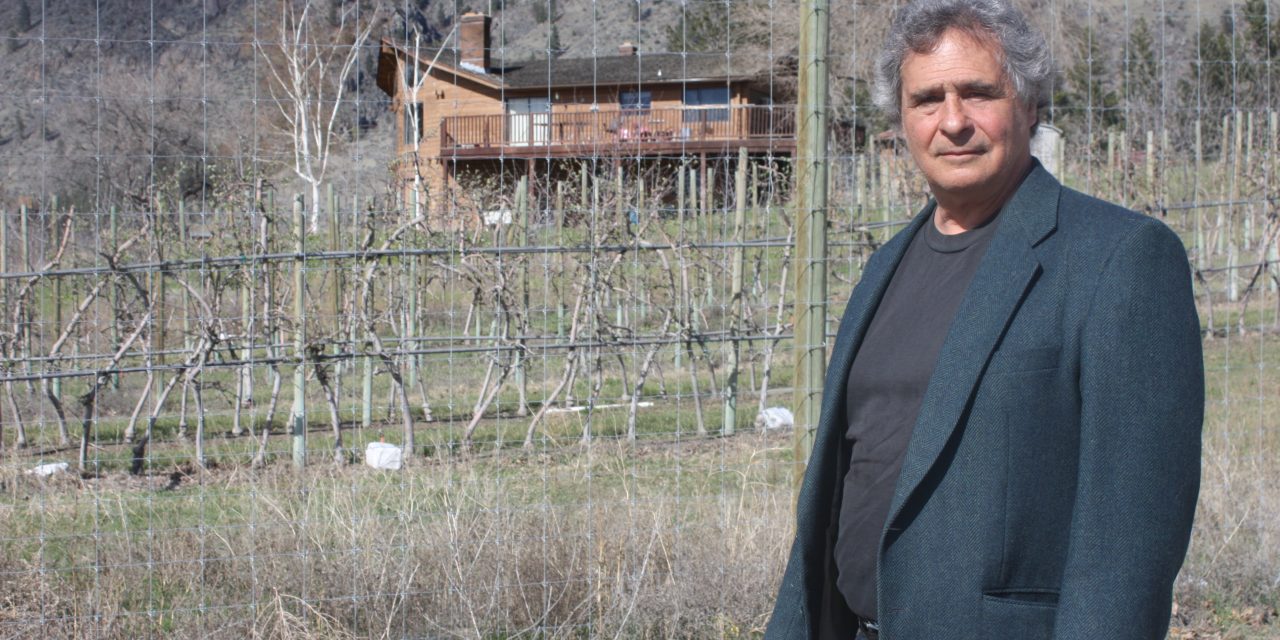
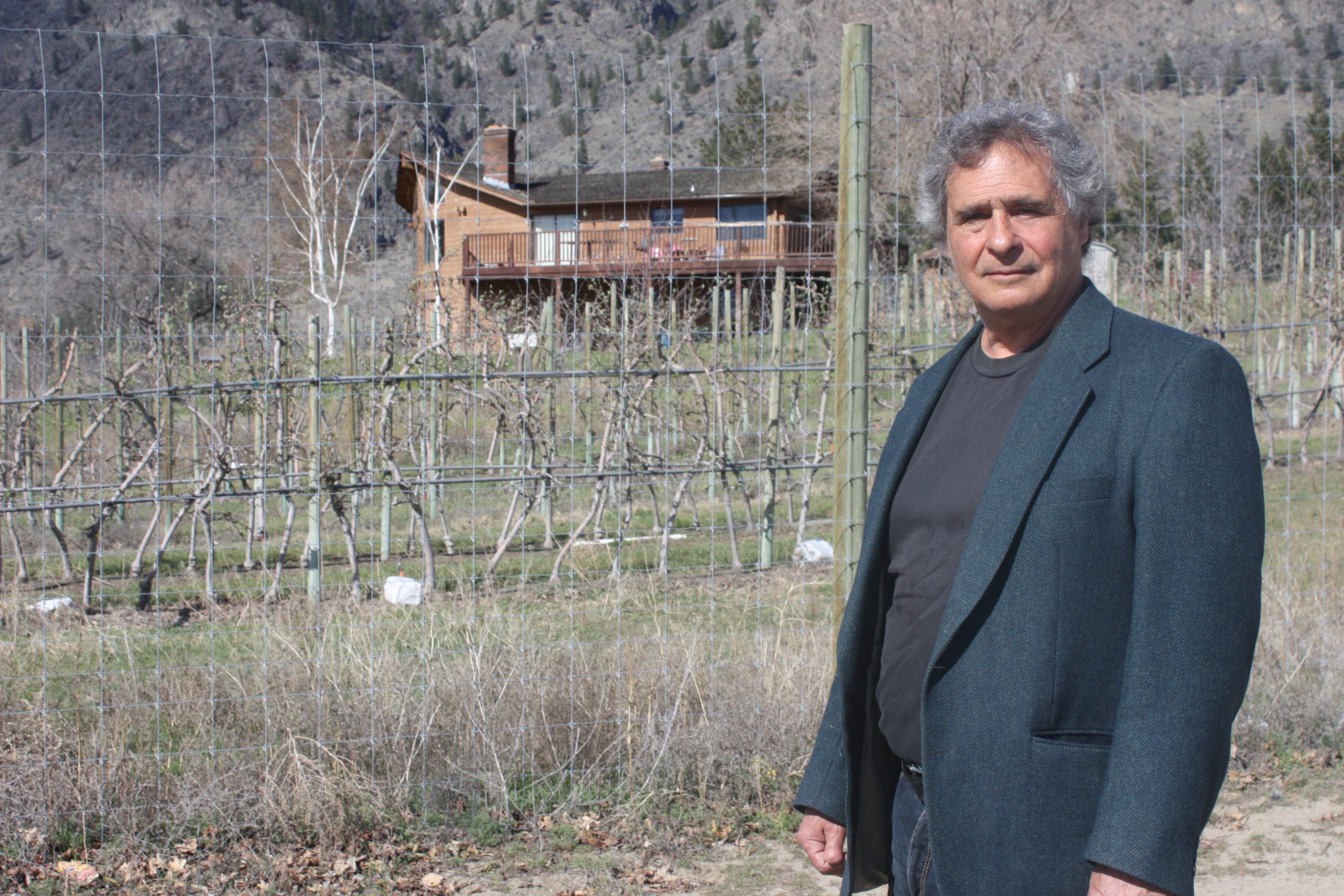
Retired Osoyoos teacher Stan Kelliher stands on his property, located only metres away from the proposed OIB House, that will be owned and operated by the Osoyoos Indian Band on the Spirit Ridge development. Kelliher said he’s all for second chances and rehabilitation of prisoners, but says the proposed location for the halfway house isn’t the right one and will negatively affect his family for years to come. Photo by Keith Lacey
As a teacher for more than 30 years, Stan Kelliher says he recognizes and appreciates giving people a second chance and opportunity to turn their lives around.
However, realizing five convicted criminals will be living only metres from his back yard several months from now upsets him deeply, said the retired Osoyoos high school teacher.
Kelliher’s seven-acre property, which he calls his “lifelong dream”, is located only metres from the OIB House – the halfway house the Osoyoos Indian Band is proposing to open on its Spirit Ridge development.
“I believe strongly in second chances and I believe 100 per cent in what Chief Louie (Clarence Louie, chief of Band) is trying to do for his people,” said Kelliher, who, along with several neighbours, politely voiced their objections to the halfway house during a public hearing last week at the Sonora Centre.
“Corrections Canada staff are also fine people and simply doing their job to the best of their ability. But I just want people to understand my position. Having this halfway house in my backyard is going to change my life. I’ve never had to lock my doors before and that’s’ going to change. We’re very secluded up here on this property and that safety factor will no longer be a positive thing. That seclusion could potentially become very dangerous.”
Kelliher said he and several neighbours believe there’s “simply a better location” to open the halfway house and wanted their voices heard at the public meeting.
“This isn’t about not in my backyard syndrome,” he said. “The reality is five adults who have served penitentiary sentences are going to be living a few metres from me and my family.
“As a longtime teacher, I have a responsibility to have an open mind and believe in second chances and I do. But my main priority is my family and they simply won’t be as safe when this place opens as they are now and I don’t think that’s fair.”
Kelliher acknowledged there are hundreds of halfway houses operating across Canada with very few negative incidents taking place.
However, almost all of them are located in urban areas and not on some secluded hill in a rural setting, he said.
“I’ve done my research and I know a lot of supporters will say these places are safe,” he said. “But I also know human nature and the reality is all we need is one person to have a bad day and there could be a serious price to pay.
“This project has been approved to this point without anyone admitting there are incidents in these places and the odds are there will be an incident and when it happens, the odds are it will happen to me and my family. I find that very difficult to accept.”
Kelliher says assurances by Corrections Canada staff that his property values won’t be negatively affected once the halfway house opens are ludicrous.
“I think that’s a crock and very few right thinking people would agree with that,” he said. “I have found that assertion a bit disingenuous on behalf of Corrections Canada.”
Kelliher said many people in the community support this halfway house, but “it’s easy to not be concerned from a distance … it’s not your life that’s going to be changed forever,” he said.
Louie said he has listened to the concerns of the neighbours who will live closest to the halfway house and realizes nothing he can say is going to change their mind.
“They have feelings and those are their feelings, even though I’m of the opinion those feelings aren’t based on fact,” said the well-respected First Nations leader. “The feelings they have are to be expected, especially when you consider no one agrees on any given issue. His concerns are his concerns and everybody is entitled to their own opinion.”
Neighbours in Kelowna and Kamloops spoke out against halfway houses in those communities, but they have come to learn they have very little to worry about and most residents don’t even know these places exist as they have blended in so well with the rest of the urban landscape in those two cities, said Louie.
“In Kelowna, you really can’t even tell where this halfway house is located,” he said.
“The neighbours had their concerns when this place opened, but you don’t hear any concerns any longer.”
Those aboriginal offenders selected to live at the Osoyoos halfway house will go through a rigorous screening process and have shown a strong willingness to find work and change their lives around, said Louie.
He respects the opinions of the affected neighbours, but is adamant this project will proceed as the OIB wants to play an active role in the rehabilitation of aboriginal offenders who are determined to make a positive contribution after paying their debt to society, he said.
Mark Pendergraft, vice-chair of the Regional District of Okanagan-Similkameen, whose board has yet to approve a zoning change to allow the halfway house to open, said this issue is “a very difficult one” as he respects the neighbours’ views and the OIB’s intentions to help their people.
If the RDOS board were to deny the zoning application, the OIB would likely add this residence and land to its existing reserve at Spirit Ridge and open the halfway house on its own, said Pendergraft.
“If we were to turn down the application, I do suspect this property would be added to the reserve and we’d lose things like the screening committee. There’s a lot of issues to consider and I’m not quite sure how to deal with this right now before I make a final recommendation. I have a lot of thinking to do and then ultimately, it’s up to the RDOS board to make a final decision.”
Melissa Taylor, project manager of aboriginal development for Corrections Canada in B.C., said she respects Kelliher’s objections to the project, but added Louie and Corrections Canada staff have gone out of their way to try and appease numerous issues brought to them by Kelliher and other neighbours.
“I think it’s natural for people to have fears and concerns about a halfway house opening next to them,” she said. “But there are halfway houses all over Canada and around the world and the model we’ve adopted has been used over and over again with great success.
“A lot of the fears and concerns that have been expressed relate to fear of the unknown and we can’t take away those concerns, but we have tried everything possible to address them.”
Suggestions opening a halfway house will lower adjacent property values is unfounded and without any proof, said Taylor.
“We have provided research and it suggests over and over again the opening of a halfway house simply does not lower property values,” she said.
Chief Louie and Corrections Canada have already agreed to alter an access road, remove an outdoor balcony and not allow anyone living at OIB House to use the front yard, so they will remain out of site for all neighbours, said Taylor.
At the end of the day, OIB House can only open once the RDOS approves the rezoning application and Corrections Canada believes that will happen as they do everything in their power to make sure the program operates safely and properly and addresses the concerns of neighbours and community at large, said Taylor.
The final decision on the rezoning application to the RDOS board is expected to be made in the next several weeks.