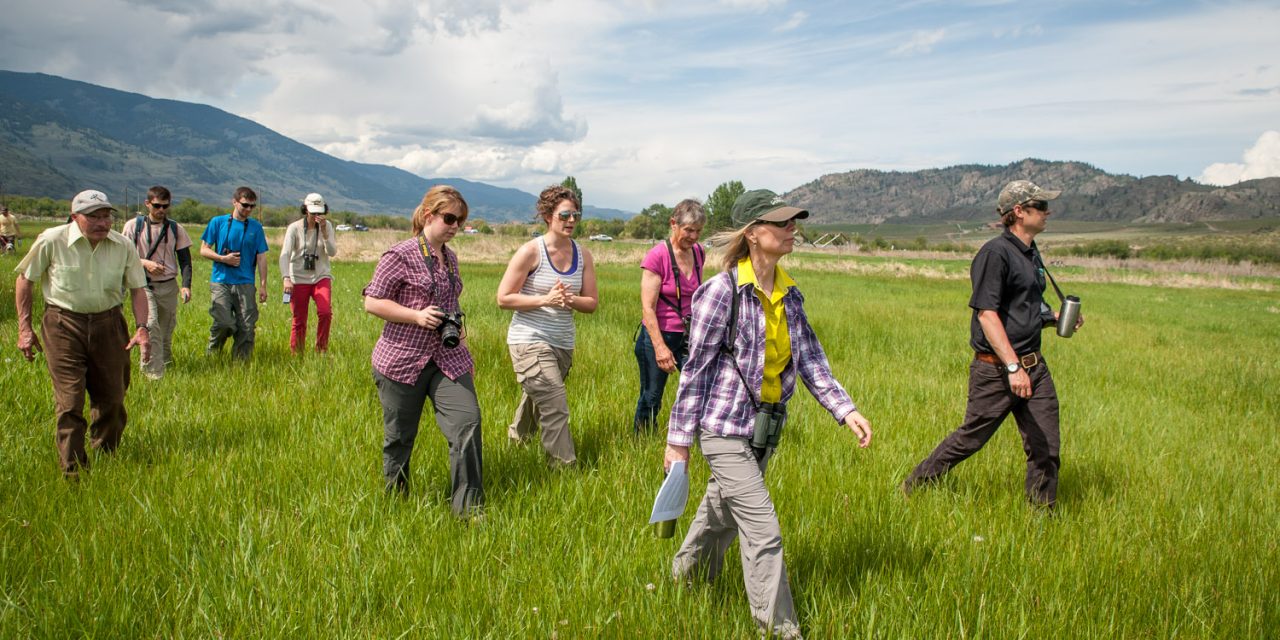
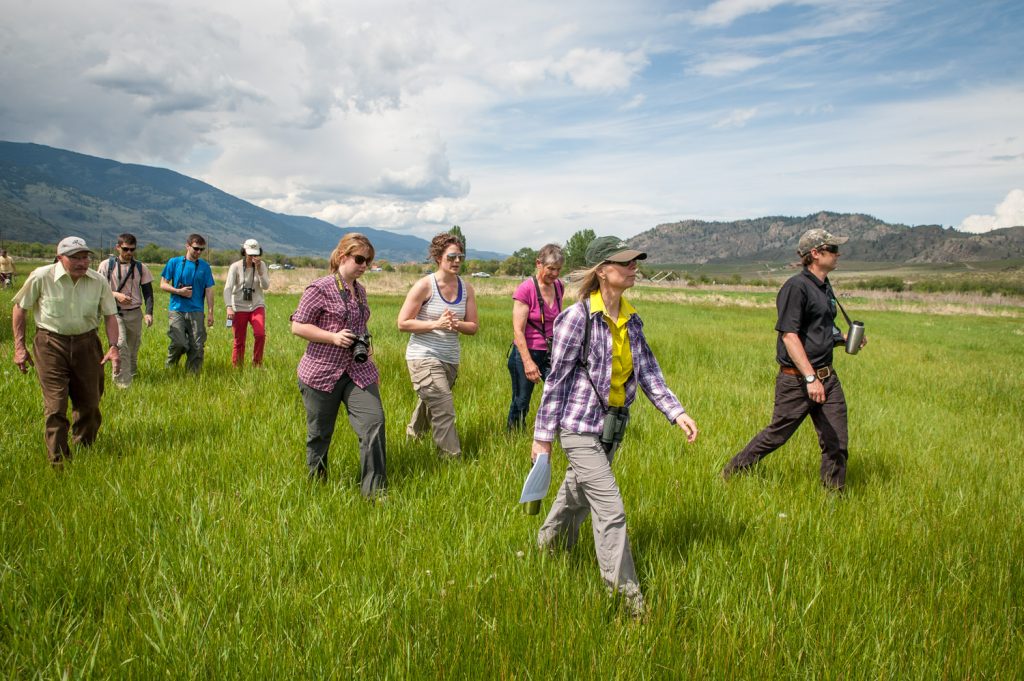
Barb Pryce, Southern Interior program manager with the Nature Conservancy of Canada, (second from right) leads a group on a walk at the Osoyoos Oxbows. The Oxbows have been reopened, and the Sage and Sparrow Conservation Area is expected to reopen soon. (Richard McGuire file photo)
Hikers and birdwatchers will once again be able to enjoy B.C. lands owned by the Nature Conservancy of Canada (NCC), which have been closed since mid-July due to fire risk.
Barb Pryce, Southern Interior program director with NCC, said the Osoyoos Oxbows are again open as of this week. The more vulnerable Sage and Sparrow Conservation Area just west of Osoyoos is expected to be open shortly.
NCC’s conservation lands have been closed throughout the province since July 18 as a precaution to minimize the chance of further human-caused wildfires.
With only a few exceptions in B.C., NCC lands were mostly untouched by the summer’s wildfires, NCC said.
Pryce pointed to the recent shift in weather that has seen temperatures cool significantly along with an increase in precipitation.
NCC owns numerous publicly accessible conservation lands across the province where low-impact recreation is welcome.
Since signs were posted in July asking people not to use them, most people have been respectful, Pryce said.
While the sites do not permit wheeled vehicles, including bicycles, off of dirt arterial roadways, walk-in use is normally allowed outside of the closure period.
“The reason most people go there is to walk around and hike around,” said Pryce. “They are photographers, birdwatchers, people that are interested in being in nature and just being out there enjoying the viewscapes through the year.”
In addition to the prohibition on wheeled vehicles off of roadways, the NCC also prohibits camping and campfires year-round.
“It’s in order to protect the sensitive grasslands and wetlands,” said Pryce.
Mostly people respect the rules, she said, but there have been some problems over the years.
When NCC first purchased the Sagebrush Slopes property beyond Kilpoola Lake in 2012, there were problems with people cutting fences and driving around locked gates, she said.
A later purchase of a nearby property known as Kit Carr also led to problems this spring when people ignored signs asking them not to drive on roads saturated with spring waters.
“They were driving in with big four-by-fours and we put up a sign saying to stay out, and they still went in,” said Pryce.
Even a gate didn’t deter some, who got bogged in the mud and tore up the road resulting in maintenance issues.
Pryce said she hopes this was an isolated incident.
NCC people are often on the properties and other users also report problems, she said.
“There are a lot of eyes and ears out on the ground,” said Pryce. “They let us know when they see issues. We’re really grateful for those partnerships and for people that are concerned about conservation values on those properties.”
The dry summer quickly followed a wet spring that brought welcome moisture to the normally arid landscapes.
“Hopefully some of that deeper water seeps into the soil and will be sustaining for those dry adaptive plants because a lot of them have deep roots,” said Pryce.
Fire can also play an important role, she said.
“It’s important for people to know that we are a conservation organization and we do recognize that fire is a natural process,” she said. “Sometimes it is an important management tool in nature. We’re quite comfortable with fire in that context. Having said that, the catastrophic fires that we’ve had this fire season aren’t great. They are heavily impactful and so our hearts do go out to the people that have been affected.”
RICHARD McGUIRE
Osoyoos Times