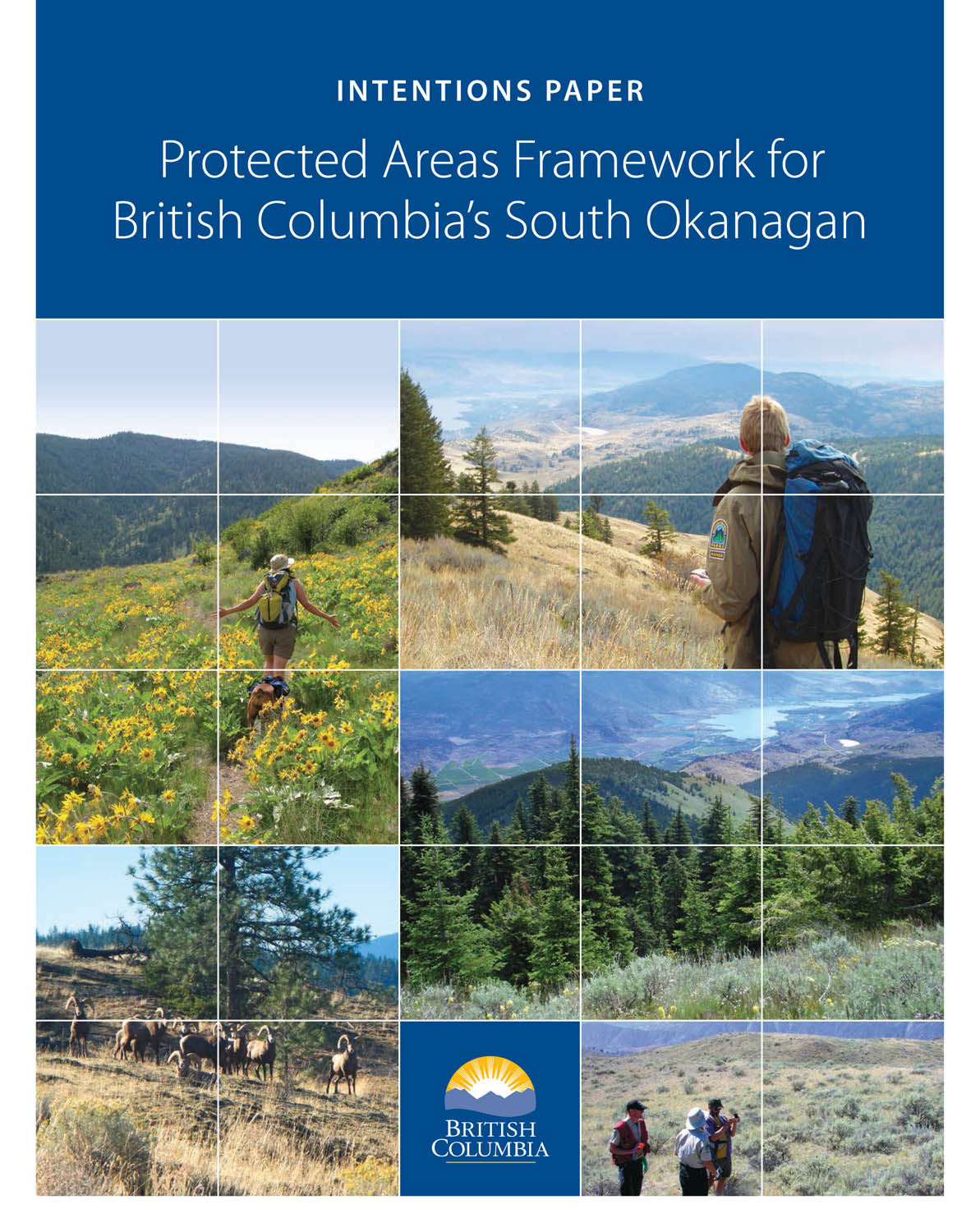
The provincial government has released an “intentions paper” outlining a broad framework proposal for protecting lands in the South Okanagan. The public has until Oct. 31, 2015 to comment.
Dear Editor:
The Province of British Columbia is seeking your comments on the question of a proposed national park for the South Okanagan-Lower Semilkameen.
Specifically, the province’s Ministry of the Environment is asking for your views, by Oct. 31, as to the size of the proposed national park.
Add your voice to the array of local community and business leaders, ranchers and First Nations throughout the Okanagan Valley who see the proposed South Okanagan – Similkameen national park as the lynchpin for a regional tourism strategy for the Okanagan Valley.
A national park would be the Crown jewel of an economic development policy for the Okanagan Valley.
National parks generate economic activity, support tourism, providing sustainable jobs and generate tax revenue to local governments.
Currently, on average each of the six national parks already in the province provides 772 jobs and local spending of $66 million per park annually.
National parks also have significant recreation value, protect sensitive ecosystems and biodiversity and preserve our history and culture.
They provide access to generous federal funding, with the new Trudeau government pledging to invest $50 million per year to enhance the development of Canada’s national park system and an added $25 million per year to early identification of ecological stresses and to avoid permanent degradation of sensitive park environments.
A properly scaled and resourced national park in the South Okanagan would dramatically increase international awareness of the region as a world class tourist destination – not only a destination for wine tourism but also a destination for outdoor recreation and eco-tourism.
It would be a showcase for Syilx environmental ethic and cultural values and would preserve and celebrate our over 100 years of cattle ranching heritage.
To her credit, provincial Environment Minister Mary Polak has begun a process to resolve the national park debate that has been a major issue in the valley for the past 10 years in advance of the 2017 provincial election.
Unfortunately, however, the province’s Intentions Paper proposes to carve out a significant area (Area 2) from the national park.
This area needs to be included in the national park to ensure that it is of sufficient size and diversity to achieve international stature as a world-class tourist destination and to achieve meaningful ecosystem management and restoration.
The intentions paper rejects the significant historical compromises, which reduced the size of the proposed national park to 284 square kilometres from the roughly 600 km originally proposed in 2006, going much further to exclude an additional 177 sq. km. (Area 2) north of Highway 3 between Cawston and Oliver from the park.
This leaves only two small areas separated by about 20 km to constitute a national park – a 98 sq km area (Area 1) west of Osoyoos between the U.S. border and Highway 3 and a separate 68 sq. km. area (Area 3) west of Vaseaux Lake, one of Canada’s prime birding sites, including White Lake.
This scaling back of the size of the proposed park severely undercuts the tourism appeal of the national park and seriously diminishes the effectiveness of the park to protect engaged species.
Polak’s proposal excludes Mount Kobau, with its spectacular views of both the Similkameen and Okanagan Valley, from the park. Mount Kobau offers unique tourism appeal for hiking and other outdoor activities and is already Canada’s premium location for astronomical viewing.
It is hard to conceive of a meaningful national park without its inclusion. Mount Kobau is a centerpiece of Sylix land and society, both spiritually and culturally; and a prime hunting and harvesting ground for local First Nations.
Ecologically, its higher elevation grasslands contain unique plant and animal communities.
Mount Kobau needs to be included in the national park to allow visitors to experience the full elevational range and diversity of South Okanagan ecosystems, and visitor opportunities – from the desert, through the grasslands, to the sky.
The ‘Intentions Paper’ proposes to regulate Area 2, including the sensitive Kobau and Kilpoola North portions of the South Okanagan Grasslands Protected Area as a Provincial ‘conservancy’.
The ‘conservancy’ designation provides a lower level of environmental protection than a provincial park, with little or no funding for either enforcement of environmental protection or the development of tourism infrastructure.
The ‘conservancy’ designation permits smaller scale industrial development and, under recent legislative changes, also the carrying out of environmental assessments and feasibility studies for larger projects; with the risk of the province amending boundaries to accommodate larger resource development projects. Although the ‘conservancy’ designation provides for a First Nation’s role in management, and for the continuation of traditional aboriginal land uses, without meaningful funding and capacity building, this is of little consequence to local First Nations.
In practice, protection efforts in provincially protected parks are poorly resourced and staffed and there is little or no enforcement or restoration activity.
For example, although ATV use is illegal on grasslands, this restriction is not currently effectively monitored or enforced. Under provincial regulation, there will be little or no investment in trails, interpretative centers or other tourism infrastructure.
Importantly, Area 2 contains significant tracts of privately owned lands. If these private lands were included in the national park, Parks Canada would stand ready to purchase these lands on a ‘willing seller, willing buyer’ basis, But with these lands remaining under provincial jurisdiction, it is more likely over time that they will be developed, destroying the connectivity and migratory corridors between Areas 1 and 3.
The exclusion of Area 2 from the national park excludes the Towns of Oliver, Keremeos, and Cawston from the opportunity to become gateway communities to the park and denies them the consequent economic benefits.
This is significant since Parks Canada is committed to creating sustainable economic development opportunities for such gateway communities.
Also, Parks Canada is a leader in both watershed protection and forest fire management suppression, both of which are funded by the federal government.
The benefits of which will be unavailable to Area 2 if it is not included in the National Park.
Encourage the province to include Area 2 in the new national park.
This is critical to achieving the international tourism and environmental protection benefits of the park.
You can participate in the Environment Ministry’s survey until Oct. 31 either at www.env.gov.bc.ca/bcparks/planning/protected-areas-framework-s-okanagan.html ; or by sending an email to [email protected] .
Al Hudec
Oliver, B.C.