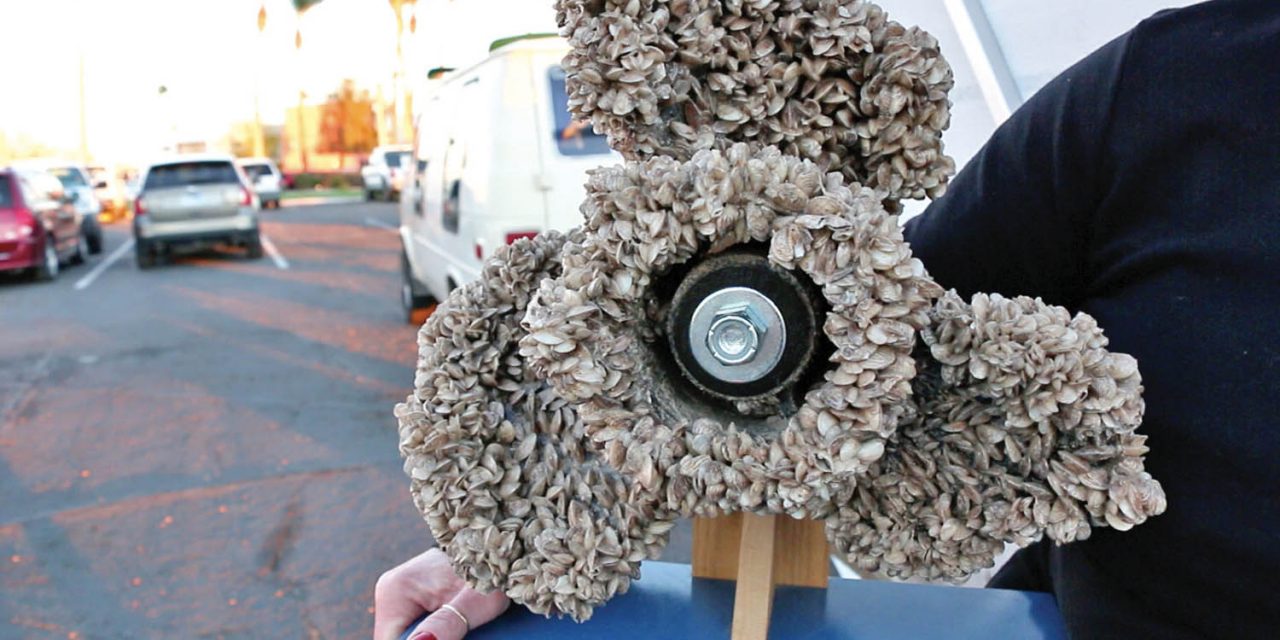
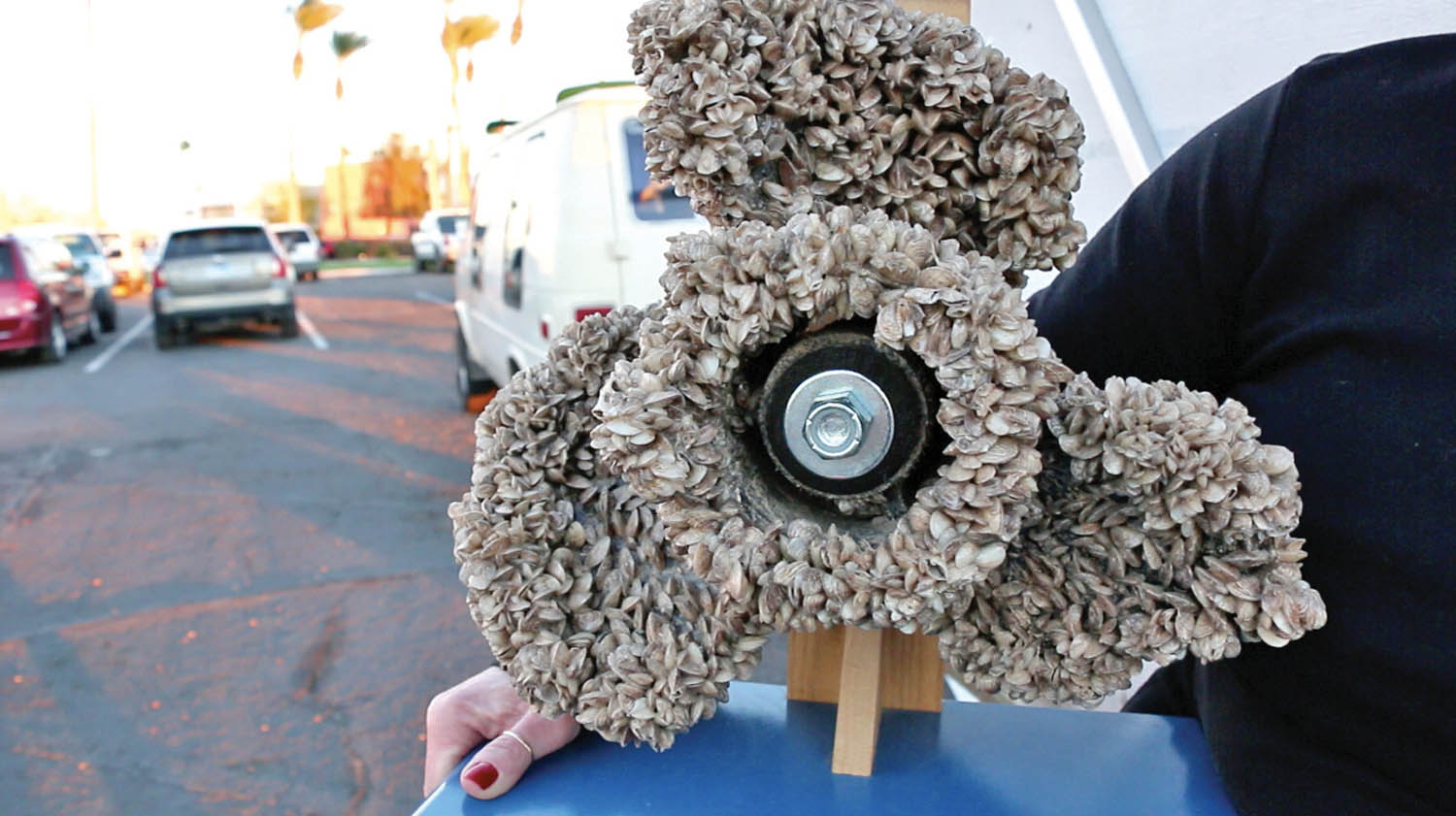
A boat propeller covered in invasive mussels is shown in this still shot from Brynne Morrice’s short documentary Mussel Threat. Once mussels get into a waterway, they are almost impossible to get rid of and they proliferate to cover every surface. (Photo supplied)
The effort to intercept invasive mussels in B.C. is doubling thanks to a $360,000 contribution from the Columbia Basin Trust.
The provincial government announced on Friday that the new resources will mean three additional mobile inspection and decontamination crews will be “dedicated to stopping and ensuring boats are free of mussels.”
Zebra and quagga mussels are typically spread by recreational boaters who fail to decontaminate their boats after using them in infested waterways. Zebra mussels have reached Manitoba and quagga mussels are now found on waterways in the southwestern U.S.
Those mussels destroy ecosystems and infrastructure and damage tourism once they are introduced into a waterway.
The new roving units will be based at Cranbrook, Valemount and Nelson.
The Okanagan Basin Water Board (OBWB), which has previously criticized provincial actions for not going far enough, welcomed the news, but continued to express concerns about the way the teams will be deployed.
“This is generally very good news,” said Anna Warwick Sears, OBWB executive director. “Inspection and decontamination in the Kootenays helps to protect the Okanagan. That being said, the OBWB would prefer the province ensure the most defensive, conservative approach possible with a minimum of five permanent inspection stations at major highway crossings on the B.C.-Alberta border.”
The teams will conduct roadside inspections of boats entering B.C. and targeting major entry points from Alberta and the U.S., said David Karn, a spokesperson for the Ministry of Environment.
They will move between border locations, focus on high-traffic routes and quickly respond to any reports of threats called in through the provincial report all poachers and polluters (RAPP) line, said Karn.
The OBWB, however, is concerned about the strategy of having roving units, but no permanent stations on highways across the Alberta border.
As James Littley, OBWB operations and grants manager puts it: “When I was in the army and we learned to take a defensive posture, we would ensure that every approach route to our position was covered. We also sometimes had roving patrols, but we wouldn’t watch some routes some of the time and then leave them open some of the time.”
With new federal regulations, the Canada Border Services Agency (CBSA) is able to intercept mussel-contaminated boats coming from the U.S.
“We need to take this approach at the provincial border as well,” said Littley. “If they amend their tactical plan from roving to permanent stations, they will have taken every step necessary to protect all B.C. waters. This isn’t about action within our borders. It is about stopping invaders at our borders.”
The OBWB has said that a mussel invasion of the Okanagan waterways would cost $43 million a year just to mitigate.
They are concerned that the province would shift this cost to local taxpayers and they’ve called on the province to commit to funding all treatment and containment programs in infested waters should an invasion occur.
The $360,000 is for the current fiscal year, said Karn. Teams were to start training July 13 and become operational by July 20, continuing their work for the remainder of the boating season to the end of October, he said.
The funding consists of $275,000 from the Columbia Basin Trust (CBT), $70,000 from Columbia Power through the CBT and $15,000 from FortisBC.
There are also in-kind contributions from four invasive species councils from the Columbia Basin and in-kind support from the province valued at $70,000, Karn said.
The CBT was established in 1995 to benefit the area most adversely affected in B.C. by the Columbia River Treaty, which resulted in the construction of dams for power production and flood control.
Warwick Sears of the OBWB points out that the OBWB relies on local tax dollars and so it has less funding than the CBT has to apply to the mussel issue.
The board is wary of the province downloading responsibility for inspection and decontamination stations.
While the new mobile units based at Valemount and Cranbrook will be close to the Yellowhead and Crowsnest highways respectively, they are not positioned near to the Trans-Canada Highway.
Karn said the existing three provincially funded units are based in Invermere, Nelson and Penticton.
“The Invermere crew generally covers the Trans-Canada and surrounding roads,” he said.
Team members on the new units have auxiliary conservation officer status, which gives them the authority to enforce the Controlled Alien Species Regulation, he said.
They typically have college diplomas in fish and wildlife, resource management or compliance and relevant experience.
These are seasonal positions and crew are provided with additional training to identify and decontaminate mussel-infested boats using mobile hot-water pressure washing units.
“It’s a difficult challenge to manage,” said the OBWB’s Warwick Sears. “Keeping out a tiny mussel that’s invisible as larvae and can live in damp carpeting or bilge water for up to a month and with boats being transported all over the western hemisphere.”
RICHARD McGUIRE
Osoyoos Times