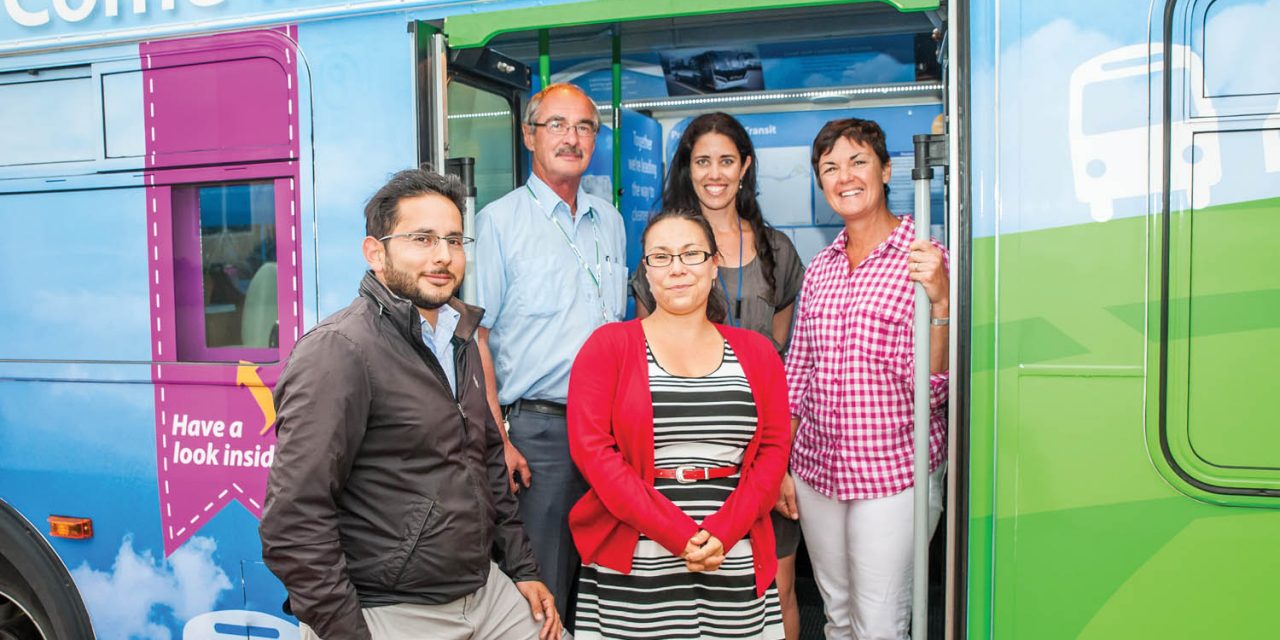
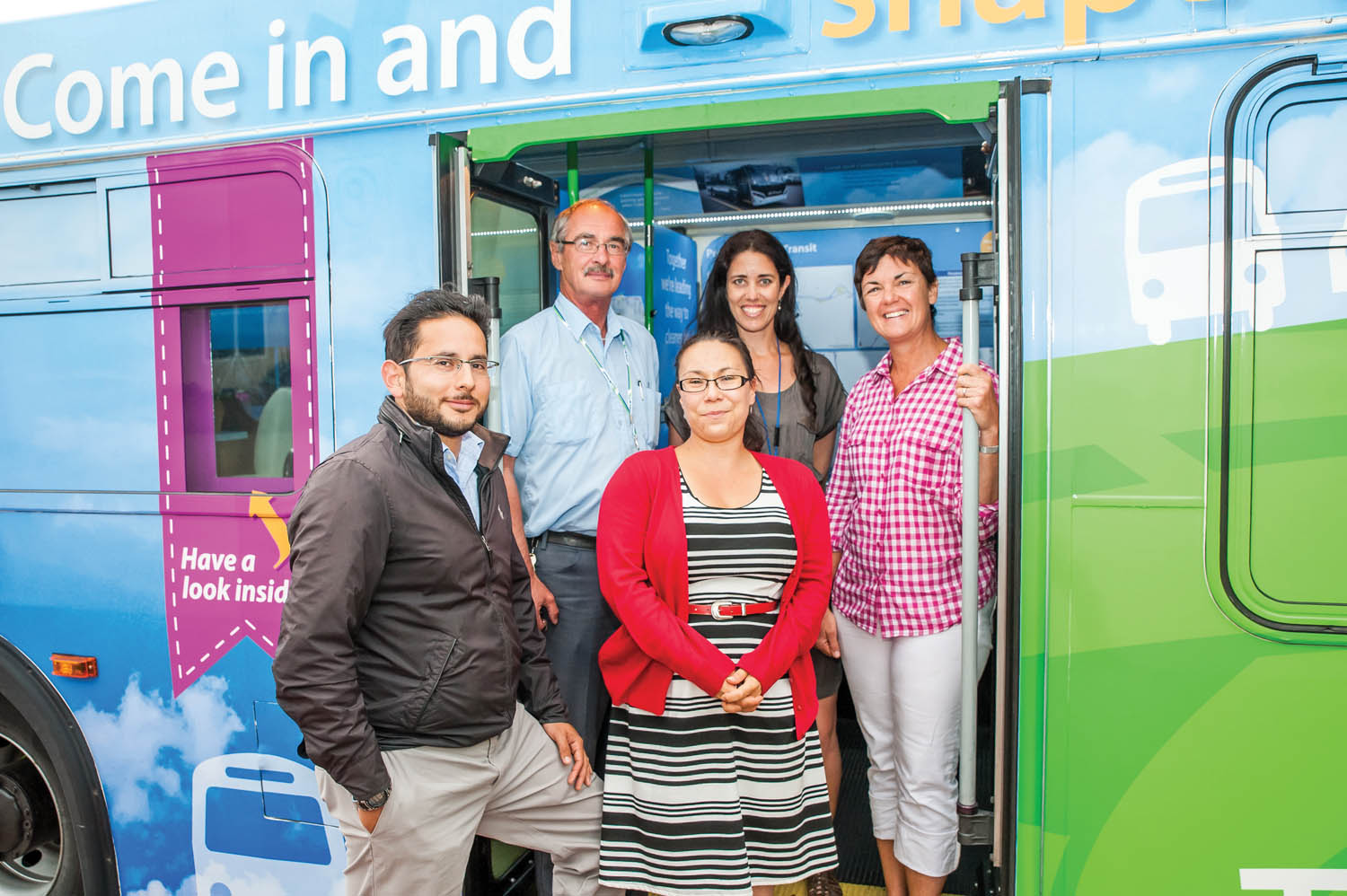
The BC Transit Future Bus team was in Osoyoos on July 23, 2014 to hear from local residents about their priorities for transit service. Front from left are Daniel Pizarro and Adriana McMullen, both of BC Transit. Behind from left are George Neil, the driver from Penticton Transit, Sarah Phillips and Maria Lockley. Pizarro and Lockley were back at council on July 6 to present the completed plan’s executive summary. (Richard McGuire file photo)
A new BC Transit plan outlining ambitious goals for public transit in the region over the next 25 years was presented to Town of Osoyoos council last week.
Council did not immediately endorse the plan, as BC Transit is requesting, but Mayor Sue McKortoff said she sees no reason that won’t happen after council has a chance to consider it.
“I’m sure that we would endorse the plan,” she said. “There wouldn’t be any reason not to from my point of view. There’s going to be a report (from town staff) that will come with all the pros and cons.”
The report, presented to council as an executive summary, calls for the expansion of local and regional bus service with better connections for trips to regional destinations such as Penticton and Kelowna. The full document is about 200 pages long.
It calls for an increase in service within five years between Osoyoos and Penticton to two round trips a day Monday to Friday, with a connection to the midday service to Kelowna from Penticton. Service could then be increased to four round trips per day.
Over the longer term, in six to 25 years, Saturday service from Osoyoos to Penticton with three round trips would be a priority and service between Osoyoos and Keremeos would be introduced.
The plan follows on consultations by BC Transit last year within the Regional District of Okanagan-Similkameen (RDOS).
The goal of the plan is that by 2040, transit in the RDOS will connect people and communities locally, regionally and inter-regionally “through cost-effective, convenient, integrated, accessible and user-friendly services.”
Daniel Pizarro, senior regional transit manager with BC Transit, said the next steps are endorsement of the plan by participating municipalities and then the formation of a transit committee to govern the integrated system.
This will likely lead to the integration of schedules in a single riders’ guide, possibly with one fare structure to make it easier to travel between different communities.
The public will likely see the first tangible improvements to the system in 12 to 18 months from now, if not sooner, he said.
Currently each system works “to an extent in isolation,” he said of the current system, where each municipality has its own operating contracts with BC Transit.
While the plan sets out goals and structures, service improvements will depend on funding from local governments and the province, he said.
“The plan is a strategic document,” said Pizarro, adding that it sets out what the funding is required to do. “The plan is a good guiding document to show what is required to get to that level of service.”
The plan has already received endorsement at the board of the RDOS, where it was presented in April and BC Transit’s board endorsed it in May, Pizarro said.
McKortoff said the goal of the plan to provide cost-effective and convenient local, regional and inter-regional transportation “sounds wonderful,” but she pointed to challenges.
Buses that repeatedly broke down are now being replaced. There remains the problem, however, that people may go to Penticton and have to wait a long time for the return trip.
“You have to be very flexible in your times,” she said. “I’ve never actually used it because I have a car.”
Other local transportation services, for example for cancer patients, use volunteers, she said, and may be more convenient for some people.
“Certainly we need to continue to deal with this, because transit is extremely important,” McKortoff added. “We can’t just keep going with more and more and more cars on our roads.”
In the past, there have been concerns that not all municipalities have paid their share, Oliver in particular, but McKortoff acknowledged that Osoyoos is at the end of the line and so potentially stands to benefit more.
Asked about the structure of a transit committee, Pizarro pointed to his experience with the system in West Kootenay and suggested six or seven elected officials with voting rights so that it doesn’t become unwieldy.
RICHARD McGUIRE
Osoyoos Times
(Read the executive summary of the BC Transit plan for the Regional District of Okanagan-Similkameen — PDF)