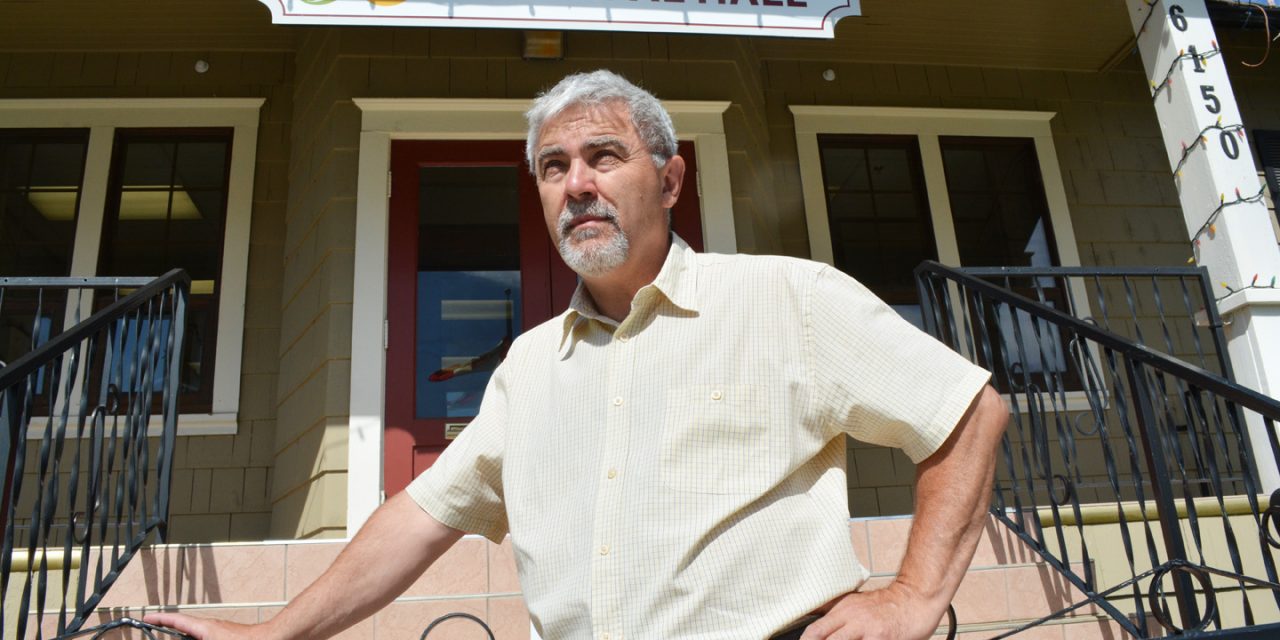

After 24 years as municipal manager for the Town of Oliver, Tom Szalay is leaving. His first order of business is to let out a sigh and focus on a bit of travelling.
Oliver’s municipal manager Tom Szalay is leaving his position after 24 years of service. He’s been a fixture in this town for what seems like forever, and knows more about this place than anyone. Before he rides off into the sunset, we ask him a bunch of questions.
Q: What kind of kid were you growing up?
A: I was kind of nerdy; one of those academic types.
Q: What was the worst trouble you got into?
A: I generally kept out of trouble, or at least never got caught.
Q: What was your first job out of high school?
A: Picking fruit at Skeleton orchard on Sportsmen’s Bowl Road, and picking onions at Covert Farms. Farm work was easy to get and was more enthusiastically embraced by local youth than today. During university years, I worked two summers as a border inspector in Osoyoos, and one summer as a water rights surveyor in the Kettle Valley.
Q: What did you want to be when you grew up?
A: I never really thought about an adult career until Grade 11 or 12. I became interested in engineering because of my love for applied science. My first job after UBC graduation was an engineer with the City of Vancouver for nine years before moving to Oliver.
Q: What is the biggest difference you see in youth today, compared to when you were growing up?
A: Today’s youth has it tough with a scarcity of well-paying jobs along with high costs of education and housing. In the late 70s there was still a strong sense of get an education and get a long-term career. Today, youth have had to lengthen their timeline for these ambitions or change focus completely. As a result there seems less dedication to career and youth are necessarily more mobile. They seem less committed to a job and are quicker to move on if things don’t suit them.
Q: How did you get the municipal manager’s job in Oliver?
A: The opening in Oliver happened to come up just as I was starting to look around (for a job) and I thought, “What the hell … I’ll throw in an application and see what happens.”
Q: What compelled you to keep this job for so many years?
A: On the personal side, our family expanded to four children and we planted roots. We have made many great friends in Oliver and that makes relocation more difficult. As you become more attached to a community, you want the best for that community and I believe I was making a positive contribution each year I was here. On the professional side, I was able to work well with the great majority of council members that have been elected since I arrived (six different mayors and 22 different councillors).
Q: You seem to be a walking encyclopedia on Oliver. Is there anything you don’t know about this town?
A: I don’t know.
Q: What’s one secret you can share that few people know about?
A: If I told you, it wouldn’t be a secret anymore.
Q: What did you enjoy most about the job?
A: The variety of projects and issues that come up almost daily. One thing for sure, it’s never boring.
Q: What did you dislike the most?
A: The perpetual politics that affects most aspects of the job, and elected officials who: are driven by the next election on a three-year cycle, rather than long-term goals; have a difficult time saying “no” to random public requests; and feel a need to be seen to be doing something when it may be best to do nothing.
Q: Name the one issue that you think caused the most controversy in Oliver.
A: Likely the firestorm surrounding Dal Carter’s resignation as mayor in 1997.
Q: What’s one thing you regret doing as municipal manager in Oliver?
A: I should have recommended that council stand firm on the operation of Oliver Parks and Recreation services during the service review about 14 years ago.
Q: You’ve been involved in many decisions in this town. What was the best one?
A: Implementation of universal water metering to fairly allocate domestic water supply costs based on consumption.
Q: Do you have any enemies in this town?
A: I have no idea. People have long memories for negativity. Senior managers tend to get blamed for many of the less popular decisions of their councils and are usually not in a position to defend themselves. As councils come and go, memories of their less popular decisions linger on and tend to become associated with the administration. I deal with this by growing a thick skin, avoiding discussion of work matters outside of the office and letting the record of the past 24 years speak for itself.
Q: There is probably at least one resident who is rejoicing the fact that you’re leaving. Any parting words for that person?
A: There is a great deal more than one such resident, I’m sure. Parting words: chill out. Take a look at what we have here in Oliver and how little we pay for it compared to many other jurisdictions. That doesn’t happen by itself; it takes a good partnership of council and administration to accomplish.
Q: Watching you on council, nobody would ever guess you’re involved in theatre. Where did the passion for acting come from?
A: Like most things in life, council meetings are a form of theatre, with each person playing a part. I am comfortable in front of an audience so it was not much of a stretch. In fact, playing a part whose lines only need to be memorized and convincingly presented is in many ways easier than having to think on your feet and having to defend controversial opinions.
Q: What is your favourite actor and why?
A: Christopher Walken – great comedic timing for a non-comedian.
Q: Favourite movie?
A: Inglourious Basterds – great blend of violence with twisted comedy. How can I be laughing at this stuff?
Q: What is your best joke?
A: It’s likely too politically incorrect for public consumption.
Q: How do you effectively deal with stress?
A: Walking, social time with friends, and leaving the job at the office.
Q: What was your happiest moment in life?
A: My marriage (to Louise) and the birth of our children.
Q: If you had one super power, what would it be and why.
A: Would the ability to stop people from being negative count?
Q: What does Oliver need most right now?
A: A national brand, mid-priced hotel.