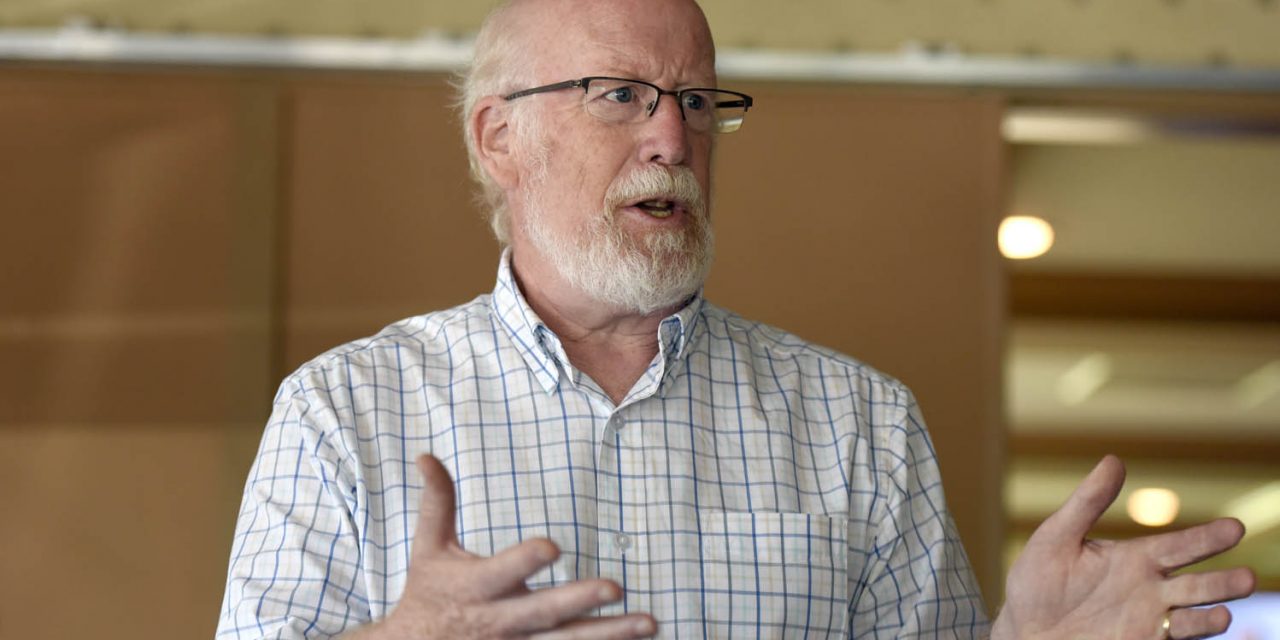
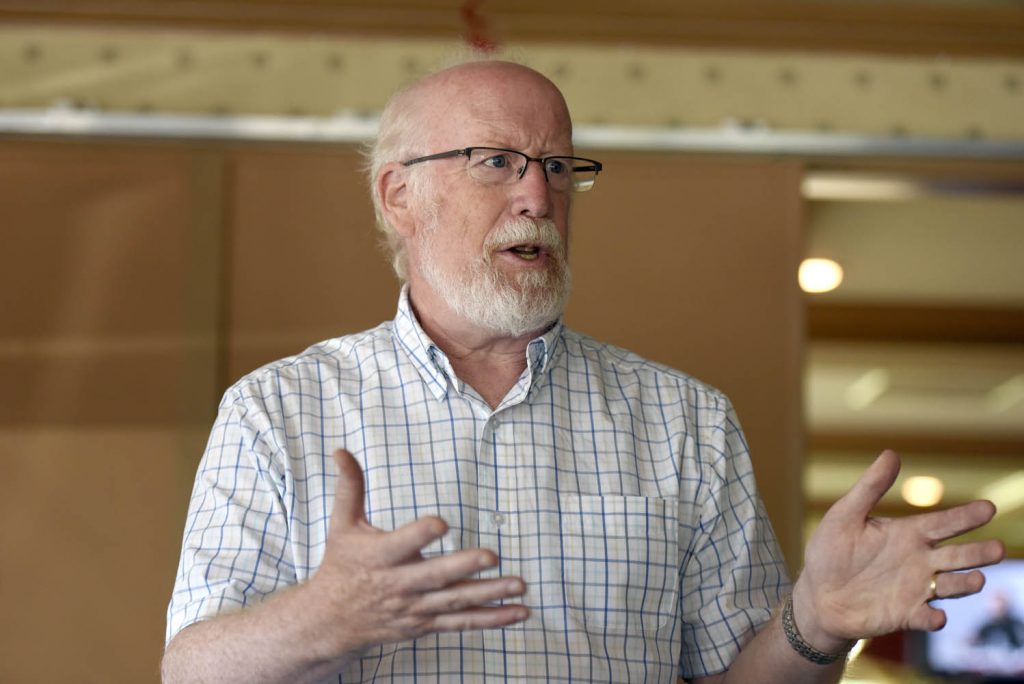
MP Richard Cannings spoke to Osoyoos Rotarians Thursday on issues ranging from the proposed national park, to interprovincial trade in wine, to softwood lumber and upcoming changes to laws on marijuana. (Richard McGuire photo)
Supporters of a national park reserve in the South Okanagan-Lower Similkameen won’t get everything they want, but MP Richard Cannings says he’s hearing “positive things from the provincial government about this.”
Cannings, the federal NDP representative for South Okanagan-West Kootenay (SOWK) made those comments as guest speaker Thursday at the lunch meeting of the Rotary Club of Osoyoos.
Cannings told the Rotarians that he met Mary Polak, the provincial environment minister, at a meeting of environment ministers in San Francisco in May.
Although the province won’t likely announce its decision on the national park until the fall, Cannings said he got a sense of the direction the province is moving.
His comments on the contentious national park issue came during a 20-minute talk in which he spoke about his first year as a Member of Parliament as well as on two other federal issues that impact the people of SOWK – softwood lumber negotiations with the U.S. and the Columbia River Treaty.
He also commented on several other issues – including marijuana and interprovincial trade in wine – in response to questions from the audience.
Cannings, a biologist, has been involved in the national park issue since 1980 when just after obtaining his Master’s degree, one of his first contracts was with Parks Canada to identify areas of the dry interior of B.C. for a national park.
In an interview following his Rotary talk, Cannings said he would like to see the area around Mount Kobau included in a national park reserve.
His impression, he said, is that the provincial government is moving to make it a Class A provincial park instead.
During public consultations last year on the provincial government’s Intentions Paper about protecting areas of the South Okanagan, the provincial government heard considerable feedback that Mount Kobau should be included in a national park reserve.
“I didn’t get any sense from her (Polak) that they had changed their minds as a result of the feedback,” said Cannings. “She didn’t say what they were going to do, through she did say they were thinking of a Class A provincial park.”
Nonetheless, Cannings stressed that his overall response to the direction the province is going is positive.
“I’m happy that they want to get back to the table and talk to the federal government about this,” said Cannings. “Whether it’s scaled back (from previous park proposals) or not, I’m just happy that this is moving forward.”
On softwood lumber, Cannings acknowledged that it is more of a concern in the Boundary and Kootenay regions, as well as Princeton, than it is in the South Okanagan.
Nonetheless, he’s worried that the present softwood lumber agreement with the U.S. expires in October and he’s concerned the federal Liberal government isn’t doing enough to get a new agreement.
“I’ve been asking questions in question period all through this session and the trade minister (Chrystia Freeland) keeps saying, ‘Oh, (Prime Minister Justin) Trudeau and (President Barack) Obama get along so well this will be done in 100 days,” Cannings said. “They said that back in March. I think those 100 days are up and every indication is that all these softwood lumber negotiations are completely off the rails, in the ditch, and we’re going to be facing some serious countervailing duties in the fall when the present agreement expires.”
The Columbia River Treaty was signed in 1964 and it runs to 2024, but since 2014 a 10-year period has started when the parties can call for renegotiations, Cannings said.
He pointed out that Canada receives a considerable funding entitlement that goes to the province and has been used for the Columbia Basin Trust.
The Americans say they pay too much, but they want more say over the water they get, Cannings noted
“So they want a lot more and they want to pay less,” said Cannings. “So I think that puts us in a pretty good negotiating position.”
Nonetheless, he’s been unable to get information from the government on the status of negotiations other than confirmation that a negotiating team is in place.
Osoyoos town councillor Jim King, also a Rotarian, asked Cannings about the transportation of wine between provinces, which he said is a major concern to the South Okanagan.
Cannings noted that federal barriers were removed in 2012 as the result of a private member’s bill by Conservative MP Dan Albas, but that provincial barriers remain.
Alberta didn’t have barriers until the federal barriers were removed and then the previous Conservative Alberta government created new ones, Cannings said.
“Right now you can drive across the Alberta border with wine in your trunk as long as you promise to drink it yourself in your home,” said Cannings. “You can’t go to a party and drink it there. It’s ridiculous.”
Cannings said he’s spoken about the issue to members of the present NDP government in Alberta, including Premier Rachel Notley and Deputy Premier Brian Mason.
Although there is a new agreement between B.C., Ontario and Quebec, B.C. wines must still go through the Liquor Control Board of Ontario (LCBO) and the Société des alcools du Québec (SAQ), Cannings said.
“So I think there’s a long way to go,” he said. “I’ve spoken in the House on this and we had a debate on interprovincial trade and I spent my whole time talking about beer and wine.”
King also asked Cannings about the status of the federal government’s proposed changes to marijuana laws.
Cannings said the Liberal government has said it will have legislation in place in 2017.
“Where they’re headed on this, I don’t know,” he said. “But I think all the people that voted Liberal because they wanted to be OK about growing some marijuana in their backyard and smoking it themselves are going to be disappointed because I think it’s heading toward a more structured regime than that.”
He recognized that municipalities currently face problems with medical marijuana dispensaries springing up even though federal law says they are still illegal.
“Hopefully within a year we’ll have some answers, but for now it’s a bit of a mess,” said Cannings.
RICHARD McGUIRE
Osoyoos Times