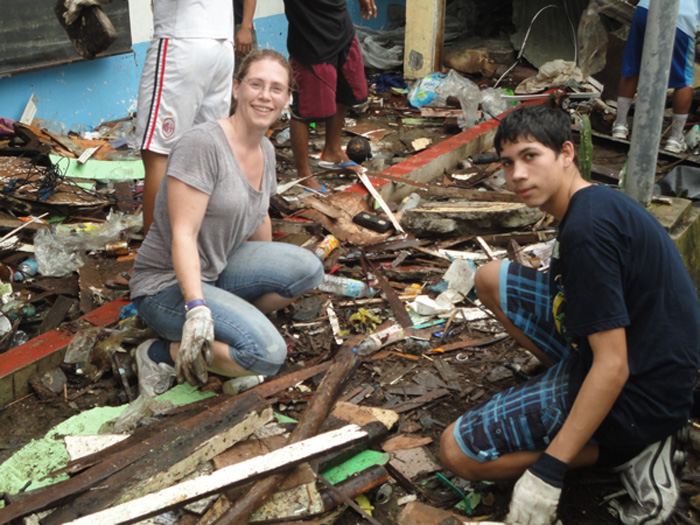

Amy and Ryan Encina clear rubble at one of the sites near Tacloban, the city hit hardest by Typhoon Hiayan.
Photos contributed
Most Christmas presents come wrapped in paper and bows, but in December Ryan and Amy Encina wrapped theirs in plywood and nails.
The local mother and son were part of a small group that travelled to the Philippines to help rebuild the ravaged country and assist people coping with the aftermath of Typhoon Haiyan.
The group, which also included Melissa Knechtel and Chris Hagel, visited between December 30 and January 15. Most of that time was spent on the island of Leyte in Tacloban, the epicentre of the typhoon’s destruction. The city of approximately 222,000 bore the brunt of 195 mph (314 kph) winds that ripped through the island country on November 8.
The storm is reported to have remained at peak Category 5 intensity for 48 consecutive hours, with storm surges nearly six metres in height causing widespread devastation.
For the Encinas, the trip was more than an answer to a national call for help. It was personal.
Tacloban is roughly 181 kilometres from Bohol, Ryan’s birthplace. The Encinas lived in the Philippines for seven years and came to Canada when Ryan was five. Ryan said they still have close ties to the country.
The 14-year-old high school student said he didn’t know what to expect but did his best to prepare himself for anything.
“Tops of buildings were wiped out, there were piles of rubble and stuff all over. It wasn’t as bad as I thought it would be, it’s just that it was everywhere. Everywhere I looked bits and pieces of homes and properties were just . . . gone.”
As an experienced relief worker, Amy has seen destruction before but even she was deeply affected by the damage she saw. “It’s the parents who had lost everything and couldn’t help their children that really got to me,” she said.
“As a mother, I can’t imagine how that would feel to lose everything and not be able to provide for your kids.”
She said she is also concerned about the long-term economic affects of the typhoon. She said some towns hit by the storm could take nearly 10 years to recover and the income loss to farmers who cannot replant their crop is substantial.
What troubles Amy is the uncertainty that faces thousands of Filipinos. “At the time we were there they were trying to get people out of the evacuation centres but they don’t have anywhere else to go. For me that was tough to see because having your own home and sense of security is so important.”
Shortly after Haiyan hit, the country’s administration announced a “no-build zone,” banning construction within 40 metres of the sea shore. With land scarce and thousands of people in need of homes, most will likely remain in housing limbo for an indefinite period.
Amy said the group’s main focus was to help where they could, which meant clearing rubble, facilitating feeding programs, handing out relief goods and packing and distributing goods.
Through the relief organization YWAM (Youth With a Mission), volunteers were able to purchase notebooks so that students could return to school.
“Theirs were just kind of . . . washed out,” said Amy. “There were thousands of students trying to go back to school and no notebooks; one school that was petitioning for our help had 6,000, well, 5,000 returning because of the death toll. We were able to buy 800 notebooks. It was a drop in the bucket compared to what is needed, but it’s something.”
The group also received donations of tarps for shelter, work gloves, flashlights with batteries and first aid kits from Oliver area businesses before they left.
Even with their homes washed away and their towns in ruins, Ryan said he was surprised to see people smiling and trying their best to continue on with their lives – particularly the children. He said he spent time playing soccer with kids at one of the orphanages and admired their resilience.
“The kids knew what happened. But they still seemed happy. I guess I didn’t expect that. It was only if you asked them questions or tried to get them to talk about what happened that they’d close up,” he explained. “They had all lost someone and they didn’t really want to talk about it. Otherwise they were cheerful and ready to play, they didn’t have any toys or anything. They were happy with so little.”
Amy said that is very typical of that culture. “They tend to just laugh things off, if it’s something that’s really close to the heart then they just won’t talk about it. That’s just how it is.”
She said she couldn’t help but be inspired. “In western culture we have so much and we seem to be always wanting more, whereas they seem to be happy enough to just have each other. Relationships just make their whole world.”
In the meantime, Ryan has returned to school but hopes to go back to the Philippines this summer. He said he has more work to do.
“There’s much to be done still. But everyone can help, you don’t have to go there. Have a yard sale, sell what you don’t need and give the money to people who really need it. You’d be surprised what you can do.”
Erin Christie
Oliver Chronicle