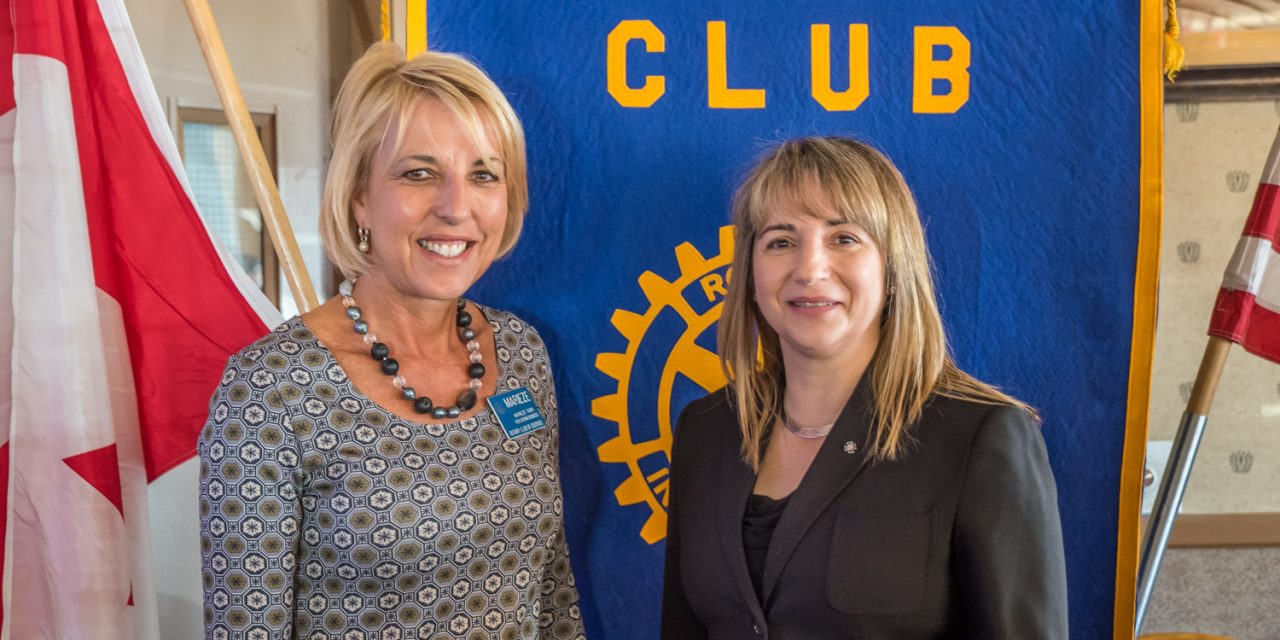
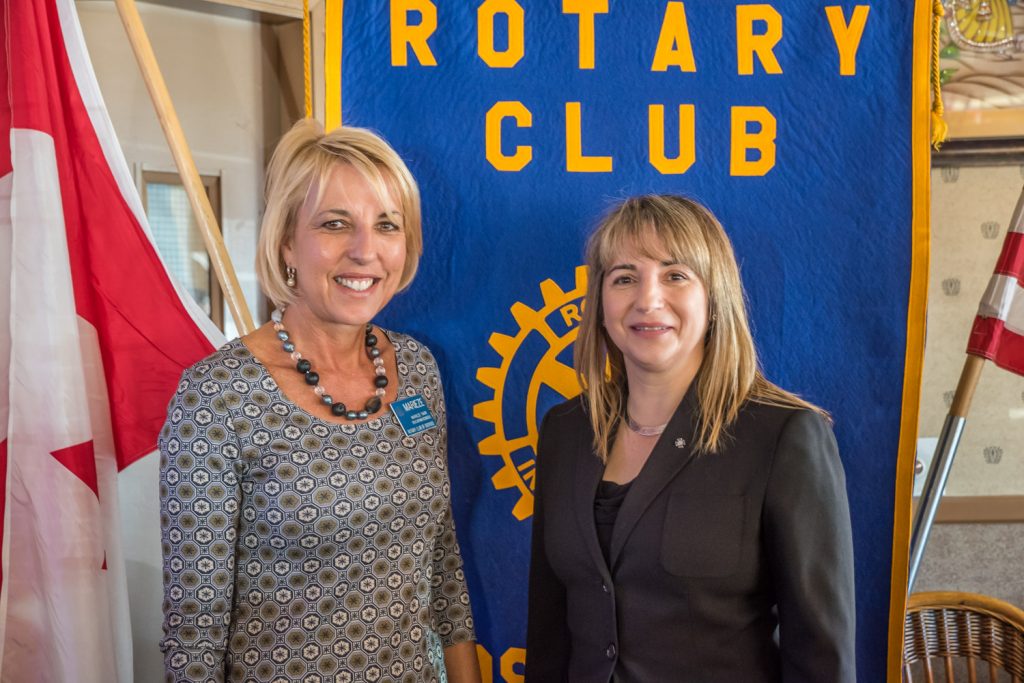
Carole Bird (right), who retired from the RCMP last year, played a major role in the establishment of the Centre for Missing Persons and Unidentified Remains. She was guest speaker at the Rotary Club of Osoyoos recently. At left is club president Marieze Tarr. (Richard McGuire photo)
When the public thinks of missing people, cases like last week’s disappearance of a two-year-old Manitoba boy, Chase Martens, later found drowned, come to mind.
Or perhaps the high-profile disappearance and presumed murder of Lyle and Marie McCann, a senior couple who disappeared in 2010 on a road trip to B.C. from their home in Alberta.
An Alberta man named Travis Vader is currently on trial for their murder, even though their bodies were never found.
About 62,000 Canadians are reported to police each year as missing, but most, however, turn up safe and sound, according to Carole Bird, a retired RCMP inspector, who was guest speaker at the Rotary Club of Osoyoos recently.
“I’m a little passionate about the issue,” said Bird, noting that typically about 21,000 missing adults are reported annually to the Canadian Police Information Centre (CPIC), as well as about 41,000 missing children.
Bird spoke at Rotary on March 17.
Bird, who retired last summer to Osoyoos, led the four-year project of establishing the National Centre for Missing Persons and Unidentified Remains (NCMPUR) based in Ottawa.
NCMPUR provides specialized investigative services to law enforcement, medical examiners and chief coroners related to missing persons and unidentified remains investigations.
It also runs a website profiling selected missing persons cases at canadasmissing.ca.
The distinction between adults – those aged 18 and over – and children is important, said Bird.
“Adults actually have the right to disappear if they want to,” said Bird. “As long as you’re not fleeing the law, as long as there are no warrants out for you, you can leave. “You can have a bad day and decide to walk away for a period of time. You can decide you want to start over. A whole bunch of people do it. It’s allowed. In fact, most of the phone calls that police get about missing adults, they come back safely on their own very shortly thereafter.”
Children, however, are a different matter.
They may run away from home, but their disappearance is always cause for concern.
Very few of those result in Amber Alerts – typically fewer than 10 a year – which are only issued by police in cases involving child abductions in the most serious, time critical cases.
On television shows, strangers are most often responsible for child abductions, but in reality cases that are international and longstanding are usually parental abductions, said Bird.
“Parental abductions mean as much to the parent that was left behind as any other missing child, and yet we see cases that take years and years to resolve and some may never be resolved,” Bird said.
Adults who disappear may be involved in high-risk activities, which can mean anything from hunting to hiking, mountain climbing, hitchhiking or even street prostitution, she said.
People can become disoriented for medical reasons, including dementia, wandering off either into the wilderness or in cities. When temperatures are extreme, this can be especially dangerous.
Missing persons cases present unique challenges unlike most criminal investigations, said Bird.
“Let’s say I was investigating a murder,” said Bird. “I have a crime scene usually and fairly quickly thereafter, hopefully, I will figure out who the murder victim was. So I know where and I know the who, and we don’t know who did it yet, but usually through an autopsy I’m going to know the how.”
In contrast, none of this is typically known in a missing persons case.
People may have some idea when the person was last seen, but narrowing down exactly when, why and how they disappeared is much more challenging.
Often, in the case of homeless people, they may only be known by a nickname that could be the same nickname used by others who have not disappeared.
“Often you are working without some of the basic parameters you would typically get in things like a homicide,” she said.
Another challenge is popular misconceptions based on television shows, said Bird.
“I love CSI, it’s a wonderful show, but I’m really sure I can’t get a DNA analysis within an hour, I can’t solve the case within an hour, but what we find is people have that expectation,” she said.
The reality is there are various police forces and standards across Canada and different protocols come into play. The needs to bring these different organizations together and develop best practices were among the reasons the NCMPUR was established.
“There are so many different circumstances and that’s what makes things so complex,” said Bird. “There’s no cookie-cutter mould for how a case will unfold. There are best practices and they may not apply to every single investigation.”
When a person goes missing, they leave behind someone who cares for them – a spouse, a friend, a colleague, or in the case of a child, parents and siblings.
When they come back, the negative circumstances that made them leave can be resolved, Bird said.
When the person doesn’t come back and harm befalls them, whether accidental or deliberate, other issues arise.
Numerous questions arise such as what happened? Can the family get closure and can they move on? Will a family need to await the outcome as a case moves through court? If the missing person was a financial contributor, will the family now have trouble paying the bills?
“These can be straightforward cases or they can be lengthy,” said Bird. “Sometimes they can be ongoing for years. For the family, that can make things very difficult.”
RICHARD McGUIRE
Osoyoos Times