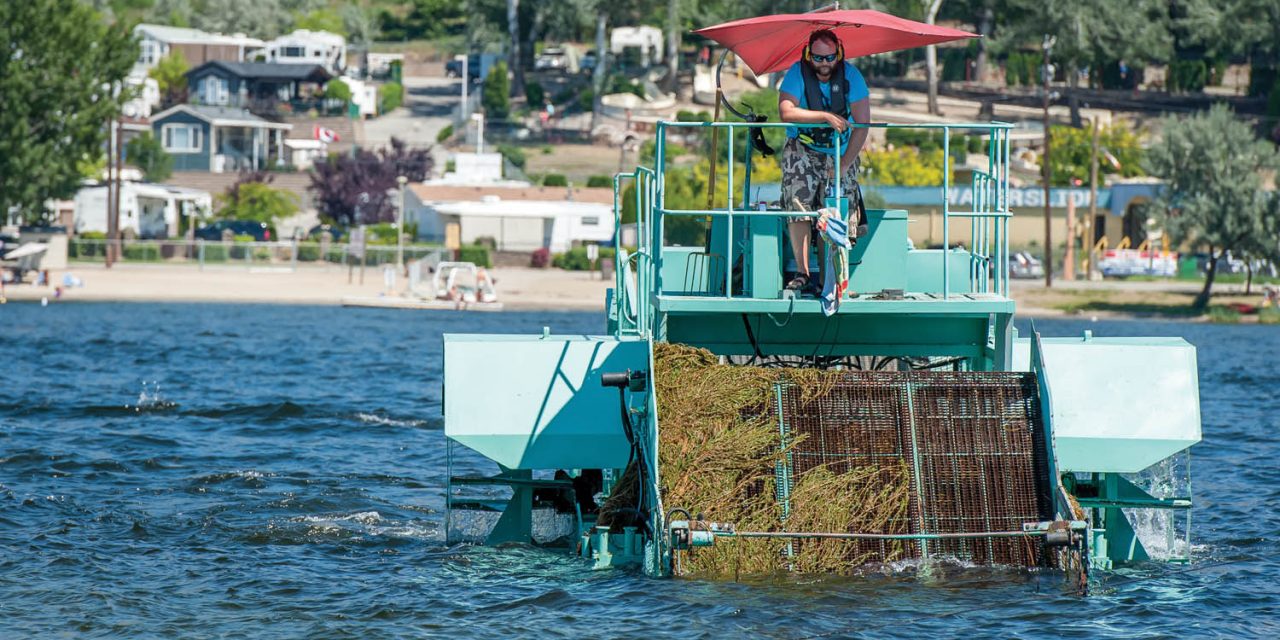
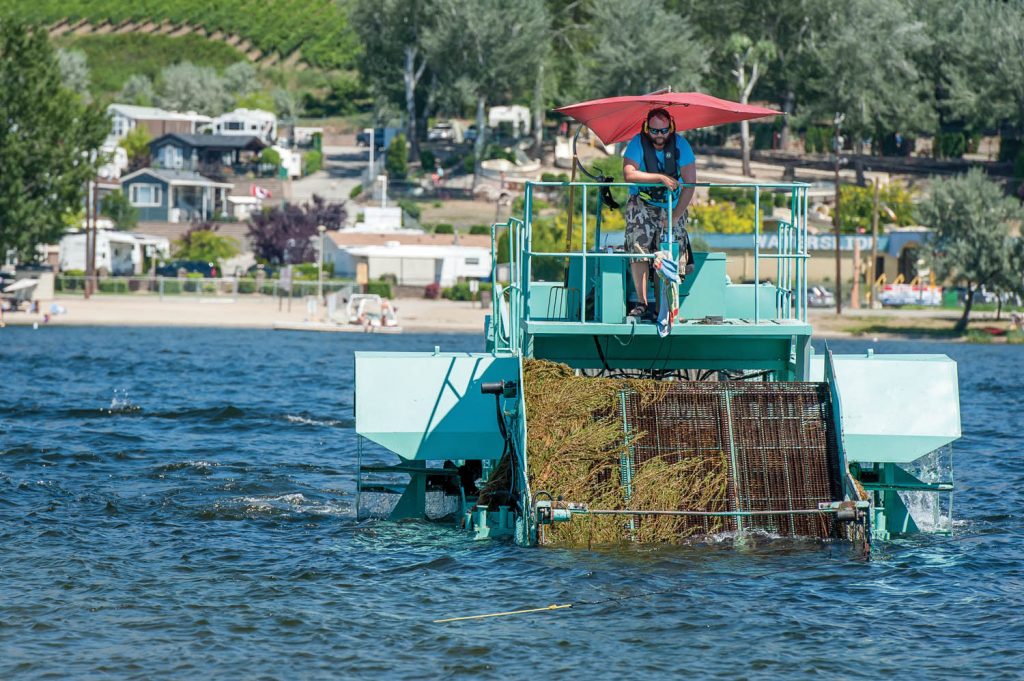
The Okanagan Basin Water Board’s milfoil harvester scoops up the invasive weed in a previous summer program. (Richard McGuire file photo)
Weather conditions have conspired to make the milfoil problem worse this year on lakes in the Okanagan, but harvesting is now underway on Osoyoos Lake.
“This year, with unprecedented floods and a predicted hot summer, we’re expecting significant growth with weather that has created ideal conditions for the milfoil,” said James Littley, operations and grants manager with the Okanagan Basic Water Board (OBWB).
But problems started earlier when the colder winter froze over the lakes, preventing milfoil rototillers from getting in and uprooting the invasive aquatic weed in several locations.
“We were very, very limited in Osoyoos Lake this year in the winter because of the freezing,” said Littley.
Normally, the OBWB must remove the machine around October because of the drop in the lake level, and then they launch it again in the spring when the water reaches the right height.
“But by the time that we would normally launch it again, the lake was still frozen and our work windows ran out,” said Littley.
Although the summer milfoil harvest program started again last Thursday on Osoyoos Lake, water levels are still too high from recent flooding to use the machine on other lakes.
“Typically we would be starting in Okanagan Lake, Wood Lake and Osoyoos Lake and we would rotate with the harvester most of the summer,” said Littley. “But because of the flooding in the other lakes, we can’t launch right now. The lake levels are just too high.”
Littley said one of the immediate priorities on Osoyoos Lake was responding to calls about milfoil on Solana Bay.
After that, the focus would be on public beach areas.
“Of course there’s some latitude as well with the operator, because he can see what’s going on,” said Littley. “He’ll see a patch of milfoil and decide if it’s near the surface and it’s really bad, he can hit that first.”
In the winter program, the milfoil is pulled up at the roots and it dies in the colder water. This is more effective at removing the plants.
By contrast, in the summer, only the top two metres are cut off to reduce the impact of milfoil for boaters and swimmers.
That’s because in the warmer weather, uprooted milfoil can re-establish itself elsewhere and spread. The summer program is less effective at controlling the plant, but the OBWB is making up for time lost over the winter.
“I think it’s going to be a worse year than we typically see,” said Littley. “But we’ll be working in there on Osoyoos Lake from now until the end of tourist season. There will be a machine in there working as much as possible.”
The plan is to operate until around mid-September, he said.
With the program behind schedule in many areas, and with the expected boom in weed growth, the OBWB will likely be unable to respond to additional calls for treatment.
“Our priority is the public beaches where the majority of people area accessing the water,” said Littley. “Shorelines in front of private property will not be considered for treatment this year until public beaches have been treated.”
Littley said the program recently hired an additional operator and it has upgraded the engines on the older harvesters so they are more efficient.
The OBWB is also in the process of obtaining an additional rototiller.
The plan is in the future to do harvesting on Vaseux Lake, which hasn’t been done except a few times in the 1990s. Residents there have asked for an expansion of the program to their lake.
Littley said the OBWB is still in the process of obtaining provincial permits to operate on that lake.
The OBWB has been treating invasive milfoil in the Okanagan for more than 40 years.
RICHARD McGUIRE
Osoyoos Times