By Don Urquhart, Times Chronicle
With over 626 impaired drivers taken off the road this summer as a result of the Summer Impaired Driving Campaign the BC Highway Patrol (BCHP) is highlighting the “alarming trend” of increasing impaired driving in the province, particularly in rural areas.
The results of the Summer Impaired Driving Campaign show that impaired driving is an issue everywhere, and it’s a particular problem in the north and central (which includes the Okanagan) regions of the province, said the BCHP in a statement.
Speaking to the Times Chronicle, Eric Dumschat, Legal Director at Mothers Against Drunk Driving (MADD) Canada didn’t mince words on the issue.
“Any amount of impaired driving is, frankly, unacceptable and atrocious. To see such a high number is, frankly, disconcerting,” he said.
Superintendent Mike Coyle, Operations Officer of BC Highway Patrol said, “this year’s Summer Impaired Driving Campaign is a graphic illustration of why we all need to do better staying sober while driving.”
Impaired driving is the leading cause of criminal death in BC, and “it’s simply unacceptable to think that it’s OK to drive while impaired by alcohol or drugs.”
Drug-impaired driving is a particular issue in the Kootenays, although it’s an increasing problem everywhere with serious and fatal collisions, says Coyle. “We need people, especially in rural areas of BC, to be more serious about staying sober.”
The over 600 drivers were taken off the road for alcohol and drug impairment during road checks across the province from June 15 to August 31.
Considering the smaller population, northern BC continues to have the highest total of driving prohibitions, criminal charges, and drug prohibitions:
- Northern BC: 146 (11 were detected impaired by drugs)
- Metro Vancouver, Sea to Sky, and eastern Fraser Valley: 150
- Vancouver Island: 131 (15 were detected impaired by drugs)
- Central (including Okanagan): 111
- Kootenay region: 88 (31 were detected impaired by drugs)
Throughout the province, BC Highway Patrol said it has been expanding the application of Mandatory Alcohol Screening (MAS).
MAS allows police officers to demand an immediate breath sample, under section 320.27(2) of the Canadian Criminal Code, from any driver who is lawfully stopped.
There is no longer any need to develop a reasonable suspicion that a driver has alcohol in their system, and the entire process can be done in less than two minutes. Drivers who refuse the breath demand are committing a criminal offence that leads to penalties similar to impaired driving charges.
The purpose of MAS is:
- To stop drivers who choose to drive while impaired. Everyone needs to know that police can test any driver during any traffic stop;
- To detect impaired drivers who do not show obvious signs of intoxication;
- To reduce alcohol-related crashes, injuries and deaths. In other words, to keep you and your loved ones safe on our roads.
In the East Kootenays, BC Highway Patrol used MAS to check more than 1,500 drivers for alcohol impairment during the Summer Impaired Driving Campaign and on Vancouver Island, MAS was used extensively during the August concert season.
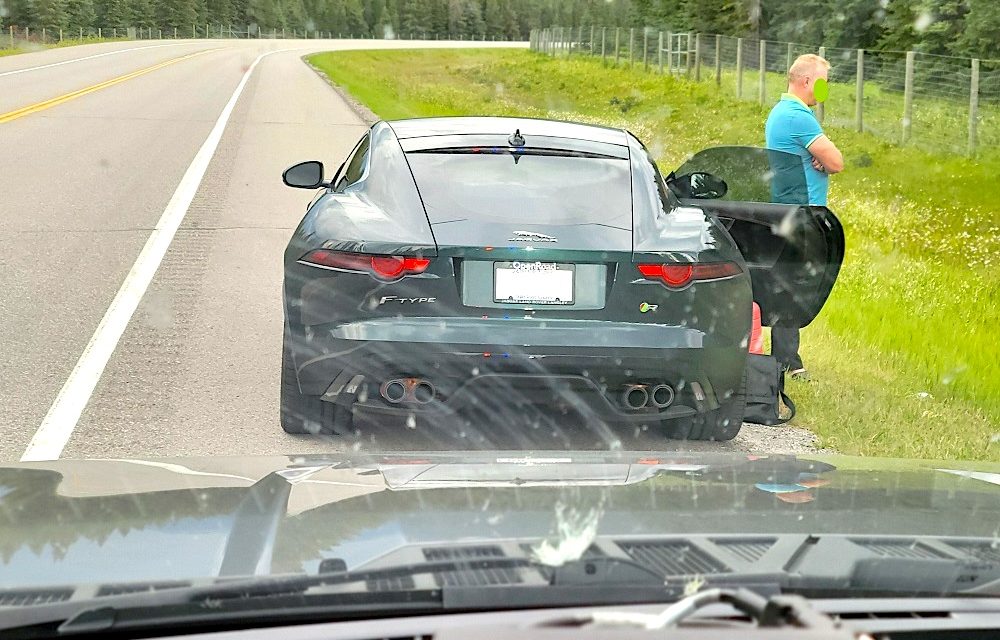
To illustrate an alarming trend in impaired driving, the BCHP points to an August 1 on Highway #93 in Kootenay National Park. A green Jaguar was clocked doing 153 km/h in a 90 km/h zone. The driver, who did not look outwardly intoxicated, was read the MAS demand. He blew a warn and received:
- A 3-day driving suspension;
- An excessive speeding ticket under section 148(1) of the BC Motor Vehicle Act (MVA) for a fine of $368;
- A 7-day vehicle impound at his expense;
- At least three years of high-risk driving premiums that will push the total cost of fines and fees to almost $2,500.
During the summer, BC Highway Patrol has stopped multiple drivers for speeding only to discover they were also impaired. Speeding and impaired driving are consistently two of the three most significant contributors to fatal collisions in BC (distracted driving is the third).
Dumschat feels that part of the reason for the rising numbers is because “people think that they’re not going to get caught.” In BC he says police need to step up the use of the mandatory alcohol screening provisions in the Criminal Code.
While the BCHW patrol made explicit reference to the use of MAS he feels it should be used all year round at every traffic stop and “not just when you are looking for impaired drivers or as part of a campaign.”
“Using it constantly and consistently makes the deterrence go up, and then you’ll start to see these numbers go down,” he argues. He acknowledges that the rising numbers of impaired drivers could in fact be a reflection of the greater use of MAS, in effect revealing a truer picture of the problem.
“We applaud their use of mandatory alcohol screening, but we would like them to be doing more,” he adds.
As for drug use, primarily cannabis, he says this was a problem prior to legalization, but could be slightly exacerbated by its change in legal status. “But in tandem with the legalization, the government did introduce new drug impaired driving Criminal Code provisions as well as gave police the ability to use the oral fluid devices (for drug testing). So, you know, they’ve got other tools,” Dumschat says.
While he had no statistics on hand, he observed that drug impaired driving has been on the rise, at least in terms of the number of people who are charged criminally. Again this number could be impacted by the fact police were given the resources to test for drug impairment which causes the rates to go up.
“It is important to note,” he says, “that impaired driving is not just alcohol impaired driving and it is not just drug impaired driving. It is both of them together,” he says referencing what is known as” polysubstance use” where people use a little bit of alcohol with a little bit of cannabis, which can have a greater impact than using either one of those alone.
For MADD the simple clear refrain that has remained virtually the same since it was founded in the fall of 1980 remains prescient: “Don’t drink and drive or consume drugs and drive.”