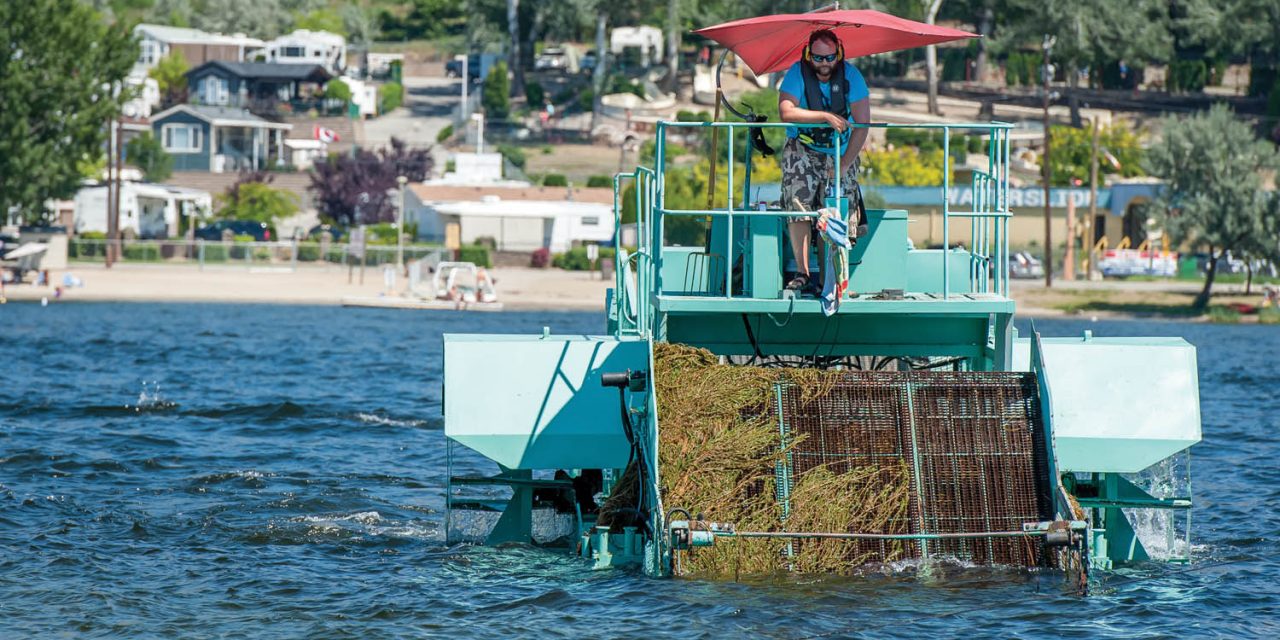
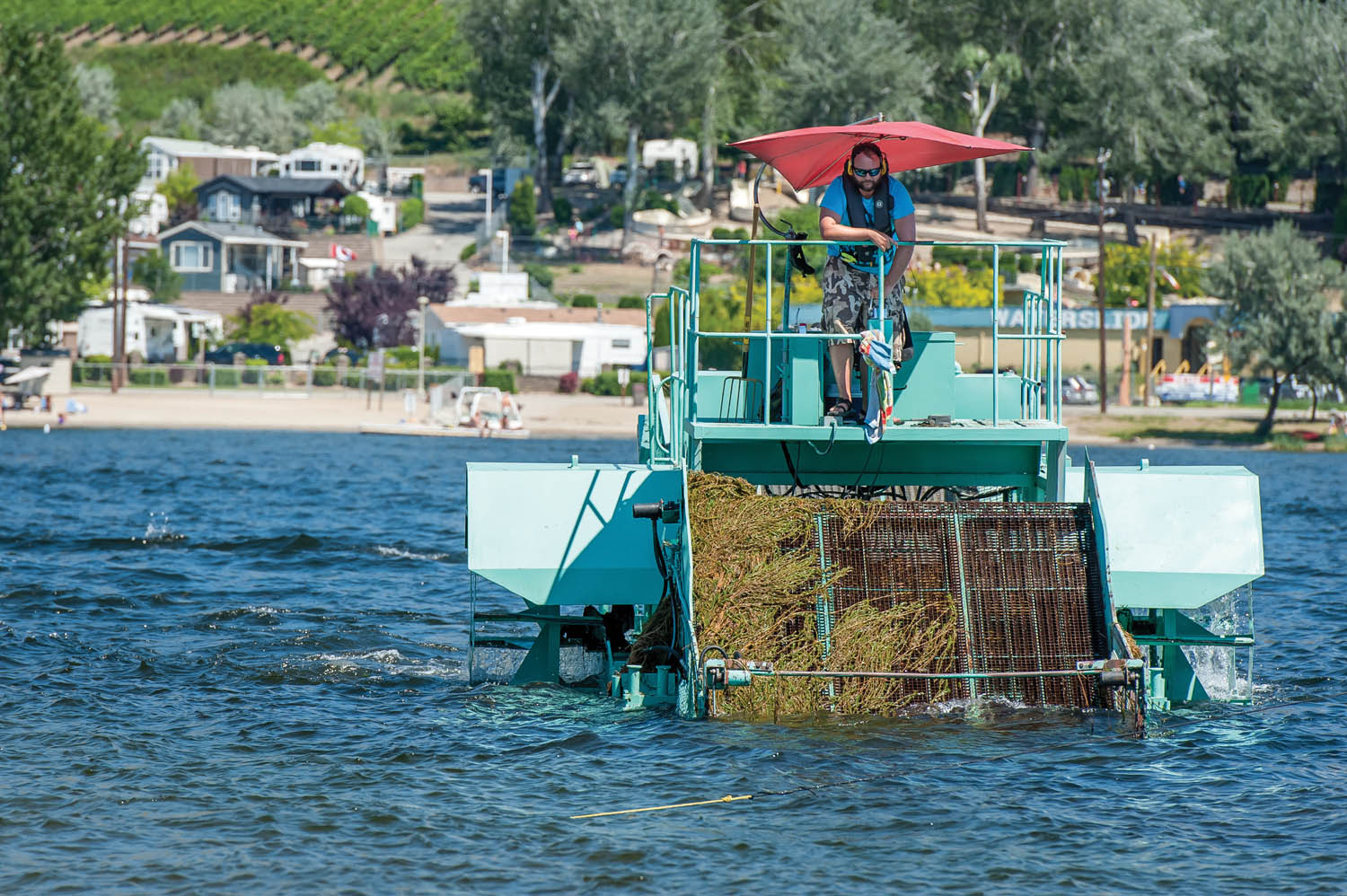
Dave Caswell of the Okanagan Basin Water Board shows how the rototiller he operates pulls Eurasian milfoil up by the roots. In the colder months, the uprooted plants die. In the summer, however, cut milfoil has to be harvested to keep the cut plants from spreading. (Richard McGuire file photo)
The Eurasian watermilfoil problem that has plagued Osoyoos Lake – and numerous other lakes across the Okanagan Valley – for the past 40 years isn’t going to be eradicated any time soon.
During a presentation to Town of Osoyoos council Monday, James Littley, the office and project manager for the Okanagan Basin Water Board (OBWB), said he doesn’t foresee a time when the serious milfoil problem in Osoyoos Lake will be eliminated.
The only two methods known to eradicate milfoil contamination include the use of potent chemical compounds or “draining the lake until everything dies and then replacing the water” and neither is viable for Osoyoos Lake, said Littley.
Chemical compounds simply wouldn’t work as Osoyoos Lake is part of a huge water system that couldn’t handle the side effects caused by strong chemicals and it’s too large a lake to ever consider draining, he said.
Experiments are being conducted in Washington State to try the use of micro-organisms that eat milfoil, however, the tiny “weevils” cost $1.20 apiece and it takes tens of thousands of them to eliminate one small area and would be prohibitively expensive on a large lake like Osoyoos Lake, he said.
Without any permanent solution to consider, the OBWB will maintain its current system where it harvests large amounts of milfoil during the summer months and using a huge rototiller machine to cut and remove dormant root fragments during the winter months, said Littley.
The summer harvesting program, where large amounts of milfoil are harvested and brought to shore, has no permanent effect as milfoil can grow up to five centimetres a day, he said.
While the winter rototilling program is much more effective as killing off large amounts of milfoil, rototilling is not permitted in all areas of Osoyoos Lake because of fish and waterfowl habitat restrictions, he said.
“Rototilling has a multi-year cumulative effect, but it’s also not a permanent solution,” he said.
Milfoil is insidious because it robs oxygen and lowers water quality, restricts native fish habitat and promotes algae blooms, causes an unsightly and strong odour on local beaches and lowers property values and discourages tourism, said Littley.
The OBWB has sent a letter to town administration to identify and designate a permanent transfer site for the central basin and one for the north basin, south of 92nd Avenue, said Littley.
The OBWB would also like to be alerted to any further changes to boat launches taking into account the operational needs of the organization and its efforts to operate its milfoil control problem, he said.
Access near the town’s new marina has negatively affected the milfoil control program as access to that former boat launch is no longer possible, he said.
The constant shifting of lake levels on Osoyoos Lake has also resulted in the rototilling machine not being able to travel under the bridge that separates the north and south part of Osoyoos Lake, which means a lot of additional work for operations crews who have to transport the machine to either side of the lake at different times of the year, he said.
“We’re at the mercy of lake levels on Osoyoos Lake more than any other lake we take care of in the Okanagan,” said Littley.
Coun. C. J. Rhodes informed Littley that the town has “no control over lake levels” and he hopes the OBWB can address its concerns about its efforts to control milfoil in Osoyoos Lake at the upcoming Water Science Forum in October.
Rhodes said he sympathizes with Littley’s concerns over having easy access to boat launches so the machinery and equipment used by OBWB staff for milfoil control isn’t made difficult.
“It kind of stresses me out that we have these huge machines and nowhere to put it in the lake,” he said.
When huge amounts of milfoil are brought to shore, there are often farmers and orchardists who pick it up and use it for fertilizer, but a large amount of the milfoil harvested from Osoyoos Lake ends up in the local landfill, said Littley.
There are no alternatives to controlling milfoil in Osoyoos Lake so the harvesting and rototilling programs will continue for the foreseeable future, he said.
KEITH LACEY
Osoyoos Times