By Sebastian Kanally, Times Chronicle
The Oliver and District Heritage Society (ODHS) Museum and Archives has been undertaking a massive project of digitally archiving the history of the Oliver Chronicle newspaper, all the way back to August 25, 1937, with tentative plans to complete the project by Sept. 1, 2023.
“This substantial project to digitize the majority of past editions of the Oliver Chronicle goes to the very heart of the service we aim to provide for the people of the community of Oliver and surrounding area,” said Darren Halsted, Executive Director of the ODHS since May 2022.
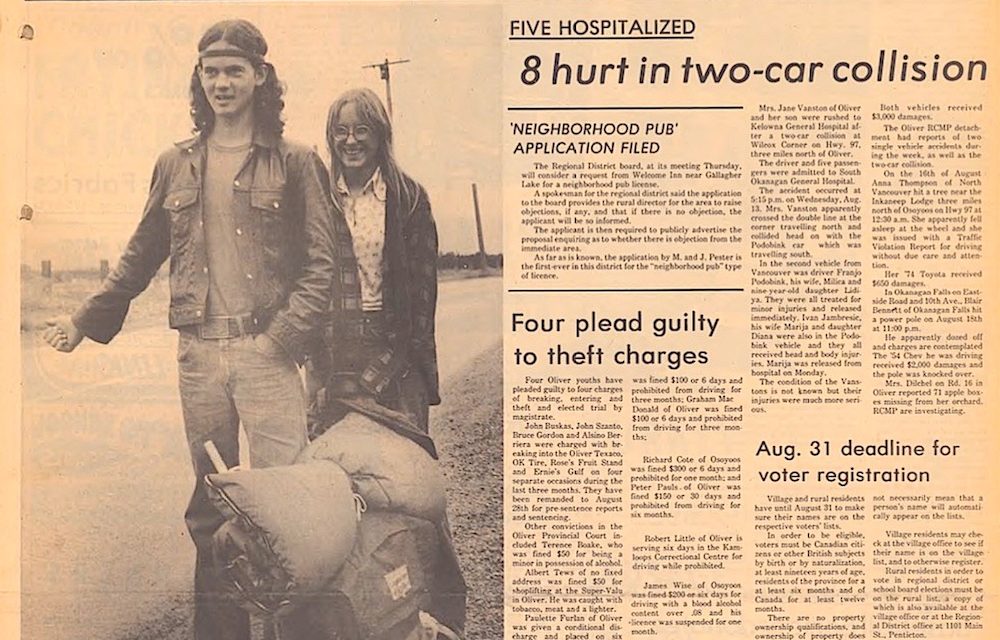
The history of the paper goes back to the late 1930’s when it was The Oliver Echo, established by H. and D.J Berryman. There is only one paper each from the years 1937, 1938 and 1939 that survives in the archives.
Alec Wolff, who is an Archives Assistant and the primary individual on the front lines of this massive task, was hired as an intern a year and a half ago for this specific job. He continues to be there because of his unique skill set: “We really are lucky to have him,” Halsted said earnestly.
The project began in 2019 when Juliana Weisgarber was the Executive Director of the ODHS, and there were various other interns, before Wolff, whose task it was to scan the documents.
A crucial springboard for the project was the museum receiving a substantial $15,000 grant from the Canadian Heritage Museum Assistance Program, which paid for a state-of-the-art scanning machine that was up to this monumental task.
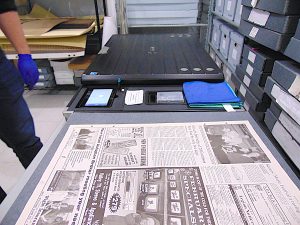
The scanner responsible with the task of the massive archival project. Sebastian Kanally photo.
This fancy scanner is not an ordinary scanner you have at home, it is large and is ideal for fragile documents. Since newspapers are a unique length and some of them very old, the scanner must be able to handle that.
Each and every page takes around 30 seconds to scan, then it takes another 30 seconds to save onto the connected thumb drive.
“Each page has to be treated as if it’s a unique piece of history,” Wolff said while he carefully picked up a page and placed it down on the scanner. He has to wear gloves, and place the pages into specific acid free boxes to preserve the fragile artifacts.
Every page is a piece of art, a unique view into the past, a fact which is not lost on anyone at the archives, especially Wolff. The papers must be treated that way and therefore the room with the scanner and where the action takes place, is climate controlled with an alarm for optimal preservation.
Wolff reflected on his role and the importance of the project: “The great thing about Oliver and its newspaper is that you’re almost certain to be either mentioned in the newspaper yourself or know someone close to you who has. I’ve seen through my digitization of the newspaper how much Oliver has changed just in the past 20 years so a project like this allows the long-time residents to reconnect with their local history and find old news articles which highlight the people and places they cherish (or loathe!) from the past.”
This is not a simple and easy task, it takes lots of time and very delicate attention to detail. Wolff has been working on the project for a year and a half and works out the math to be around 30,000 pages he alone has scanned.
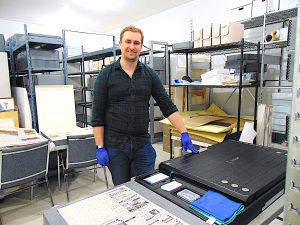
Alec Wolff is an Archives Assistant with the ODHS and is the primary individual on the front lines of digitizing the Oliver Chronicle. Sebastian Kanally photo.
Scanning is just the beginning though. Once pages have been scanned, Wolff takes the USB drive over to the computer and opens up an image editing software called Next Image Software. Here the program auto adjusts the contrast and colours to be ideal. Wolff then has to go into each and every one to sometimes crop some of the perimeter out, or adjust the crop if the image came out tilted.
Wolff breaks down the project into batches of each year of the paper’s history. After the process of adjusting all the images is completed he has to back up all the external hard drives and rename each of them. This is a huge amount of information, “it takes seven hours to back up the 1,200 images,” Wolff informs, adding it’s roughly equivalent to the size of one year of the paper.
Once the entire project is finished all of the digital files of all the years of the paper will be uploaded to the British Columbia Regional Digitized History (BCRDH) online database. This database is focused on preserving the history of the Okanagan and the southern interior and is an evolution of the Digitized Okanagan History project. These materials are open online for anyone to view for free.
The intended goal of the project is to make the paper “easily and freely available to anyone wherever they are in the world, in searchable online format irrespective of their ability to travel or pay,” Halsted said.
“To me this is the very embodiment of the role of a community archive; conserving local history, and enabling its contents to be considered and enjoyed as the communities of today and tomorrow seek to access it and learn from that rich past.” Halstead said reflecting on the project.
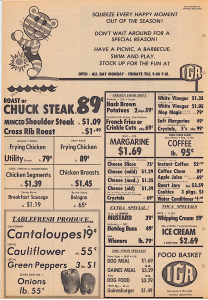
IGA ad from 1975 with food prices. Contributed photo.
This is also an expensive process because of how time consuming it is and why Halstead is extremely pleased with any grants and bursaries that can keep them and the project going.
They have a tentative deadline for finishing the scanning up to 2014 by September 1, 2023. But Halsted expressed that the project has already taken longer than they thought, firstly because of the pandemic and the problems with getting people in to scan pages. But also because the paper grew through the years.
What started in the 1940’s as a 15 page paper, grew to over 30, and with various Christmas supplements and larger papers, it is an enormous amount of pages that need to be scanned.
When asked why they undertook such a massive project, ODHS president Vance Potter, said that the project was prompted by a few different factors. First of all a fear that all the papers would be lost as a result of selling buildings that the papers had been stored in. In addition to this the money that they received for the new scanner prompted them to undertake the project.
Wolff addressed the importance of the project by saying, “this nostalgic reconnection is important to keeping the feeling of a close-knit community alive as new folks are introduced into our town, especially in the wake of COVID lockdowns.”
The archives are primarily supported financially by the Town of Oliver and the Regional District of the Okanagan-Similkameen (RDOS).They are responsible for chronicling and preserving the entire town of Oliver’s history. With only a few paid employees the archives depend on substantial volunteer help.
Speaking more generally about the work of the archives, the amount of material the archives has is enormous, boxes stacked everywhere. Wolff said “it’s not sexy work, but we just don’t have enough people to go through and file and organize all the resources they have.”
The first paper was Aug. 25, 1937 when it was The Oliver Echo. Following this, Aug. 19, 1942, was the first paper under “The Oliver Chronicle and Osoyoos Observer” banner. For 13 years the paper covered Oliver and Osoyoos up until 1955 when the Osoyoos Observer was officially dropped.
The Oliver Archives is located at 430 Fairview Rd, Oliver.