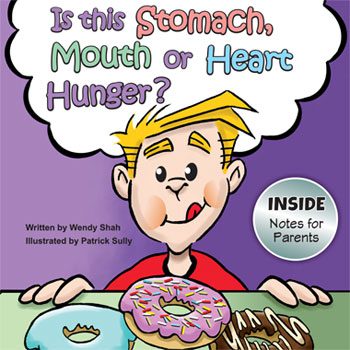
Wendy Shah’s new children’s book focuses on teaching children about healthy eating habits and letting them develop their personal self awareness around hunger. The book, ‘Is This Stomach, Mouth or Heart Hunger?’ asks this very question and follows the main character, Moe, as he tried to understands his own hunger.
Shah, who has been a clinical dietitian for 40 years now, developed a program with the help of a clinical psychologist in 2008 to help adults with their eating habits and how they can make healthy changes to their food cravings. The program ‘Craving Change’ is structured for health professionals who work with adults struggling to make positive eating behaviour changes.
“We came up with a program that not only covered issues about why it was so hard for people to change their eating but also what their specific personal triggers were, and cognitive behavioral strategies they could use to make some changes to reduce these eating triggers,” said Shah, who lives up on Anarchist Mountain.
However, as she met many adults through the program struggling with similar issues, Shah said she realized that this workaround building healthy eating habits needed to start much earlier in an individual’s life. And so she took on the challenge to write a children’s book.
“Based on my clinical experience, I have realized that our complex and personal relationship with food begins in childhood. Therefore, I adapted the most popular eating self-awareness technique of the Craving Change program for children in the form of an illustrated storybook,” she said.
The technique Shah refers to is in the title of the storybook—identifying whether the hunger one feels is from the stomach, mouth, or heart.
Stomach hunger is pretty self explanatory and is a physical need in our stomach for food. Mouth hunger is the craving for the sensory pleasure of eating food, like the smells, textures and tastes. Heart hunger, on the other hand, is a little bit more complicated, referring to the emotions that lead to eating. Shah explained that for some people this could stem from boredom, stress, loneliness, or a list of other emotions.
“For many people, they soothe themselves or they use food as a way to reward themselves. And again, there’s nothing wrong with that once in a while but if that’s what you constantly turn to and that’s affecting your blood sugar or your blood pressure or you’re struggling with your weight, there are other ways to respond to those emotions than with food,” said Shah.
Heart hunger also refers to eating behaviours that are simply learned since childhood. Shah uses the example of Christmas time being a season where many people experience heart hunger since they are used to eating a feast of traditional foods.
By starting to build this awareness around hunger and identifying the different types of hunger from a young age, Shah said she wants this to create healthy habits and eating patterns from a young age. This learning also applies to parents and caregivers as well to help their children on this journey.
All three types of hunger are normal, natural and there’s nothing wrong with experiencing them, said Shah. “There’s nothing wrong with eating for these other reasons but they could also maybe learn to be aware when they’re eating for what we now call mouth and heart hunger.”
“My hope is that children will be more in tune with their signals to eat and to develop responses that lead to a positive, healthy relationship with food,” said Shah. “The goal of the book is to provide children, and the adults who influence them, with a vocabulary to discuss their hunger and eating behaviours. For example, learning to identify ‘heart hunger’ and to find other options for managing emotions, other than eating, can be very helpful.”
The storybook is currently available for sale at the new stationery store The Happy Paper Parlor in Osoyoos or can be found online at www.cravingchange.ca/4kids.