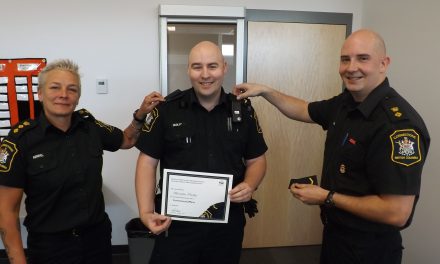
Todd Kunz has been a paramedic for 21 years, spending the past three and a half years serving the community of Osoyoos.
At an Osoyoos Rotary Club meeting last week, Kunz detailed the changes and challenges in his experience during the past year with COVID-19.
The Emergency Support Services (ESS) station in Osoyoos is staffed by mostly part-time and casual workers. Kunz stated that there are in fact only two full-time employees (including himself), and 14 part-time staff.
There’s a lot of dedication and hard work there, said Kunz, adding that many staff members are unable to leave town for months because “they’re living their life by carrying a pager and have to be able to respond.”
And with this level of work and stress, Kunz noted that there’s been a collective exhaustion within emergency services workers across the province.
“We will see a lot of burnout, a lot of book-offs, because people are just exhausted and don’t want to come to work anymore. So that’s been challenging throughout the province,” he said.
The ESS works closely with Interior Health, community health care teams and family physicians. They work to fill the gaps within the health care system and provide at-home care. When paramedics provide preventative medicine at someone’s home, it avoids more 911 trips, as well as long term stays in hospitals.
Kunz stated that their team responded to just over 2,000 calls in town last year.
“I think this year we’re already on track for more just because our COVID numbers have gone up, and with regards to emergency responses with COVID,” said Kunz.
Also with people unable to travel across the borders, there are more people who stayed in Osoyoos over the past year, causing the ESS call volume to skyrocket, especially through the lockdown period.
As for vaccine support, the ESS is still waiting for the provincial health order to allow them to help.
Although paramedics, as Kunz said, have been giving injections throughout their careers, the COVID-19 vaccine has a ton of logistics behind it, especially because of the cold temperature the vaccine must be stored at.
They would have to store them in small portable coolers, while also considering the transportation times, making the process very tricky.
Kunz said that as paramedics, they often get a lot of flack for why the vaccine rollout has been so slow.
“But there’s a lot of logistics behind it as I’m learning now with that process. It’s a tough one, because I still feel a need that we could be working harder to help Interior Health. But we’re not allowed to do anything until we get those provincial health orders.”
“So we don’t have the ability yet to go home and give that vaccine, but we’re told it is coming very soon. But we are and we’ll be doing vaccines in support of the clinics as well,” said Kunz.
They are also fully capable of doing COVID-19 swab testing at home for those who need it.
If they get a request, ESS can go into somebody’s home and give them a COVID-19 test if they’re unable to take themselves to a testing centre.
Kunz also mentioned that his team is seeing a change in the attitude of their patients who are becoming “more patient,” especially when compared to the beginning of the pandemic
“There’s a little bit more of a public education campaign of what to expect when they see a paramedic roll up. I guess they’re understanding there’s better communication skills with our 911 operators,” he said.