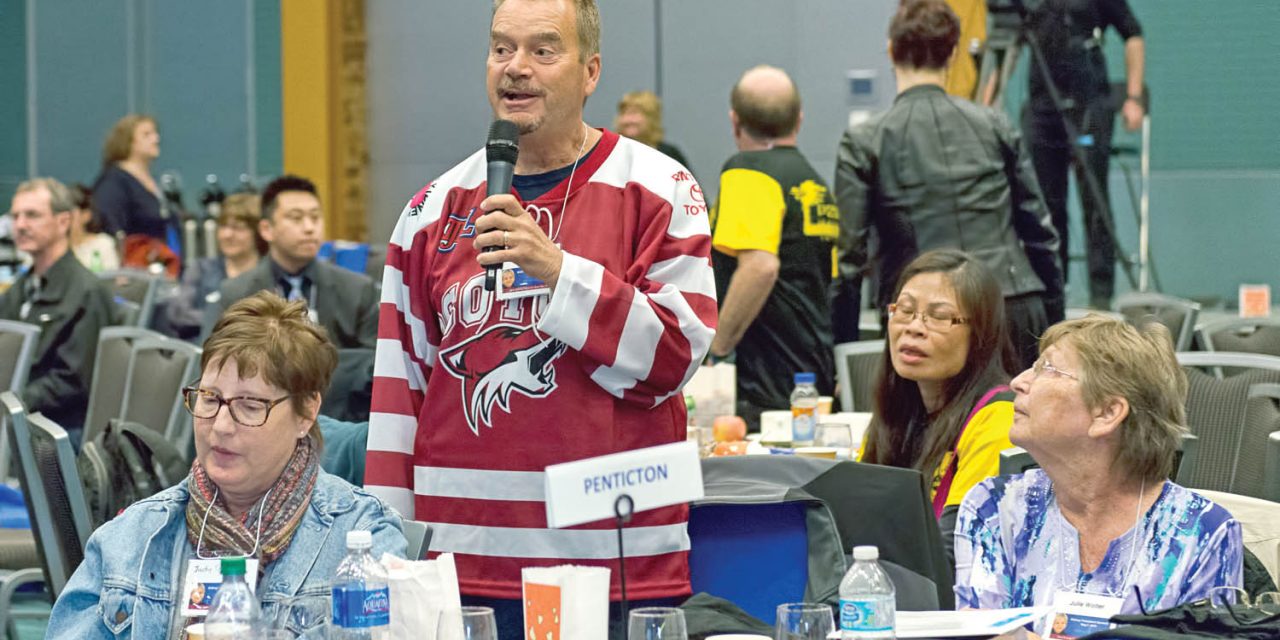
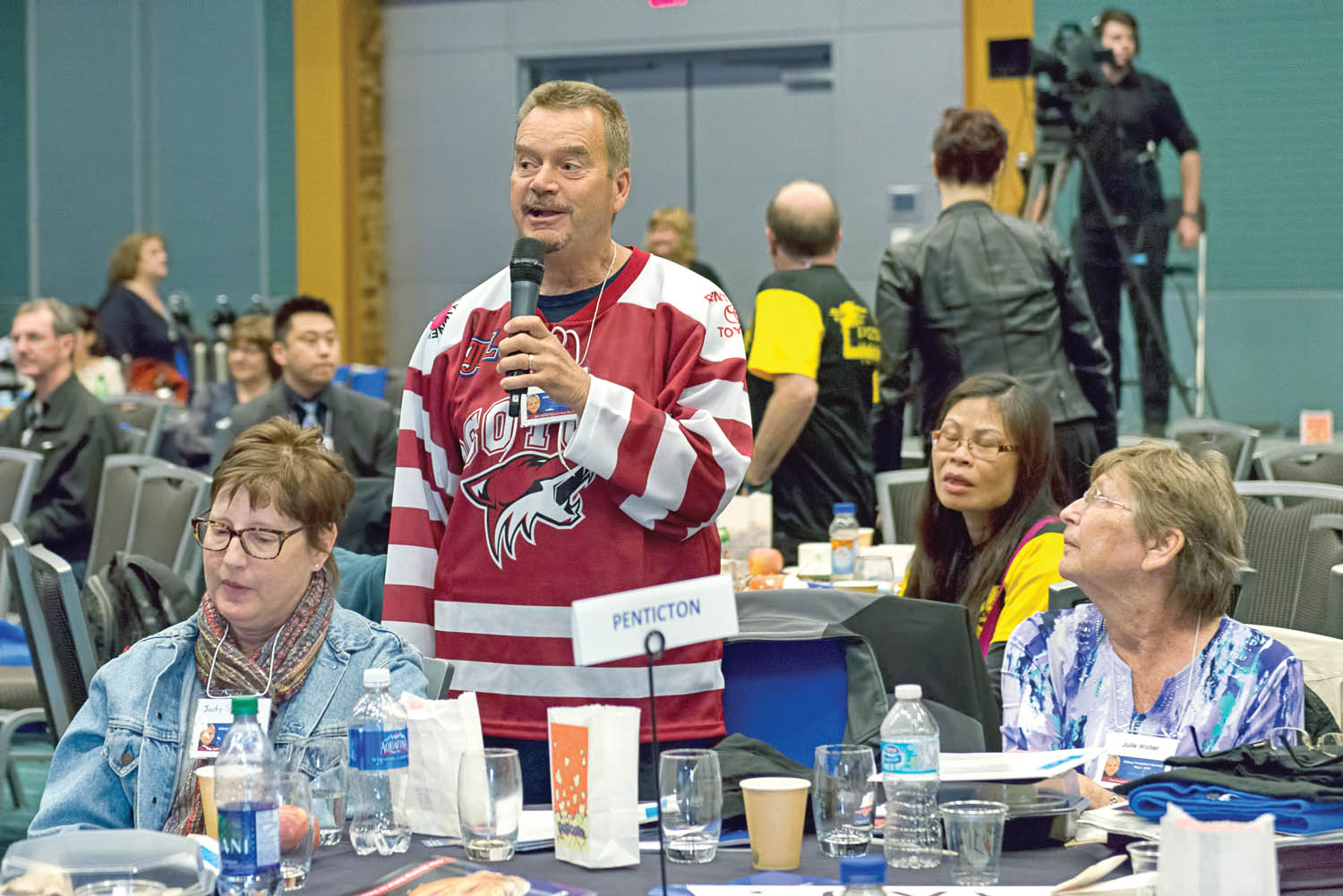
Wearing an Osoyoos Coyotes jersey with the slogan “Be the Kidney,” Brian Rawlings spoke at the Kidney Transplant Summit about Osoyoos Share Your Spare campaign. At left is Judy Sloan, who received a cadaver kidney and at right is Julie Wolter, who received one of Rawlings’ kidneys. (Tracy Riddell photo)
Three people from Osoyoos were guests at a Kidney Transplant Summit in Vancouver recently where they told about this community’s efforts to raise kidney donor awareness.
Brian Rawlings and Judy Sloan decided at the last minute to attend after earlier deciding the trip schedule would be too onerous for Sloan, who received a kidney transplant less than a year ago.
Julie Wolter, who received a kidney donated by Rawlings in March, joined them.
Wolter has been recovering from the operation in Vancouver so she would be close to the hospital if there were complications, but she has now been released and is back in Osoyoos.
The first-ever Kidney Transplant Summit was held May 1 at the Vancouver Trade and Convention Centre. It was hosted by the B.C. and Yukon branch of the Kidney Foundation of Canada.
Wearing an Osoyoos Coyotes jersey with a patch saying, “Be the Kidney,” Rawlings spoke at a roundtable event about how a group in Osoyoos has been working to eliminate the kidney recipient waiting list.
They achieved success when Wolter received Rawlings’ kidney. Rawlings had previously offered to give up a kidney so that Sloan could get one from a suitable donor under a paired exchange, but she obtained a kidney from a cadaver donor before the exchange could take place.
Rawlings said he and Wolter were interviewed for a CTV television news report and they were asked to act as though they were meeting for the first time since the operation.
“I was walking around the corner towards Julie and the cameraman was following me,” he said. “We acted and embraced each other and she started to cry.”
The conference included doctors, statisticians, policy people and a number of kidney donors and recipients, all with stories to tell, said Rawlings.
Among topics discussed was the issue of whether B.C. should adopt a system of “presumed consent” in which people who have not explicitly opted out of being organ donors are presumed to give consent for organs to be removed from them in the event of accidental death.
This led to a heated debate, Rawlings said.
Another topic was whether financial incentives should be provided to living organ donors. The consensus, he said, was that people didn’t want to see organ donation commercialized as occurs in some countries, but that compensating donors for expenses is reasonable.
The problem of a disproportionate number of aboriginal people not being helped by the system was also discussed, he said.
Originally Rawlings and Sloan were offered a chance to ride on a bus with a group from Penticton, but this would have meant leaving at 4:30 a.m. and returning the same night.
When they decided they couldn’t go, the B.C. and Yukon branch of the Kidney Foundation of Canada offered to fly Rawlings and Sloan down and put them up in a hotel.
“I wondered why they picked us,” said Rawlings. “There were so many compelling stories there.”
Despite the many stories on the human side from donors and recipients, Rawlings said one of the things that impressed him the most was when an economist broke down the costs of keeping a kidney patient on dialysis compared to giving the patient a donated kidney.
A patient may be on dialysis for seven or eight years given current waiting lists at a cost of at least $75,000 a year, he said. The total cost then is considerably more than $500,000.
A transplant operation from a living donor costs $120,000 plus between $5,000 and $7,000 in follow-up costs. The savings with the transplant then are around $400,000, and this doesn’t even take into account the improved quality of life.
“I can’t believe this hasn’t become a political issue because somebody isn’t pushing from the top down and saying make this happen,” said Rawlings.
RICHARD McGUIRE
Osoyoos Times