Dear Editor:
History of Rep by Pop vs. first past the post:
Representation by population (Rep by Pop) started in 1840 between Upper Canada (Ontario) and Lower Canada (Quebec).
Quebec had the most population, but the founding fathers set the voting terms of the union, which joined the two and chose to use equal votes for both.
Quebec deemed this to be unfair and demanded Rep by Pop. After much wrangling, it was decided to have equal representation.
In 1851, Ontario began to grow and Central Canada would also increase. Now Upper Canada wanted to change voting to Rep by Pop. Quebec feared that this would lead to Upper Canada destroying their culture by assimilation.
In 1867, the federal system was created and with it came a guarantee that if Quebec agreed to Rep by Pop, it would receive a fixed number of votes, being 65, and not to fall below that number.
Fast forward:
Rep by Pop is still in use federally, but was supposed to have been solved by the Meech Lake Accord, but it failed to do so.
In our province, representation by population will severely impact on all our communities that are “beyond Hope.” (Those in the Interior).
We can’t compete with the population of the Lower Mainland.
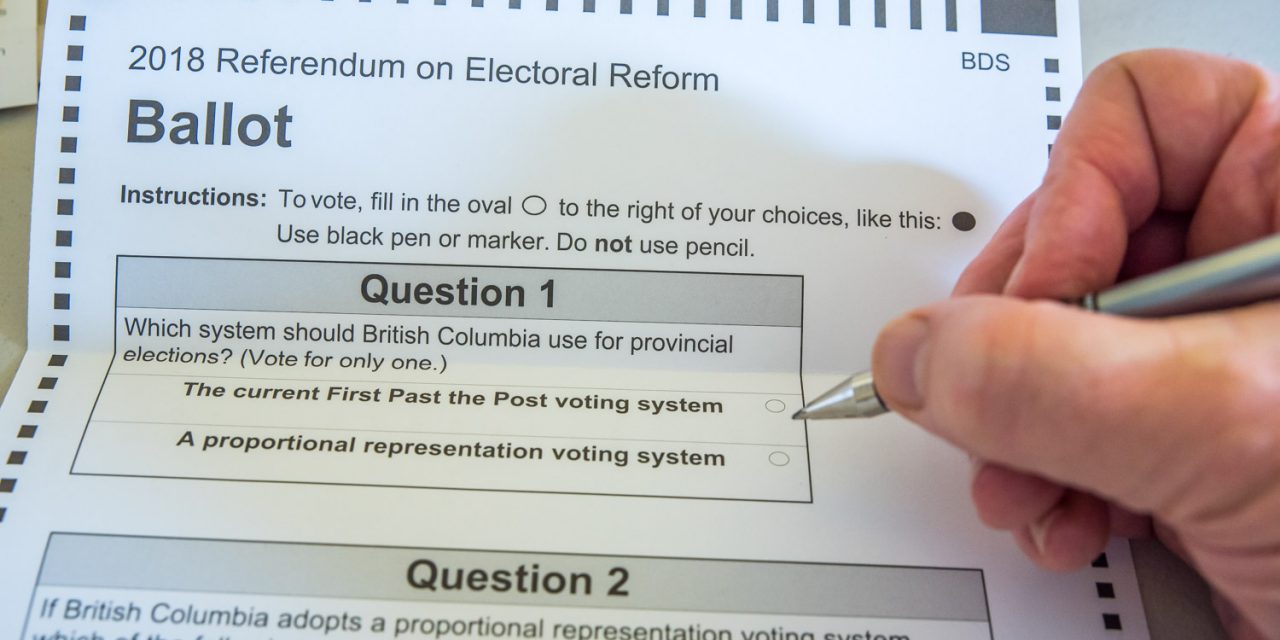
The referendum that was prepared for this vote was done in an unethical manner. Confusing for a purpose!
If you fill in the dot on the first question (an answer of “First past the post”) you don’t need to answer any more on the ballot – period! The rest is simply a smoke screen.
As an aside, referendums and voting are sometimes referred to as “this will be a real horse race.” The Kentucky Derby and the Queen’s Plate winners are both decided by “First past the post.”
Our current system has worked well for us. Let’s not monkey with it!
Fred Cawdell,
Osoyoos, B.C.