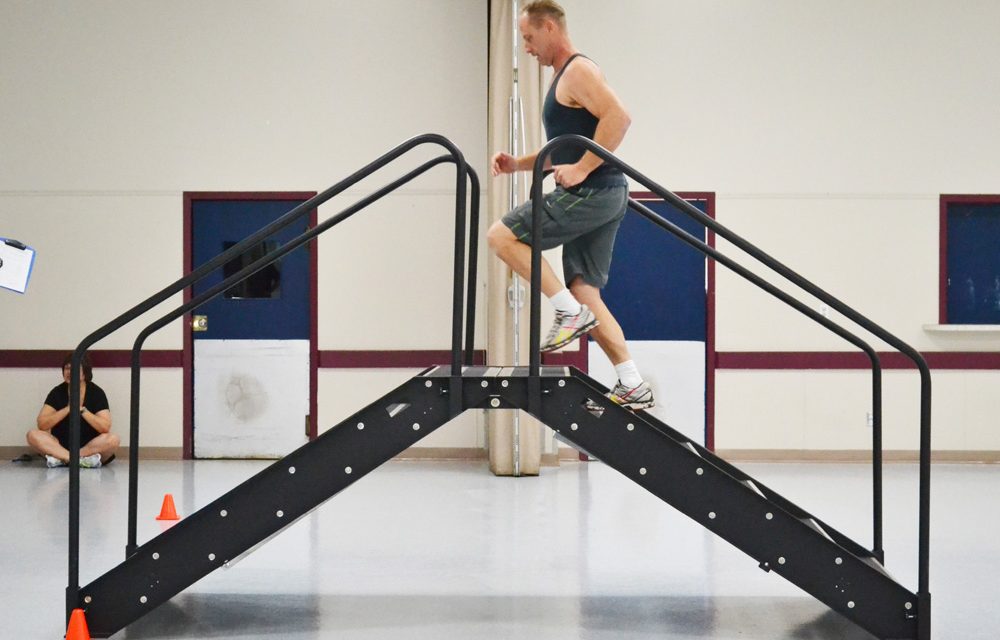

Andrew Strehl tackles the stairs during the physical testing session. Photo by Trevor Nichols
It starts with a sprint, around a course of orange cones, to the foot of a set of stairs.
You’ve got to make it up and down the stairs six times, touching each step along the way. Speed is essential.
By the time you’re done you’re likely already a little winded. Cheering and applause will be echoing in the hall as other test-takers waiting for their shot shout encouragements.
Now you’ve got to sprint to the mobility, agility and speed run. As a super-fit officer in an intimidating uniform directs you, you weave through a course of more cones, hurdling over three knee-high blockades along the way.
Now the push and pull station looms in your path. First you’ve got to push in a weight and strafe back and forth in a wide arc six times. You’re probably feeling the burn in your arms now, and you’re certainly getting even more winded.
Now pull the weight out and strafe six more times in an arch. The whole time, the burly officers yell at you.
“Push it. Come on, you got this. Good time, good time; you’re making good time. Come on, you got this.”
The crowd whoops its encouragement.
Now it’s on to the dreaded modified squat thrust stand. You’re probably really winded now, and your arms are still burning from the weights. But you hit the mat, chest down, then vault over a bar and drop to your back. Then back over the bar to your chest. Repeat nine times.
If you manage to finish, and you’ve done it in less than two minutes and 50 seconds, you get a short rest before you have to pick up and carry a 32 kilogram bag to a checkpoint and back.
Do that, and you’ve officially passed the Corrections Officer’s Physical Abilities Test (COPAT).
On October 24, 67 prospective prison guards, dressed in activewear and clutching water bottles, packed into the Oliver Community Centre to try their luck at the COPAT. The Okanagan Correctional Centre is set to open in Oliver in 2016, and with more than 100 guard positions up for grabs, this was the first opportunity for eager participants to take the test.
Steve DiCastri, the warden of the soon-to-be-opened facility, explains the COPAT is an important part of the application process. It’s been around for decades, and its goal is to ensure that recruits are up to the physical challenges that come with being a prison guard.
“It’s about safety. It’s about being able to get to an area to help officers, or to help an inmate. It’s about pulling a door open or pushing a door open. These little stations that you hop over, it might be a chair you have to get over, things like that,” he said.
On November 2 the job ad asking for applicants for prison guard positions at the new facility will go live. It’s a long, multi-stage process, but anyone who wants one of those jobs has to at some point pass the COPAT. This is why DiCastri first offered the test last Saturday, and will offer it several more times as he continues the hiring process, to make sure anyone interested has plenty of opportunities to pass.
On October 24, one of those people was Alphie Zupan. Zupan was one of the earlier people to take the test, managing to finish just under the 2:50 time limit.
“I wanted to see if I still got it,” a gasping Zupan said with a smile just after finishing the test. “It’s still there, but maybe a little tougher than when I was younger.”
Like everyone who took the test that day, she was surprised by how difficult it was, saying several times that the course was “way harder than it looks.”
Zupan considers herself quite fit, but she still made sure to train before coming to take the test. She said she spent a day running up and down stairs, carrying pieces of concrete around her house and hauling concrete.
She has every intention of becoming a guard, and said that money is her big motivation.
Andrew Strehl, a construction worker who also passed the test, said “curiosity” brought him to take the test, which he did to keep his options open. He also was surprised that the test was much harder than it looked.
“It gets really vigorous towards the end,” he said shortly after finishing.
“The problem is your nerves are up, so that takes a lot of your energy. Normally it wouldn’t be that overly tough but you’re nervous, so that’s half the battle.”
Strehl didn’t train specifically for the test, but he stays in shape by hitting the gym and biking.
Stevan Ellis also didn’t train for the test, but keeps himself in good shape by working out and running races such as the “Tough Mudder.”
Ellis said he thinks the test is deceptively tough because it is timed. The constant nagging in the back of your mind that you have to complete it in a certain amount of time is stressful, and makes it harder to concentrate on the tasks at hand.
DiCastri agreed with Ellis’ assessment. He still remembers when he first took the test back in 1985.
“You’re nervous. Because you want the job, you’d like the job in the field. It is nerve wracking and a lot of pressure,” he said, adding that about 75-80 per cent of the people who take the test will pass.
By Trevor Nichols