By Don Urquhart, Times Chronicle
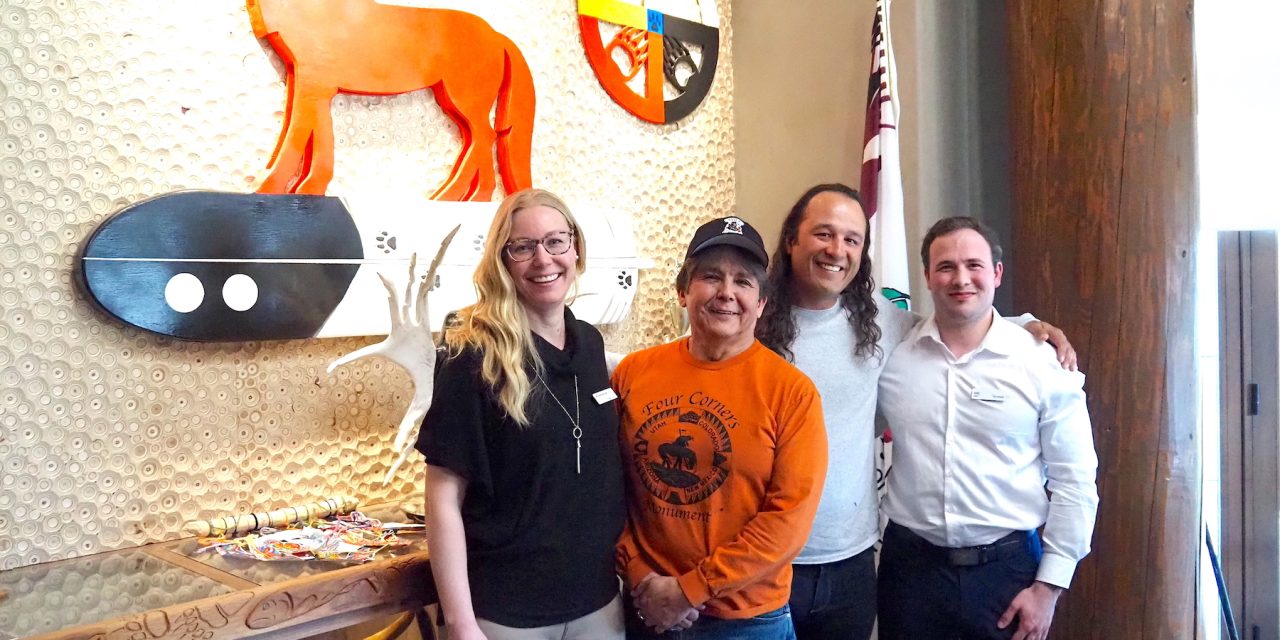
A medical supply chain company and its partner, a manufacturer of medical PPE, were in Oliver recently to present a social enterprise giveback worth $75,000 as part of their commitment to the Truth and Reconciliation Calls to Action.
Medical, Surgical and Safety Supplies Limited (MSS), an Indigenous-owned supply chain company, in partnership with PRIMED Medical Products, an Edmonton-based manufacturer of medical PPE, presented the $75,000 giveback to the Osoyoos Indian Band ($51,000), Lheidli T’enneh (LTN) First Nation ($18,000) and the Kelowna General Hospital (KGH) Foundation ($5,000).
“This initiative highlights MSS’s commitment to supporting Indigenous communities, advancing Economic Reconciliation and strengthening Canada’s healthcare system through meaningful partnerships,” the pair said during an event hosted by the Osoyoos Indian Band (OIB) at its band office recently.
Specifically the initiative addresses Call to Action 92 (there are a total of 94 calls to action) which calls upon the corporate sector in Canada to “adopt the United Nations Declaration on the Rights of Indigenous Peoples as a reconciliation framework and to apply its principles, norms, and standards to corporate policy and core operational activities involving Indigenous peoples and their lands and resources.”
For PRIMED, a Canadian-owned manufacturer and supplier of industry leading medical PPE with over 30 years of supplying much of the Canadian healthcare market, this initiative is about working for supply chain equity within Canada. This is accomplished by returning 51 per cent of net proceeds as part of a social benefit program.
“We’re very, very proud to be partnered with MSS through the indigenous-owned distribution company based out of Hay River,” said Eric Brent, PRIMED representative. “Through this partnership, we’ve been able to introduce our co-branded nitrile exam glove and mask line,” he said.
“And that’s really the ‘why’ behind, why we’re here today. It’s about reconciliation, it’s about give back to the community. It’s about supply chain equity, and we’re very proud to be partnered with MSS on this journey,” Brent said.
James Heibert, MSS President said the company, which has been in business for 31 years, went on what he describes as “a reconciliation journey,” where they sought out indigenous bands across Canada to partner with and share revenues from their supply chain business.
Hiebert explains that as a certified social enterprise when the company enters into contracts, “we have to dedicate a certain amount to our partners so a certain amount of that contract every quarter gets distributed out in what’s called a social benefit giveback.”
The funds are doled out according to the amount of PPE that they’re selling into the Interior and Northern Health systems, tracking the amounts on a quarterly basis and then distributing the funds back out into the communities, Heibert explained.
He noted that Chief Clarence Louie of the Osoyoos Indian Band (OIB) understood what Heibert and MSS were trying to do and were one of the first nations to become part of it. “
Heibert says that like many people across the country they are participating in reconciliation and actively working to change their supply chain from “the typical American supply chain to a Canadian and Indigenous supply chain”.
“We’re happy to say now we’ve been able to do $175,000 in total social benefits to about eight different nations so far and we plan on doing more,” he added.
“I want to thank James for all his hard work and doing this,” said Louie adding that the OIB is always looking to engage partnerships. “We probably have more joint ventures than any other First Nation in the country, and of course, we’re actively involved in many health programs here in hospitals on our own reserve lands that they stole from us back in 1877 so we have a pretty close relationship with the hospital here.”
He added that every First Nation uses medical services, “we all use them, we’re all going to wind up in hospital one day,” he said. “We’re glad that James was able to work out some procurement because, of course, there’s a lot of money being spent by the government on health – it’s probably one of his biggest budgets, and First Nations need to be part of that supply chain in those budgets.”
Also expressing gratitude was Bettina Muller, Director of Philanthropy, Corporate and Community Giving at the Kelowna General Hospital Foundation who noted the value the foundation places on “building relationships, listening wholeheartedly, engaging in continuous learning and education and ultimately providing the goal of making our hospital safe for all members.”
She noted that with community support and now the support of MSS, “this represents an important step forward towards fostering inclusivity, cultural safety and meaningful change in healthcare for our region.”
Expressing his thanks for all those who attended the event, both in person and online, Louie added: “I always tell people that reconciliation starts with money and land – those two things.
“Doing land acknowledgments and hanging our flags at municipal hall or putting up artwork, those are nice gestures, but in order to improve the quality of life of First Nations people, everything costs money.
“Health providers don’t work for free. Teachers don’t work for free. Police don’t work for free. Nobody works for free, and neither should they. We need healthy budgets in order to provide any type of care and service to our people. So this money will go to a good cause. Thank you.”