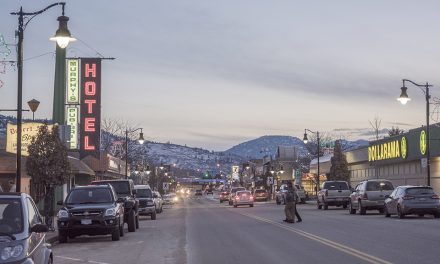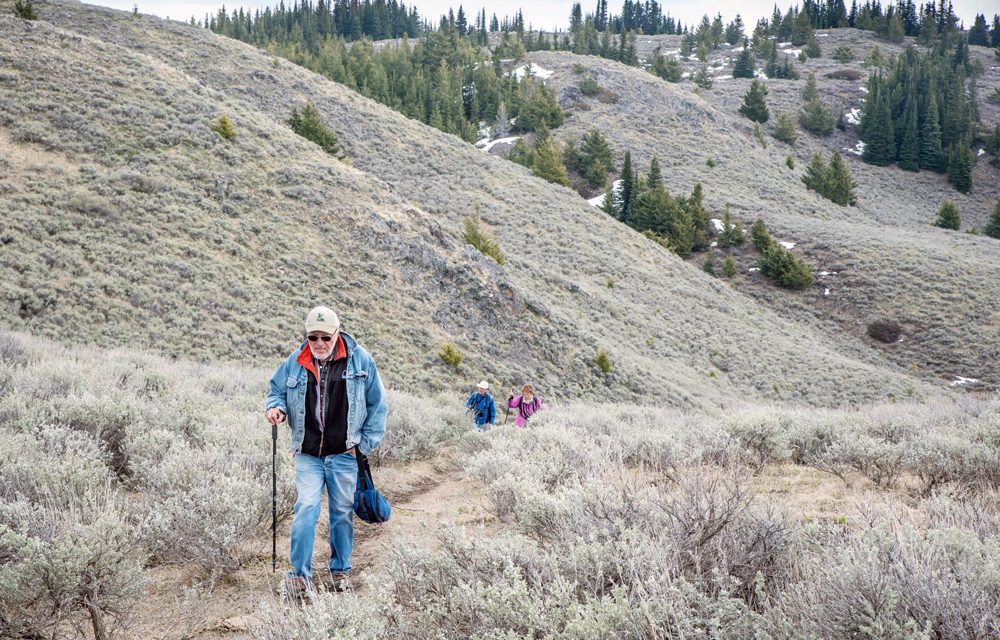

Harry Nielsen, Jim Wyse and Doreen Olson hike up Mount Kobau, which the province says it will exclude from any national park, regardless of the calls they received to include it in the feedback to the Intentions Paper.
Richard McGuire photo
The provincial government received 3,460 responses to its Intentions Paper on protected areas in the South Okanagan, but some of those responses will count more than others.
Much of the feedback on the pros and cons of a national park will be given less weight, or in the case of the widely made suggestion to include Mount Kobau in a national park reserve, won’t be considered at all.
Very little support was indicated for the province’s plan to make Area 2, which includes Mount Kobau, into a provincial conservancy, which offers less protection than a national park reserve.
Most of the organizations opposing a conservancy said they wanted that area included in a national park reserve instead – a solution the province has ruled out.
A government report released last week shows that 37 organizations made submissions, a majority supporting a national park reserve throughout the entire area in question.
The report, originally scheduled for release early in the year, is based on feedback the government received over 81 days following the release of the Intentions Paper on Aug. 13 last year.
The government’s next steps will be to consider the findings and prepare a report for cabinet, to continue engagement with First Nations and to identify any short-to-medium-term interim protection measures.
Park supporters are greeting the report with mixed reaction, some arguing the report is skewed, although the Wilderness Committee welcomed the release of the report and said it looks forward to the B.C. government sitting down with the federal government and First Nations to move the process forward.
Locally, the Osoyoos Wildlife Federation, a hunting and angling group, took a wait-and-see attitude.
“We are pleased the government agrees with us that wildlife and wilderness need protection,” said Aubrey White, past president. “The important questions have yet to be answered specifically – how the protection will be accomplished and who will do the protection. Until these decisions are made, we must reserve our judgment.”
The government was more interested in receiving responses to seven pre-determined questions about the boundaries and special considerations pertaining to three areas.
In addition to Area 2, which extends from Highway 3 north to beyond the road connecting Oliver and Cawston, Area 1 is south of Highway 3 and west of Osoyoos, and Area 3 is west of Vaseux Lake extending to White Lake.
Areas 1 and 3 are the only areas the government is willing to consider for a national park reserve.
Submissions dealing with the 2010 proposal for a national park reserve, “weighed far less in the analysis process than responses focused on the questions in the Intentions Paper,” the report said.
The analysis also factored the quantity of responses less than the quality of responses as they addressed seven pre-determined questions.
Of the 37 organizations responding, 29 supported a national park, six opposed it and two gave no answer on this issue.
Particularly contentious was the recommendation from 22 organizations that Area 2 should be included in a national park reserve.
The provincial government has ruled out that option completely, insisting it must become a provincial conservancy, which would provide a lesser degree of protection, but would allow such activities as hunting, off-road vehicles and mining.
While most responses to the government came from individuals rather than organizations, no quantification of opinions in individual responses is given.
“It is important to note that the comment process was not designed to be a statistically valid opinion poll or to measure about whether more people support or oppose the concept of a national park reserve in the area,” said the report.
“This feedback process was intended to reveal some of the specific issues and themes that people feel are important to consider when contemplating additional land protection measures in the South Okanagan.”
The report notes that only 411 of the individual submissions, 12 per cent, used the online form on the Intentions Paper website. And those who didn’t use the form often offered views that fell outside the seven pre-determined questions.
More than 3,000 other submissions consisted of emails and letters to Environment Minister Mary Polak, to B.C. Parks or to local MLA Linda Larson.
The majority of submissions, 1,972 in total, came through websites of the pro-park Canadian Parks and Wilderness Society (CPAWS) and the Wilderness Committee.
Additionally, 873 postcards were received using template language from the Wilderness Committee.
Private citizens also sent 167 submissions, primarily through email, which were not associated with mechanisms from the Wilderness Committee or CPAWS.
The government divided submissions from organizations into “local” and “non-local.”
It also looked at the “local” and “non-local” natures of individual responses, while acknowledging that the online submission format was not designed to capture the locality or respondents and the vast majority of submissions didn’t indicate the respondent’s residency.
Among 16 “local” organizations, 12 supported a national park reserve in Areas 1 and 3.
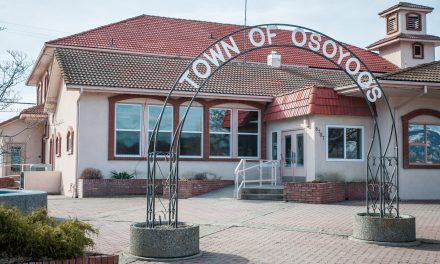
These organizations included Osoyoos Town Council, Thompson Okanagan Tourism Association (TOTA), South Okanagan Naturalists Club, Oliver Tourism Association, Destination Osoyoos, South Okanagan-Similkameen National Park Network (SOSNPN), Oliver Women’s Institute, the Nature Trust of B.C. and others.
Three local organizations, all aligned with hunting or ranching, opposed a national park reserve in Areas 1 and 3. These were the Osoyoos Wildlife Federation, the Okanagan Similkameen Stock Association and the B.C. Wildlife Federation – Okanagan Region.
One, the South Okanagan-Similkameen Conservation Program (SOSCP), an umbrella group representing organizations on both sides of the issue, did not give an answer on this question.
Nine of the local organizations opposed making Area 2 a provincial conservancy, arguing instead that it should become part of a national park reserve – a position the province has ruled out.
Only one local organization, Speak Up for Wildlife Foundation, a small and little known charity based in Penticton, supported the province’s plan to make Area 2 a provincial conservancy.
It, however, qualified this support to say that this would be under the proviso that there be no hunting, grazing or helicopter training – activities a provincial conservancy would normally permit.
Themes identified in the responses:
The need for connectivity, not only between the three areas, but also with other natural landscapes outside these areas;
Recreational use for hunting and fishing “was identified as important for many in the South Okanagan”;
Tourism;
The importance of ranching and grazing for economic benefit and as a land management tool;
Recreation use, both non-motorized and motorized, including hiking, hunting, wildlife viewing and camping;
Protection of biodiversity;
Economic benefit, whether through tourism and national park reserve designation or through current tenures such as ranching, forestry and mining.
By Richard McGuire