Donna Gordan (left) started last week as the new executive director of the Desert Valley Hospice Society. Lisa Calder (right) has been helping to fill in some of that role while also serving as DVHS program co-ordinator. (Richard McGuire photo)
The Desert Valley Hospice Society (DVHS) hopes its newly hired Executive Director Donna Gordan can help to increase funding for the organization that provides palliative programs for those at the end of their lives.
Ken Clarke, president of the DVHS board of directors, and Pat Wycherley, a director, gave a presentation recently to the Rotary Club of Osoyoos about the services DVHS provides.
“This is why we brought on our executive director,” said Clarke, responding to a question about grants and funding that DVHS currently receives.
“Very little comes right now,” he added. “We’re really looking forward to having somebody with a bit more expertise in this area to help us.”
Gordan started work June 7 and has a fundraising background with the Canadian Breast Cancer Foundation and has also worked in public relations, sales and marketing.
Clarke and Wycherley also spoke about the need for a standalone hospice in this area, but they said Interior Health is unwilling to provide funding for any more hospices.
DVHS has been providing programs in Oliver and Osoyoos for those nearing the end of their lives due to serious illnesses, as well as for their families and caregivers.
Recently DVHS expanded its service area to include Okanagan Falls.
Trained volunteers provide most services, but in addition to Gordan, staff includes Lisa Calder, program co-ordinator, who has been performing many of the executive director functions while the position was vacant.
Tracy McFadden, the previous executive director, left in the fall of 2016.
DVHS runs a Supportive Care Centre at 22 Jonagold Place in Osoyoos where some of its programs are run, including the Supportive Day Program, which offers support in dealing with serious illnesses as well as providing respite for caregivers once a week.
The facility can also provide accommodation for family members who are in the South Okanagan during the end of life of a loved one.
But DVHS doesn’t receive funding from Interior Health to provide hospice beds.
Instead, a small number of designated hospice beds are located at other facilities such as the South Okanagan General Hospital in Oliver, McKinney Place Extended Care in Oliver, Sunnybank Centre in Oliver and Mariposa Gardens in Osoyoos.
Clarke said this situation is not ideal.
The designated beds can also be used for other health needs, he said, so people may or may not get a palliative bed if they need it.
“They are not in the environment that we would like to see for people to have that calming environment at the end of life,” he said, suggesting a long-term aim is to provide this kind of service at the Jonagold facility, but without funding from Interior Health, the costs would be prohibitive.
“Interior Health has made it very clear that there is no funding for standalone hospices right now,” he said, adding that the cost of providing four to six beds would be between $800,000 and $1 million a year.
The initial step, he said, would be to provide overnight respite care, which would require a registered nurse to be there.
“We do have a vision to provide space for respite care,” Clarke said. “That’s our next step and we’re hoping to align with Interior Health somewhere down the road.”
Calder said the closest standalone hospice is in Penticton at the Moog and Friends Hospice House.
“Our folks if they do want a hospice residence they need to go to Penticton, which may isolate them from family and friends,” said Calder. “The hospice is very busy in Penticton and there is a wait list. Not everyone who wants to go to the hospice is able to go there before they pass away.”
Gordan worked as fundraising co-ordinator for the Canadian Breast Cancer Foundation from 2014 to 2016 before it merged with the Canadian Cancer Society. She was based in Edmonton.
But previously she worked for Russ Fons Public Relations in Las Vegas for nearly a decade.
The death of Russ Fons, the owner of the company in 2010, contributed to her desire to work in hospice care.
“Russ passed away and it was a lengthy illness,” she said. “I helped him through a lot of that. Then my mother passed away at the age of 94 and I was her caregiver. I helped her transition into her end-of-life journey.”
People who saw the care and attention she gave to Fons and to her mother, who died in 2013, told her she would be very good working in that field.
“So I took my heart and my head and merged them together,” she said. “I have a lot of sales and marketing and fundraising background, so it’s a nice fit for me and hopefully for this society as well.”
DVHS receives some provincial funding from BC Housing for its facility and it also receives seed grant funding for two programs, Clarke told the Rotarians.
RICHARD McGUIRE
Osoyoos Times
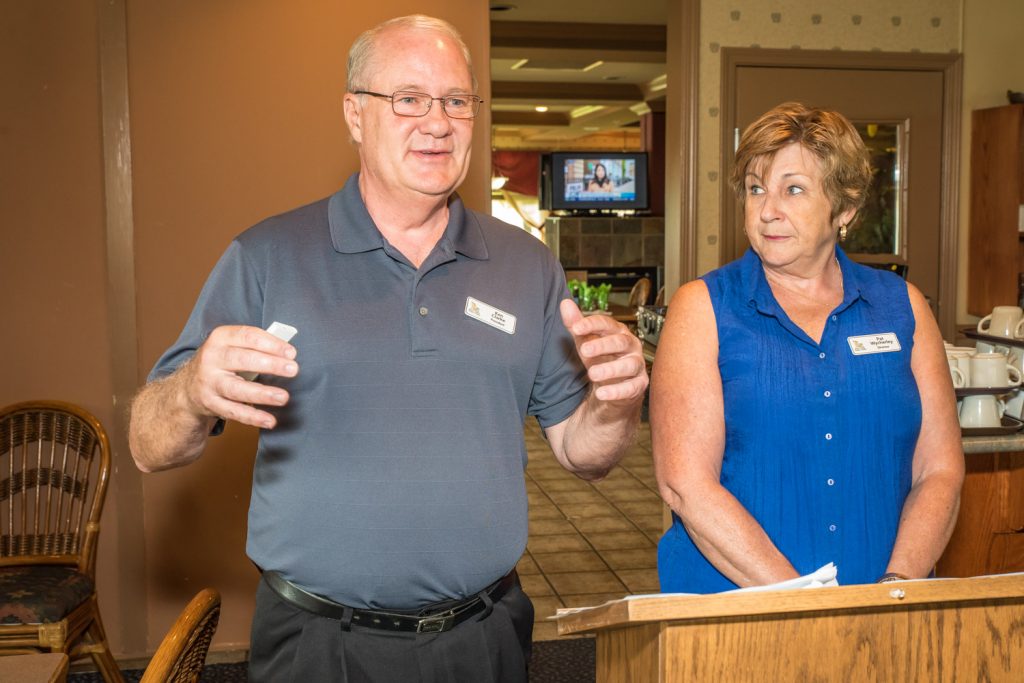
Ken Clarke, president of Desert Valley Hospice Society, and Pat Wycherley, a DVHS director, gave a presentation recently to the Rotary Club of Osoyoos about their organization. (Richard McGuire photo)