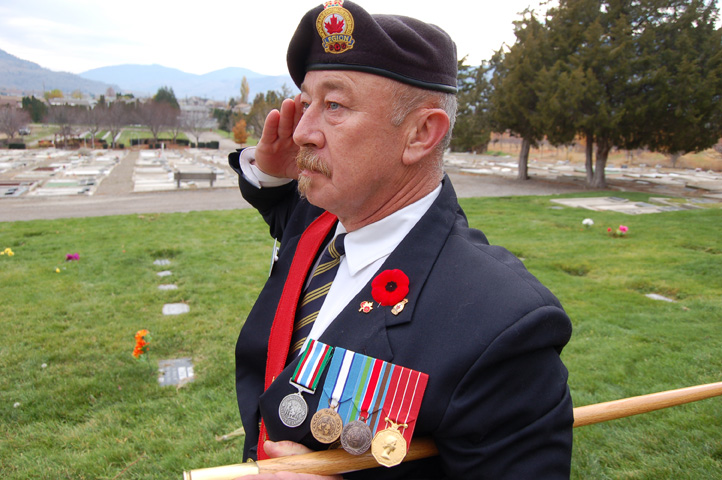

War veteran, Jim Stewart salutes the flag.
Lyonel Doherty photo
When Jim Stewart looked down at the awe-struck youngster staring up at him, time raced backward 43 years to the day he sat on the floor gazing at war veterans and their shiny medals.
It was powerful and surreal.
There he was again, a boy in wide-eyed wonderment, watching the former soldiers march into the school, medals clinking with every step.
“I know that look,” Stewart reminisced.
The Sergeant at Arms for the Oliver Legion was also moved by pupils who ran up to his Colour Party with paper and pens in hand, hoping to get autographs. One lad didn’t have a piece of paper, so he handed over his ball cap for a signature. The gesture reduced some veterans to tears.
“It’s moments like this that make all of this important. We’re getting the message out there,” said Stewart, now 50.
Flash back half a century to Waskada, Manitoba, a small farming community where he was born. When he was six, his family moved to Oliver. His father worked as a mechanic at the “Home” gas station, and his mother ran a bookstore in town.
Stewart joined the Air Cadets in 1976 because of his family background – both of his grandfathers served in the Second World War, and his father served in the Canadian Armed Forces in the late 1950s.
At age 17, Stewart spent spring break signing up for the Armed Forces. He would soon graduate from SOSS, but didn’t see any job prospects at the time.
“I saw the army as an opportunity to get educated and see the world, and possibly do some good along the way.”
Little did he know about the horrors that awaited him in Croatia.
He was barely out of high school when he left for basic training in Nova Scotia in 1981. Stewart initially wanted to be a pilot, but night vision problems foiled that dream. His second career choice was electronics because he was intrigued by his grandfather’s talent in fixing broken radios.
Although basic training was hell (12 weeks of complete exhaustion and sleep deprivation), it prepared him for the real horrors that lie ahead.
Comprehensive training in electronics gave Stewart expertise in night vision technology and sighting systems in armored vehicles, primarily Leopard tanks.
Stewart saw his first tour of duty in Cyprus, where he spent seven uneventful months in a peacekeeping role.
“It was incredibly hot,” he recalled, noting it was 51 C the day they landed.
After taking a leadership course in battle school, Stewart was sent to Spar Aerospace in Ontario, where he was one of the first soldiers in Canada to be trained in thermal imaging technology.
But there was one significant drawback: “It made the same noise as a mosquito in heat, which attracted every mosquito in town,” Stewart chuckled.
He was promoted to master corporal and made section commander, and soon after was transferred to 3rd Battalion PPCLI, the same unit his father served in.
Six months later in August 1992, he was deployed to Croatia, where his horror story began. The Serb and Croatian conflict resulted in pure devastation; nothing was left as villages were completely demolished, Stewart said.
He noted the Serbs began what was called “ethnic cleansing,” the indiscriminate killing of the Croatian people.
The United Nations had established a cease fire line, and Stewart’s unit was assigned to patrol this zone to rid the area of weapons. Anyone caught with a weapon was arrested on the spot.
“It was high stakes, high stress . . . you were always watching your back,” Stewart pointed out.
His unit tried to restore civility between the two factions, but it was difficult.
The silver lining came when they pulled into a new town and the villagers came out to greet them with bread.
“These people had nothing, but they gave us bread, and we would break bread with them and develop their trust.”
Near the end of their duty, the Serb army started getting “nasty” by laying booby-traps for the Croatians, said Stewart, whose eyes welled up with tears.
Stewart said the Serbs saw every opportunity to kill you by setting traps. For example, if you saw an abandoned AK-47 leaning against a tree, you didn’t go near it because it was likely rigged to an explosive device.
Stewart’s unit lost an engineer to a land mine that was set after his crew cleared a roadway to a small village. (On the return trip, the road had been re-mined.)
Stewart had one close call with a land mine. One of his comrades behind him yelled “Stop!” because he saw the glint of metal. Stewart’s foot was only an inch away from the explosive.
“It took a long time before I could walk on grass again.”
Stewart walked through endless devastation. He’ll never forget what happened to a new hospital in Croatian territory. “The Serbs decided that if they couldn’t have it, then neither would Croatia, so they killed everyone in it. The hospital was riddled with (thousands of) bullet holes.”
After seven months in that hell, Stewart returned to Canada and taught electronics to new technicians.
At that time the government was cutting back on the Armed Forces and offering soldiers early retirement.
Stewart never considered the offer until his captain told him he’d be going back to Croatia.
“I knew something had changed (in me). I was reacting differently to everything. It’s like everything flipped (upside down) in my life.”
Three months after returning from Croatia, Stewart began having nightmares and was later diagnosed with severe post-traumatic stress disorder (PTSD). And he’s not alone.
Every year 22 soldiers lose their lives to the devastating effects of PTSD.
Stewart was asked what he learned from his time in the military.
“I learned that when you sign the dotted line, you’re signing a blank cheque to the government of Canada for anything up to and including your own life.”
But his military experience made Stewart cherish the bond of brotherhood that transcends generations.
“A lot of veterans are brothers to me . . . there is nothing I wouldn’t do for these guys.”
Lyonel Doherty
Oliver Chronicle