Some fruit growers in the South Okanagan have suffered major losses due to extreme heat this season.
Glen Lucas, general manager of the BC Fruit Growers’ Association (BCFGA) said that cherry crop loss is on average 50 to 70 per cent due to the unprecedented heat wave that reached 45°C last week.
The extreme heat broke daytime high temperature records all across the Okanagan Valley. Osoyoos saw a new record of 42.7°C, breaking its old record of 37.7°C set in 2000.
“Some farms have been totally wiped. Others are 50 to 70 [per cent loss of cherries]. And then some may be fortunate to not have as much damage but it does seem that damage occurred on all cherry orchards in the South Okanagan,” said Lucas.
However, the damage varies
between orchards. Different varieties as well are impacted uniquely.
Even neighbouring orchards are affected differently because they might have different irrigation systems. As well, within the same tree, there may be damage at the top but not the bottom, according to Lucas.
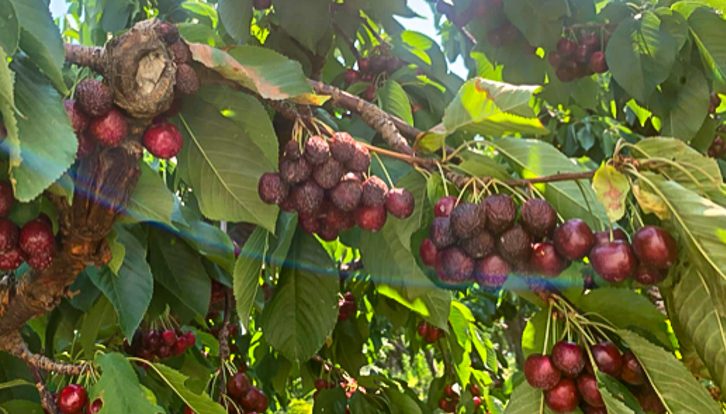
Heat makes a fruit sweeter, however, the extreme heat can damage the cherries.
Catherine Sandhu at C&C Orchards said they’re seeing their fruit, leaves and even bark on the trees burnt.
At the moment, Sandhu estimates that the cherry crop that’s lost due to the heat is about 40 per cent. Grapes and apples have also seen damage.
It softens [the cherries] a lot, so it gets very soft…they almost look like they’re dehydrated,” said Sandhu.
Aside from the damage to the actual fruit, the heat damage on different parts of the tree can be detrimental as well.
“I was in an orchard where all the leaves on the tree had turned brown and crispy; they were baked. So that’s not good, that weakens the tree,” explained Lucas. “There are diseases that can enter into a weakened tree. So maybe it didn’t die from the sunburn or the baking, it died of a subsequent disease that found it easier to invade.”
Damage to the bark and stems of the tree is a potential issue but isn’t obvious at the moment as there’s only been a few cases of this type of damage that the BCFGA is aware of currently.
The earlier season cherries are the one that have taken the hardest hit. The less mature, later season cherries haven’t yet been fully accessed yet.
“We’re hoping that those late season cherries don’t have as much damage. There will be damage to late season cherry crops, but hopefully not as high as 50 to 70 per cent,” said Lucas.
Sandhu noted there is about 50 per cent damage to the apples already. Though harvesting apples only starts at the end of August, Sandhu said their apples have brown spots from the heat wave.
“The apples get sunburned, and then we have to go through and remove all of them before they cause disease to the rest of the tree,” said Sandhu. “If you don’t pretty quickly go through those trees now and remove the fruit that was damaged, it will spread to the other fruit.”
During the heat wave, Lucas mentioned that growers benefitted from alternating how they watered their orchards.
“The other thing that helps is we’re hearing that if growers were able to switch their irrigation to one hour time blocks and shift between that throughout the orchard, each block would get watered for an hour…that helped to cool the whole orchard,” said Lucas.
“If they were able to rotate through and keep everything somewhat damp and keep that evaporation going, it seemed to help with the cooling.”
However, the situation now is to look at how to recover from last week’s extreme weather.
At the moment, many growers in the region are getting their orchards assessed by insurance adjusters for crop insurance, said Lucas. This helps growers decide whether it’s worthwhile for them to continue harvesting what’s left of the crop.
“That tends to be in the Southern Okanagan where they’re really scrambling to get that information to the growers,” said Lucas.
He added that growers will also be working with their horticulture advisors, and with their packing house quality control to get feedback on the quality of their cherries which may not be sunburnt but nevertheless have their quality impacted by the heat.