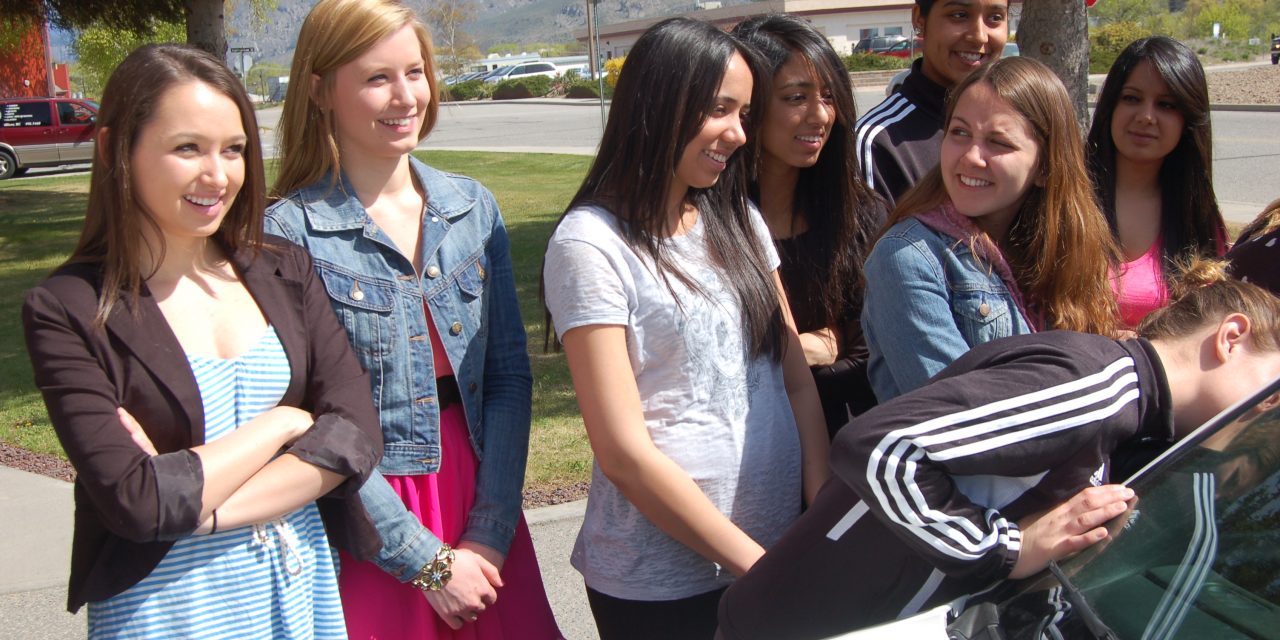

At top, Sgt. Ken Harrington talks to Law 12 students Courtney Marshall and Jenn Van Aller during a class tour of the Oliver RCMP detachment. Above, students huddle around a police car to see the latest technology.
 If there’s one lesson Law 12 students in Oliver learned the most last week, it was simple – don’t find yourself in the local “drunk tank.”
That’s what Sgt. Ken Harrington made very clear during a tour of the Oliver RCMP detachment.
“Once in here (police cells), life is pretty much miserable,” he told the students. “Once the iron door shuts, you are closed off to the world. There’s no phone, no TV . . . this is a place you don’t want to be in.”
Harrington said the cell has a toilet, but don’t expect any privacy since police can check on you at any time.
The commanding officer said 99 per cent of the students will never spend time in a cell, but those who act unruly are in for eight long hours of solitude.
“Don’t do drugs. Don’t steal. Don’t drink and drive, and don’t beat your partner.”
Harrington began the tour by introducing public service employee C. Hahn, who is generally the first person you see when you walk into the detachment. She explained how the Canadian Police Information Service Centre (CPIC) works by linking all law information agencies together in the sharing of data on crimes and criminals.
If you want to know about stolen vehicles, arrest warrants, criminal records, thefts and who’s on probation, CPIC is the place to go.
Hahn also said the detachment deals with disclosure questions. For example, people have a right to know what types of information the police have on them. They also handle court orders from judges.
Next on the tour was a visit with Cst. Joe Bayda and Cpl. Scott VanEvery, who work in the general investigation section for the region. These plain clothes officers investigate major crimes, including assaults and drug trafficking.
Yes, they kick down doors and arrest people.
Harrington said VanEvery and Bayda have a keen ability in knowing what’s going on in the community in order keep Oliver streets safe.
Harrington made an interesting comment when referring to Crime Stoppers, saying some drug dealers use it to report other drug dealers that they have grudges against.
The students also met Cst. Sue Harper, the detachment’s First Nations policing officer who deals with situations on native reserves in Oliver and Keremeos. For example, if there is a domestic assault, Harper will bridge that communication gap between the police and local First Nations.
“Sue is our bridge,” Harrington said. “Sue is able to identify victims of crime who otherwise wouldn’t report.”
A student asked Harper if she was the only RCMP member allowed on the reserve. Harper said no, explaining she can accompany another member to bridge that cultural gap between authorities and aboriginals.
The students were introduced to Cst. C Derksen, who showed them a police cruiser and all of the data that officers can access while driving. But isn’t that distracted driving? Precisely, which is why police officers receive advanced driver training in order to do all of that multi-tasking safely behind the wheel.
The students also learned about Victim Services and how this program assists people who are victims of crime, such as assault. The programs goes as far as helping victims prepare for court.
After the tour, Harrington told the students he has watched them grow up, saying it was a privilege knowing them. He said some of them will fall into disrepair in life, but encouraged any student to come in and see him if they need help.
“We (police) are not oppressive. If we are, we are not doing our job.”
Law 12 teacher Sarah Riordan said the tour allowed the students to see all of the different jobs that police officers perform.
“They got to see that the police are human, doing the best job they can.”
Student Brooke Cederholm agreed, saying they learned that police are not all scary and mean. “They do have a friendly side, and if you stay on that side, you will do well.”
When asked what she enjoyed most about the tour, Cederholm said the jail cells.
The student said she really respects people who choose policing as a career, but . . . “I don’t think I could be a police officer having to deal with angry people. I’m not good at that.”
Cederholm noted she would be better at handing out speeding tickets.
Lyonel Doherty
Oliver Chronicle