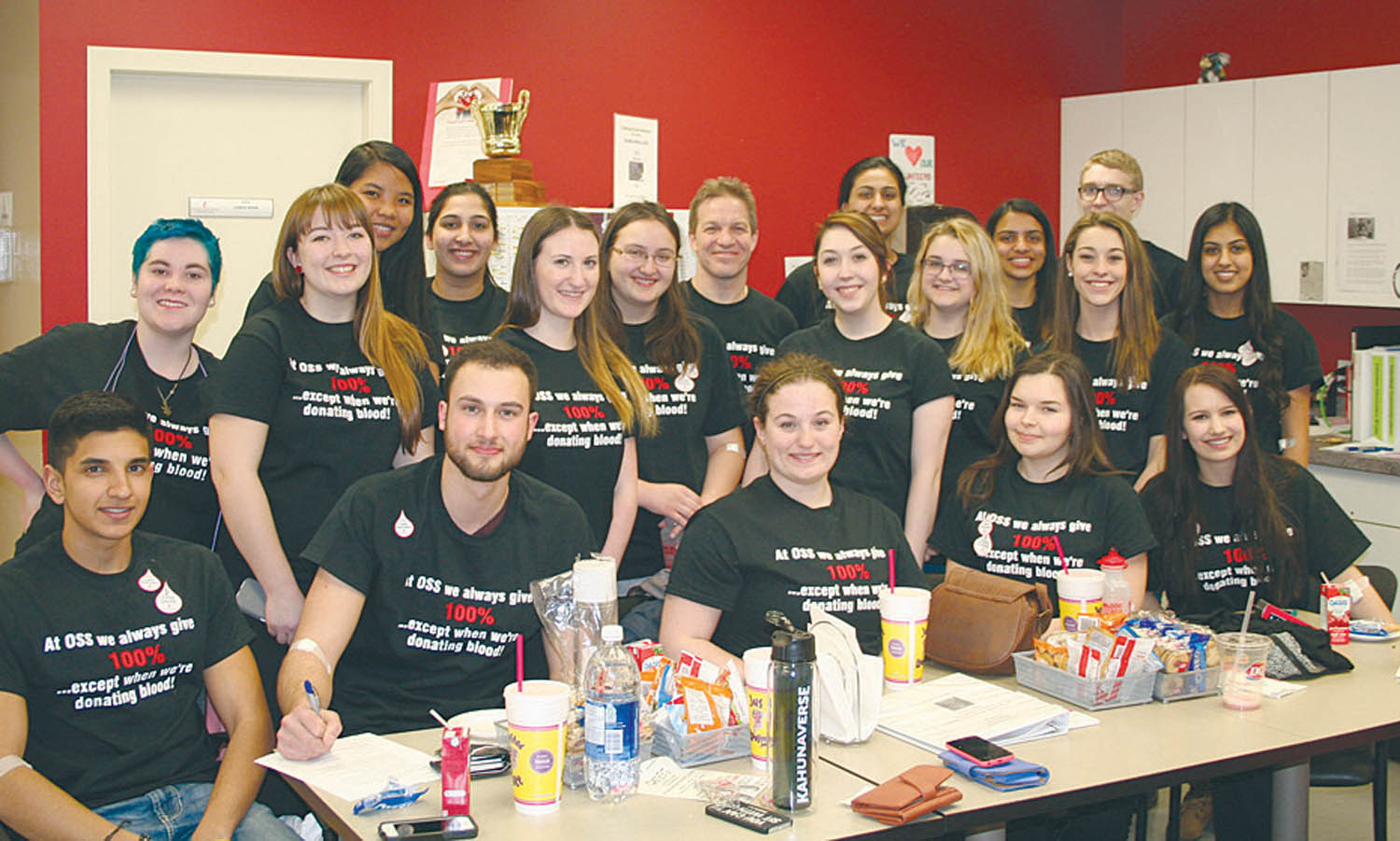
The Grade 12 class from Osoyoos Secondary School recently travelled to Kelowna to participate in a blood donor clinic organized by Canadian Blood Services. Longtime OSS biology teacher Peter Gajda (centre back row), who has been donating blood since he was 18, accompanied the first-time donors during their memorable excursion to Kelowna. (Cailun Mocci photo)
Several Biology 12 students traveled to Kelowna several weeks ago to donate blood for the first time.
Longtime Osoyoos Secondary School biology teacher Peter Gajda, who has been donating blood since he was 18, accompanied these first-time donors.
With 54 donations up his sleeve, Gajda aimed to encourage his students to strive towards the same attitude in blood donation.
The process to donate blood was a rather short process for many of the students due to some precautions regarding hemoglobin levels.
The Canadian Blood Services has policies in place that don’t allow people with low hemoglobin levels to donate blood because it could negatively affect their health.
For many students who were rejected for their low hemoglobin levels, the next date they are eligible to donate is in late April.
Gayle Voyer, whom oversaw the high school trip to the clinic, said the extended time line for young patients to try and donate blood after being rejected is mandated to allow the patient enough time to build their iron levels to a reasonable rate (125 being the minimum level in both males and females).
The process to donate includes a screening process. This process is in place to ensure it is safe for the donors to donate and safe for the recipients who receive the blood.
Some of the students were referred to a nurse due to low hemoglobin levels. The nurse will then suggest options for those donors, including iron rich foods and further information if required.
Jaden Cline, an Osoyoos graduating student, was eager to donate blood to try and help others.
Cline was the first from the group of Osoyoos students to donate blood, kicking off an afternoon of excitement. Within 10 minutes Cline was finished and directed towards the “cookie table”, where students go to regain blood sugar after donating blood.
Cline described the experience as “a little discomfort, but not bad.”
Young donors aged 17-24 account for 19 per cent of the blood donations nationally, said Voyer, who added young donors are always welcomed and encouraged to donate blood and other blood products.
With an aging donor base, it is important to provide educational information to youth so that they can make an informed decision to donate, said Voyer.
Four high schools in the Kelowna area already participate in four to five blood drives each annually with about 20 to 50 people per drive, said Voyer.
Voyer finds that youth giving back to their community is “inspiring” and urges those to carry on this attitude as they get older.
With thousands of people needing donor blood each year, it is essential that healthy Canadians continue to donate blood and blood products, said Voyer.
Not only could you possibly be helping a stranger in need. But you could also be helping a family member or friend in the future, she said.
While the screening process might omit many potential donors, it’s all for the good cause that leads directly to lives being saved, she said.
One donation can help save a life and with the whole donation process lasting less than an hour; it’s an experience that everyone should try once in his or her life if eligible, she said.
Gajda urged the other schools to follow in the path of Osoyoos Secondary School and organize blood donation drives.
Participating in events like this are a glowing example for young people to get involved in positive action and bring a positive reputation to the teenage generation, he said.
To get involved, contact your local blood donation centre or clinic and book an appointment at www.blood.ca.
To check your eligibility in advance of your donation, visit www.blood.ca/en/eligibility-quiz or call 1-888- 236-6283.
Cailyn Mocci is a Grade 12 student at Osoyoos Secondary School, who participated in the blood donation drive by classmates in Kelowna. She is also an aspiring writer and photographer.
CAILYN MOCCI
Special to the Times
This story has been corrected to indicate that the clinic was organized by Canadian Blood Services and not the Canadian Red Cross. We apologize for the error.