By Don Urquhart
Stepping into the Okanagan Art Gallery, aka the Hidden Door Gallery, always involves a degree of mystery and excitement. The non-descript glass door and narrow hallway adorned with small works of art are like a portal that spills visitors out into an alternate universe of artistic exuberance.
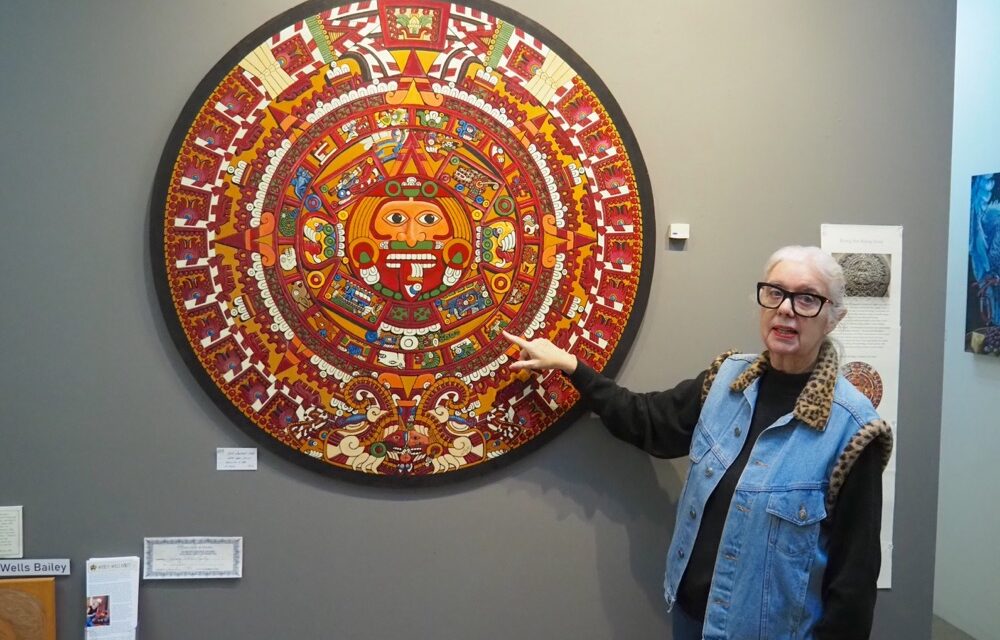
For the last few weeks and until Dec. 2 visitors transiting that portal from street to canvas are stunningly greeted by a giant Aztec calendar stone known as the tonalpohualli or “counting of the days”.
The stunningly detailed artwork in earthen hues immediately captures your gaze and pulls you, deeper and deeper into its beautiful web of complexity.
The large artwork, over a metre in diameter, is a 1/3 scale representation of the 3.3 metre diameter original, is the work of famed Meso- and Southwest-American artist Wendy Wells-Bailey.
The piece is one of the highlights of her extensive career as an artist that sees her artwork in collectors’ homes and corporate offices across North America.
Her work hangs in the Senate offices in Washington, in Marriott Hotels, the Mayo Clinic, the International Airport Phoenix, and most impressively as part of the Smithsonian permanent collection of American Women Artists which puts Wells-Baily’s work in the company of that of Georgia O’Keefe and Emily Carr.
Luckily for the South Okanagan, she now resides, and of course creates, from her home outside Oliver.
Her first brush with the Aztec Calendar Stone, or Piedra del Sol, came about when she was working for the Los Angeles Museum of Art doing sketches of Aztec temples on the Yucatán Peninsula.
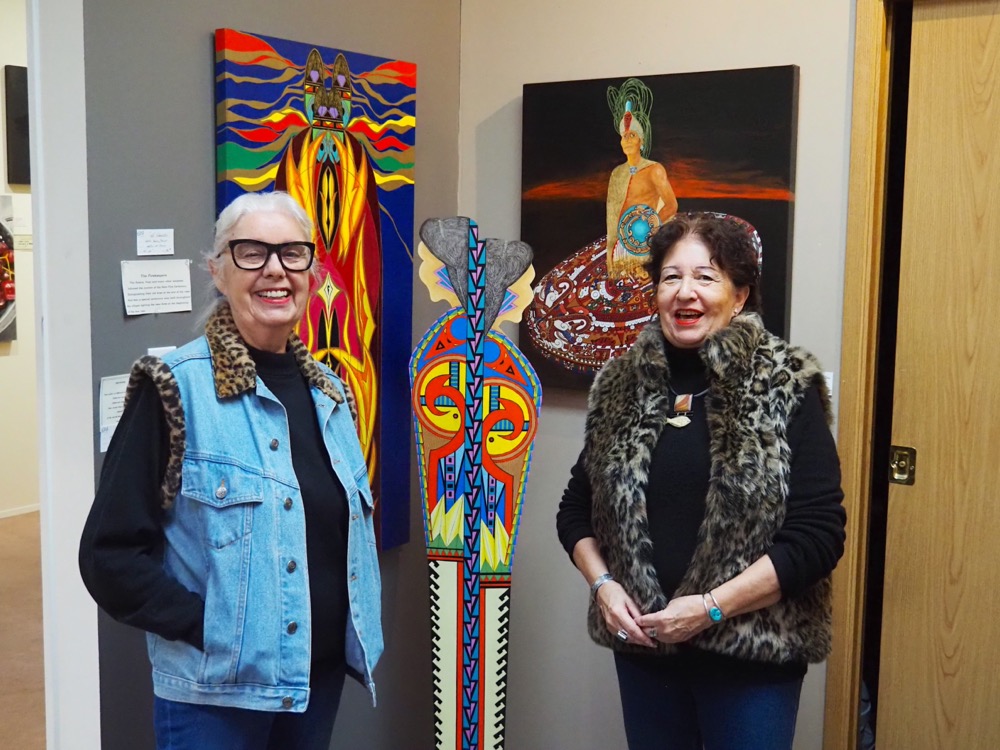
Wendy Wells-Bailey (left) with her sister Diane L. Carter-Brown.
It was there she met the team that was working on recreating the colours that once adorned this calendar stone weighing 22 tonnes and dating from 1,000 BCE.
Wells-Bailey explains that the stone was buried face down in what is now Mexico City’s main plaza, or Zócalo to hide it from Spanish conquistadors led by Hernán Cortés who ultimately played a key role in the demise of the Aztec Empire.
Rediscovered in 1790, work began in earnest from 1959 extending over the years to restore the stone.
The colouring of the stone was basically organic vegetable dyes which had worn off long ago, but enough was left on it and other similar stones to guide the work.
She spent three weeks with the team with the goal of helping to identify colours, the information which she would bring back to the museum.
“I was with them for three weeks and I wasn’t absolutely no help,” she chuckles. But they promised her that once complete they would send her a copy of the colour data, which came five years later.
The original stone, the last to be carved some 500 years before the arrival of the conquistadors, is “incredible to see”, she says.
Standing before her stunning reproduction which took 1,000 hours of drawing and 500 hours of painting to create, one can only imagine what the original must evoke.
The calendar is more than simply that, it was an almanac and a sophisticated component of Aztec life, a culture that was more advanced in some ways than their European colonizers and less advanced in others. It was a star chart, an agricultural guide, a religious instrument, and a historical record amongst other things.
Wells-Bailey says her first interest was in the pyramids of Egypt, “that was my big thing.” Introduced to South American cultural history with the Mayan temples around age 14 she became fascinated with early Americas cultural history, eventually writing her final papers on the subject at the London Art Academy.
It was also at the academy where she was influenced by the Fauvists, Cubists and Futurists of the 20th century, aspects of which influence her painting style to this day.
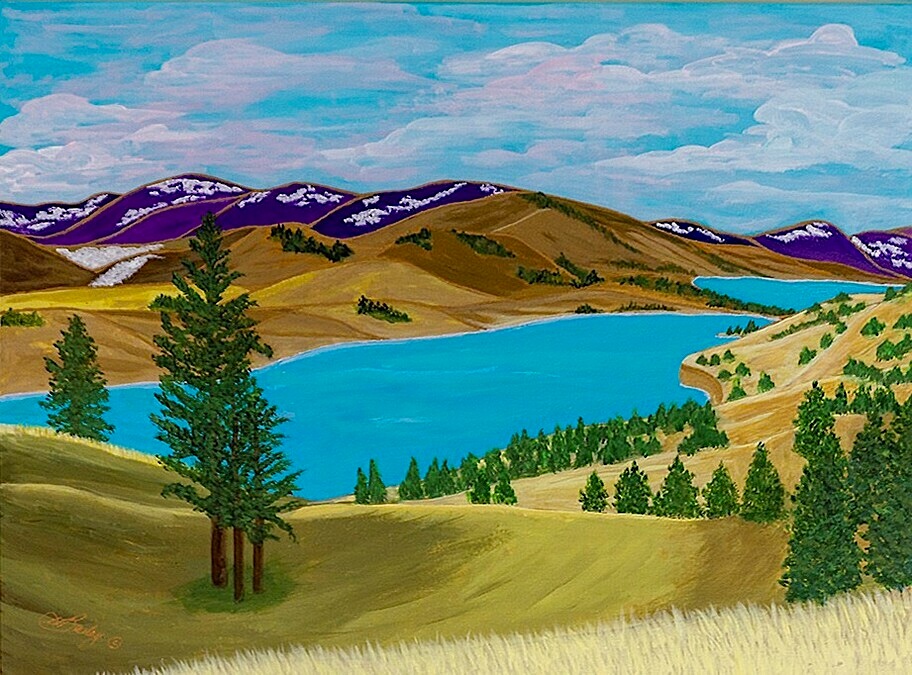
Skaha Solitude by Wendy Wells-Bailey.
But the 20-plus years she spent living in Arizona clearly had a formative impact on her artwork. “That was, you know, a big period, doing shows all around the country.”
She laughs that in her early days, she had this kind of deal going, “I basically did it as a trade. If I needed four new tires for my car I did a painting.”
That was then, this is now and her most recent foray has been into “freestanding paintings”. Painted on heavy metal vertical “canvases” they feature paintings on both sides with Wells-Bailey laughing that they are perfect “when you have too much art on your wall!”
Some feature ponies, others people, “they’re, different races, different religions, they’re looking in a different direction, but all these are Hopi [Native American] symbols,” explains Wells-Bailey’s sister Diane L. Carter-Brown.
“And here’s Wendy’s eagle, which is the heart and then we have rain. And here we have corn, or maíz with a rainbow around, so we are all thinking the same thing. We all need the same thing, we all need love,” she says pointing to the various pieces.
Picking up the thread Wells-Bailey says: “Imagine if everybody, because we’re the same inside doesn’t matter how we look on the outside, imagine if we could live as one in harmony.”
Her sister then asks if she’s quoting John Lennon to much laughter.
And of course, her paintings cover a range of other subject matter as well such as flowers and landscapes, many reflecting scenes of the South Okanagan.
Wendy Wells-Bailey’s show at the Okanagan Art Gallery is on until Saturday, Dec. 2 (final day) located at 302 Main St, Osoyoos. Her artwork can also be viewed on wendywellsbailey.com. The gallery will be hosting its First Friday event this Friday, Dec. 1 between 5-7 p.m. featuring wall-to-wall art, artists on site – some of whom are creating during the event – music and wine and cheese.
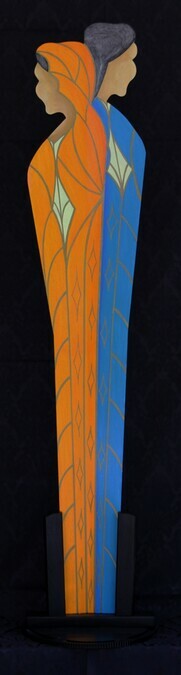
Harmony by Wendy Wells-Bailey.