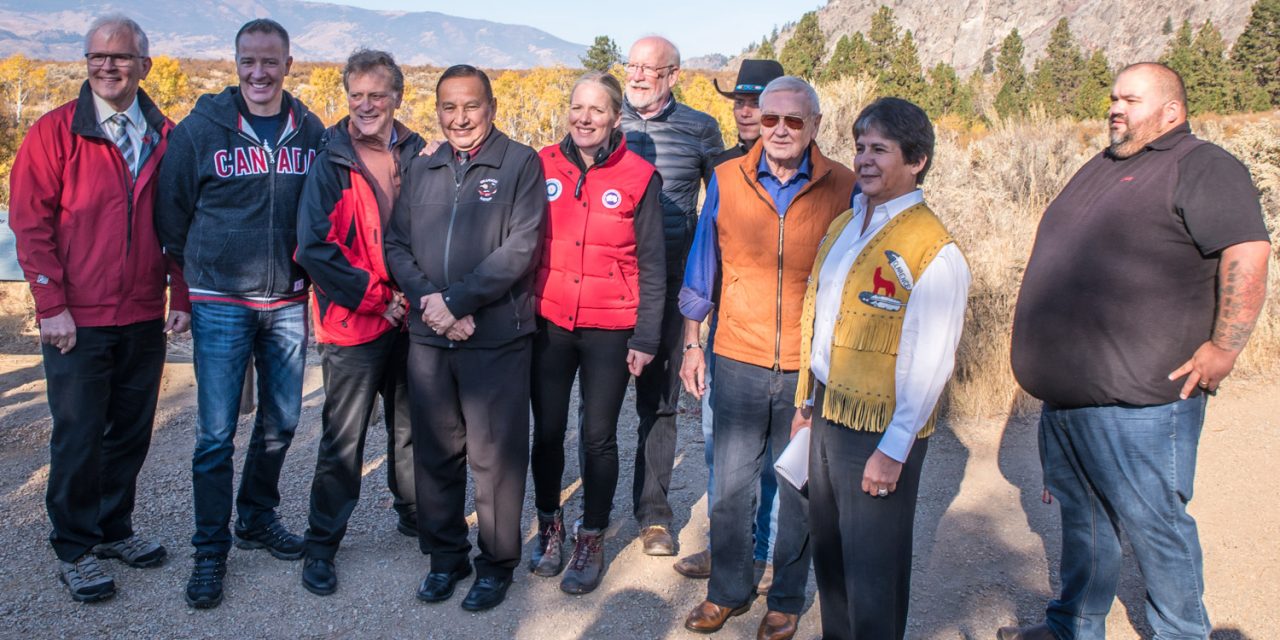
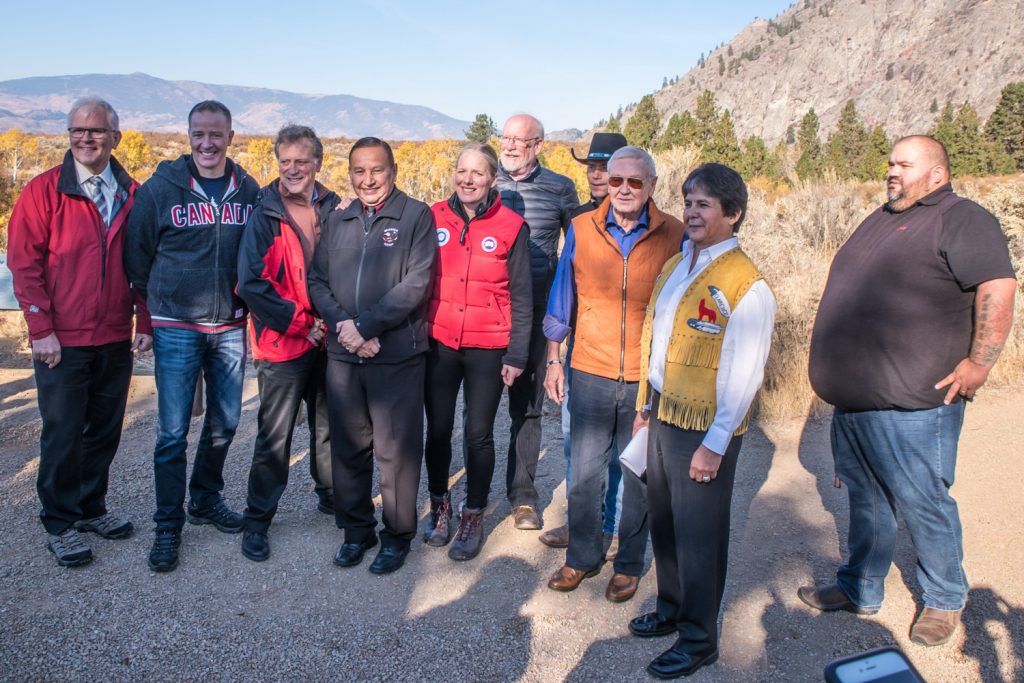
Following the formal announcement of a new tripartite effort to establish a national park reserve in the South Okanagan, politicians from federal, provincial and First Nations governments and opposition posed for a group photo. From left are: Wayne Stetski (NDP MP Kootenay-Columbia), Stephen Fuhr (Liberal MP Kelowna-Lake Country), George Heyman (NDP B.C. minister of environment and climate change strategy), Grand Chief Stewart Phillip (president of the Union of B.C. Indian Chiefs), Catherine McKenna (Liberal federal minister of enviroment and climate change), Richard Cannings (NDP MP South Okanagan-West Kootenay), Chief Chad Eneas (Penticton Indian Band), Ross Fitzpatrick (retired Liberal Senator), Chief Clarence Louie (Osoyoos Indian Band and Chief Keith Crow (Lower Similkameen Indian Band) (Richard McGuire photo)
Three levels of government – federal, provincial and First Nations – announced Friday they are beginning planning discussions immediately as a partnership to establish a national park reserve in the South Okanagan.
Catherine McKenna, federal minister of environment and climate change, said this is the first time the three levels of government have worked together to establish a park in the South Okanagan.
“There have been fits and starts, some of them good, some of them not so good, but for the first time you’re seeing a political will to work together and to find solutions,” she said. “This is part of reconciliation.”
George Heyman, B.C. minister of environment and climate change strategy, emphasized that the three levels of government are full partners.
“I want to say today that the province of British Columbia is here to announce that we will be a full partner, with First Nations and the federal government, toward the establishment of a national park reserve in this area,” Heyman said.
The announcement took place Friday morning at the Nk’Mip Desert Cultural Centre, the same location where exactly nine months earlier the former B.C. Liberal Environment Minister Mary Polak announced tentative plans to re-engage with the federal government about a possible national park reserve.
The tone of the two announcements, on Jan. 27 and Oct. 27, was markedly different. In January there was no federal presence at the announcement and there was much less enthusiasm from a provincial government that had abruptly pulled out of talks six years earlier.
But while there were lofty expressions of enthusiasm for the beauty of the area, reconciliation with First Nations and for the commitment to renewed talks, Friday’s announcement offered almost no specifics.
There was no announcement of boundaries or even principles to be considered when establishing them.
There was no timeline given other than a commitment to start discussions immediately and try to get most of the negotiations done within two years.
“I am absolutely committed, and I know the Prime Minister (Justin Trudeau) is absolutely committed to getting this done as soon as possible,” McKenna told reporters.
And there was no talk of how a park might be managed, although there were broad hints that whatever is decided, First Nations will play a key role in management.
“The Okanagan language has to be part of this national park,” said Osoyoos Indian Band Chief Clarence Louie, who introduced the other speakers and shared his own love of national parks acquired when he spent a summer working at Kootenay National Park at the age of 16.
“National parks are a country’s gems,” said Louie, noting that national parks in both Canada and the U.S. have experienced initial local opposition before being embraced.
“It doesn’t take very long for people to realize it was the best decision ever made,” said Louie, who has supported a national park in the South Okanangan since 2002, when he and now retired Senator Ross Fitzpatrick proposed the idea to then Prime Minister Jean Chrétien.
Since that time, however, the Okanagan Nation Alliance and the provincial government both got cold feet at different times.
“Unfortunately, the last time the music died as a consequence of a very intransigent federal government and provincial government, who refused to engage on a tripartite basis,” said Grand Chief Stewart Phillip, a former Penticton Indian Band chief who has been president of the Union of B.C. Indian Chiefs since 1998.
“They said no, this is a bilateral process between the federal government and the provincial government and that is just the way it is,” said Phillip. “We said that’s absolutely unacceptable in today’s world and we got up and left the table. I can tell you with great certainty that we’re back.”
Asked by reporters if the project was stalled because of the previous B.C. Liberal government, provincial minister Heyman agreed.
“The previous provincial government just wasn’t interested in establishing a national park reserve of the appropriate size,” said Heyman. “I know in the past there’s also been issues about true partnership with First Nations being equal partners at the table. I think both those impediments are being removed today.”
Among invited supporters of a national park at Friday’s event, there was much enthusiasm and celebration.
“I’m tremendously happy,” said Doreen Olson, co-ordinator of the South Okanagan-Similkameen National Park Network (SOSNPN). “I said to somebody, it’s better than getting a new puppy.”
Olson said the previous B.C. Liberal government seemed to be moving reluctantly when it made its January announcement. Participants in Friday’s announcement seemed much more sincere, she said.
She’s not disappointed at the lack of discussion of boundaries at the announcement because she believes the governments will work for the best, she said.
Jessie Corey, terrestrial conservation manager with Canadian Parks and Wilderness Society’s B.C. chapter (CPAWS-BC) was also excited.
“I’m so encouraged by this,” said Corey. “It’s the biggest thing that’s happened for this park process in over 15 years.”
She said it’s most significant that all three governments are back together at the same table talking about the same thing.
“The fact that they used the word ‘immediately’ is a really big deal to get this process going,” Corey said.
Both Olson and Corey want to see Mount Kobau included in the national park reserve and they want to see connectivity throughout the park.
Corey said Mount Kobau is important for connectivity, it’s culturally important to First Nations and it will provide economic benefits from the park to gateway communities such as Oliver, Cawston and Keremeos.
Glenn Mandziuk, president and chief executive officer with the Thompson Okanagan Tourism Association (TOTA), said the park will be a huge boost for tourism not just in the South Okanagan, but throughout the entire region.
“We couldn’t be more happy in the tourism industry to see this process get back to the table,” said Mandziuk. “National parks have been proven to attract international visitation to a particular area. This park will enable us as a region to draw more visitation to the province of B.C. and particularly our area.”
But the ministers acknowledged that efforts will be needed to engage opponents of the park and to address concerns of existing users of the area.
Federal minister McKenna underlined the importance of helicopter training in her opening remarks, pointing to the need to ensure access.
Canadian Helicopters, a branch of HNZ, which operates a flight school in Penticton, has been a park opponent, fearing it would lose access to areas used for training.
“You have to bring everyone together and that is my commitment today,” said McKenna, adding that there’s an opportunity to work with ranchers and farmers.
“You have my commitment that I will work very hard, that I will listen to everyone,” she said. “I know there are a lot of different perspectives. That’s normal. That’s good.”
Heyman agreed, saying the interests of different users such as ranchers, helicopters and recreation users need to be accommodated while protecting the important ecological values.
“I believe that can be done if we engage in partnership in good faith discussions in an open and transparent way,” said Heyman. “That’s exactly what the provincial government intends to do with our partners.”
RICHARD McGUIRE
Osoyoos Times
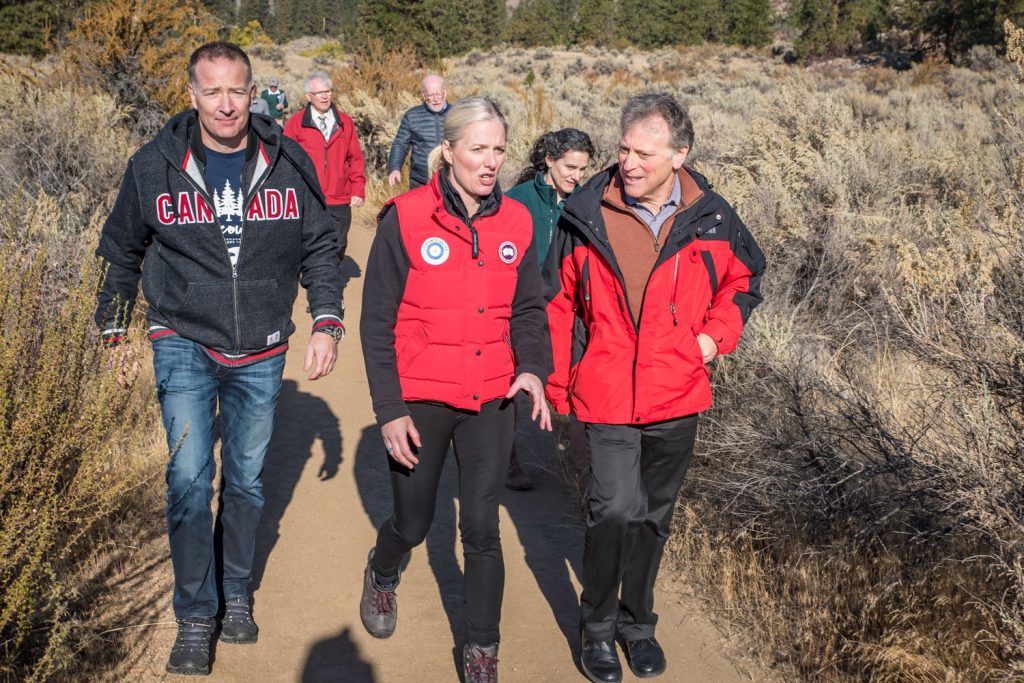
Catherine McKenna, the federal minister of environment and climate change (centre), chats with her provincial counterpart, George Heyman, as they take a hike in the grasslands following the announcement of reviewed efforts to achieve a national park reserve. On the left is Stephen Fuhr, MP for Kelowna-Lake Country and behind McKenna is Richard Cannings, MP for South Okanagan-West Kootenay. (Richard McGuire photo)
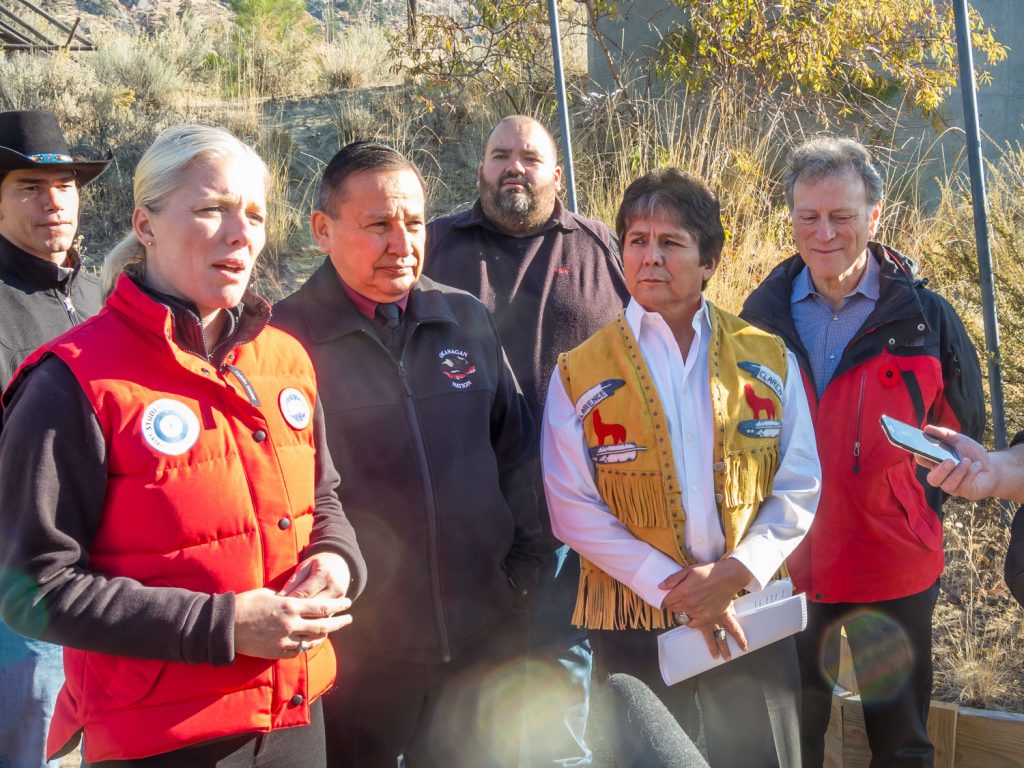
Catherine McKenna, the federal minister of environment and climate change (left) responds to a question during a media availability following the announcement of a renewed commitment to develop a national park reserve in the South Okanagan. To the right are Grand Chief Stewart Phillip, Osoyoos Indian Band Chief Clarence Louie and George Heyman, B.C. minister of environment and climate change strategy. In background are Chief Chad Eneas of the Penticton Indian Band (far left) and Chief Keith Crow of the Lower Similkameen Indian Band (centre). (Richard McGuire photo)