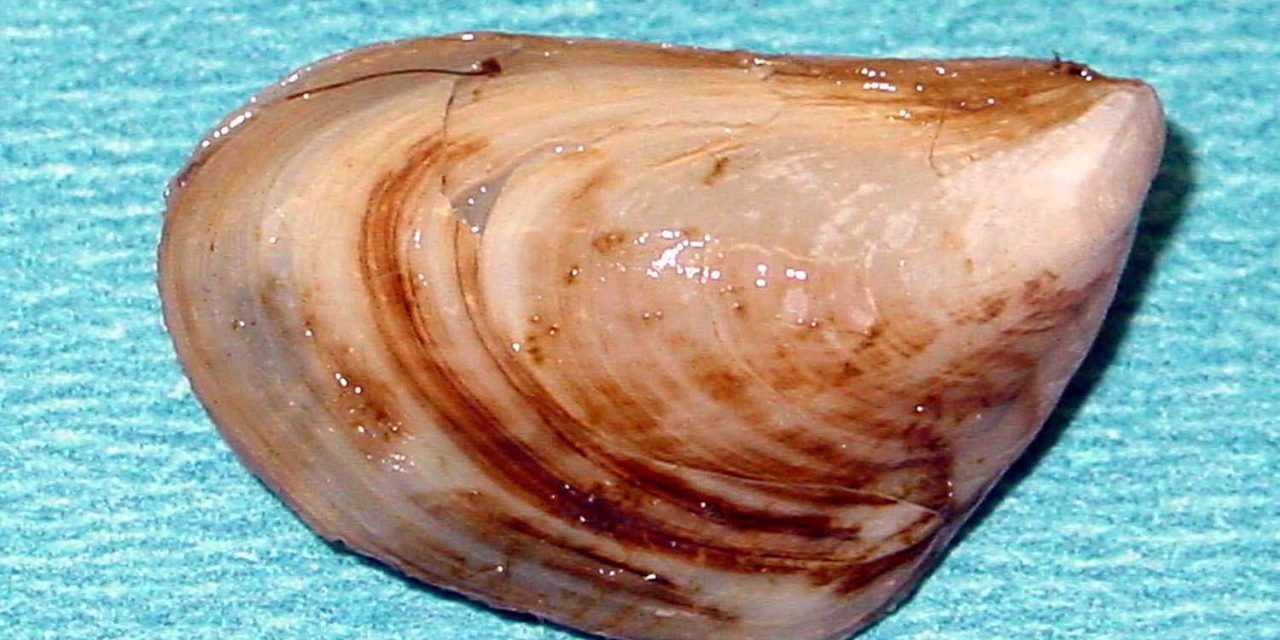
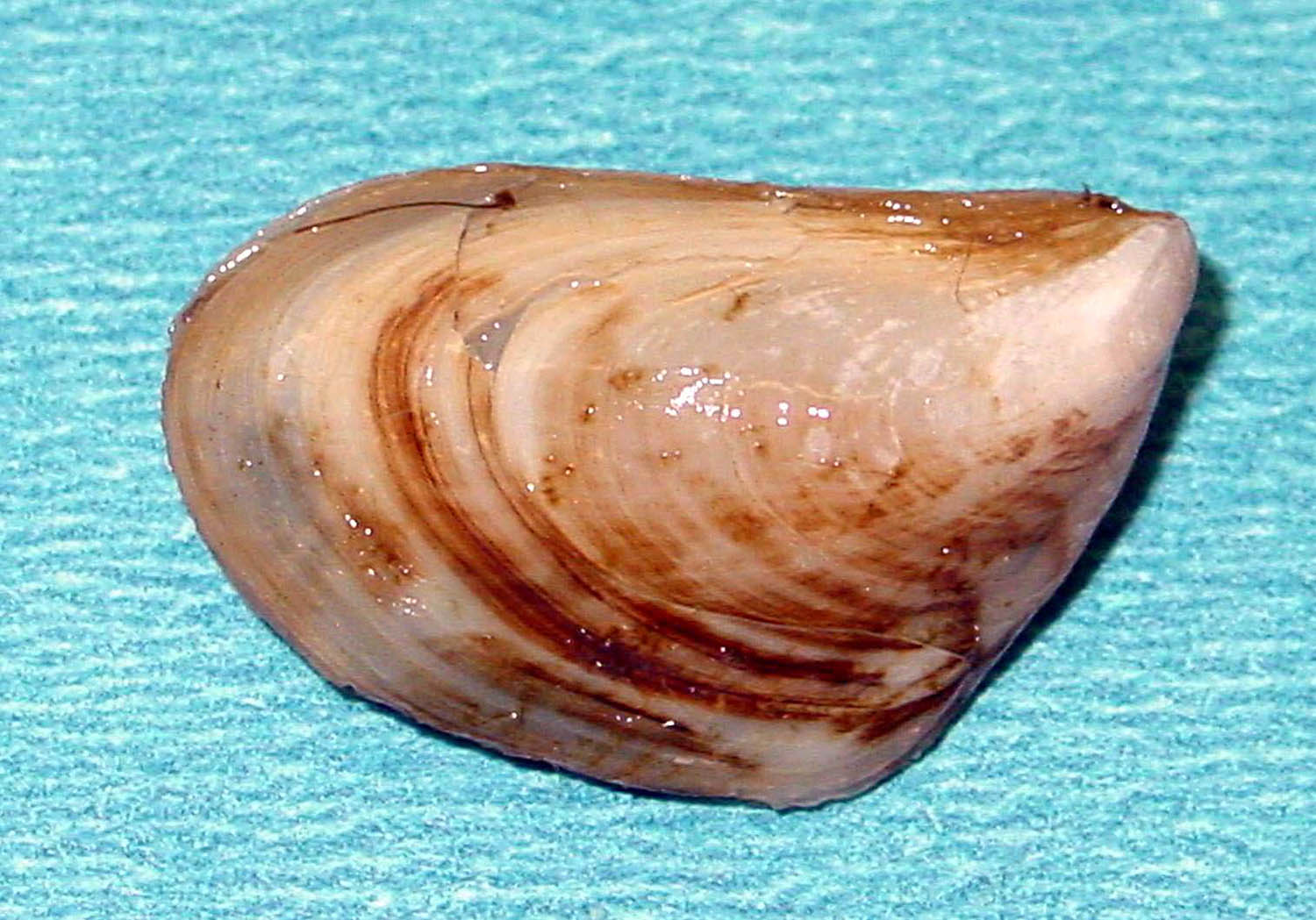
Quagga mussel. (Courtesy of the U.S. Geological Survey)
More than 11 years after a House of Commons committee urged the federal government to bring in comprehensive regulations to address the threat of aquatic invasive species, those regulations were announced on Friday.
Reflecting concerns about the threat to Okanagan lakes posed by invasive zebra and quagga mussels, one of three media events across Canada was held in Kelowna.
Local Conservative MPs Dan Albas and Ron Cannan made the announcement on behalf of Gail Shea, minister of fisheries and oceans, who spoke at another event in London, Ont. focusing on the threat posed by Asian carp to the Great Lakes.
A third media event was held in Winnipeg, Man. Zebra mussels were found to have spread into Lake Winnipeg in October 2013.
The new regulations will make it an offence under the Fisheries Act to transport certain invasive species, including zebra and quagga mussels, into Canada, across provincial and territorial boundaries and between ecosystems within a region.
The regulations address intentional and unintentional introductions of these species.
Most importantly, the new regulations would give border officials with the Canada Border Services Agency (CBSA) the authority to inspect and detain boats suspected of transporting invasive species into Canada.
Typically mussels are spread on recreational boats that haven’t been properly cleaned, drained and dried after being removed from an infected lake.
They can also be spread on floatplanes and other aquatic equipment. At the larva stage, mussels may not be visible.
Zebra and quagga mussels originated in Eastern Europe and now infest many waterways in Eastern North America, more recently making inroads into lakes and rivers of the U.S. Southwest.
The Okanagan Basin Water Board (OBWB) estimates the cost of mitigating a mussel invasion in the Okanagan at $43 million a year.
The new regulations don’t take effect immediately, but Cannan said the goal is to have them in place as soon as possible.
The regulations were published Saturday in the Canada Gazette, Part I, for a 30-day period in which the public can comment. Depending on the feedback received, further revisions may be necessary and could delay implementation.
“I think it’s a very good thing that it happened,” said Anna Warwick Sears, executive director of the OBWB in reaction to the announcement. “It is really essential and it is probably the most direct, simple, efficient thing to do. It’s not that there isn’t more that needs to be done, but simply giving the border agents the ability to stop and inspect boats for the import of aquatic invasive species makes a lot of sense.”
Warwick Sears said the regulations seem straight forward, but people will need to wait to see how much government funding is provided to implement them.
“One just hopes that it’s adequately budgeted because that’s always going to be the weak spot,” she said.
Doug Findlater, chair of the OBWB and mayor of West Kelowna, was present at the Kelowna press announcement.
He pointed out that the OBWB applied pressure on federal MPs through its DontMoveAMussel.ca website that allowed the public to generate emails to MPs on the issue.
Gail Wallin, executive director of the Invasive Species Council of British Columbia, also spoke at the Kelowna event.
“The news of having regulations is really, really important for Canada,” she said. “There’s not just the economic impact, but a huge environmental impact.”
Wallin noted that invasive species would threaten salmon in the Okanagan, Fraser and Columbia river systems.
“Prevention is the key,” she said. “Dealing with responding (after an infestation) is definitely important, but we’re much smarter and wiser to invest in the prevention side.”
Robert Chisholm, NDP fisheries and oceans critic, said he thinks the regulations “should do the trick,” but he awaits public feedback during the comment stage.
“We’ll see what needs to be done, whether or not they need to be strengthened in various areas or adjusted in any way,” Chisholm said in an interview on Monday.
He was, however, critical of the time it has taken the government to bring the regulations forward.
“This government moves pretty slowly on a lot of things,” said Chisholm. “I look at the history and you have to shake your head because these invasive species are doing a lot of damage and creating a lot of havoc in various parts of the country. Regulations like this, they are taking their sweet time getting this done.”
It has taken more than a decade and two governments to arrive at these regulations.
The need for comprehensive regulations to address aquatic invasive species was flagged to the former federal Liberal government by the House of Commons Standing Committee on Fisheries and Oceans in May 2003.
That committee issued a report titled Aquatic Invasive Species: Uninvited Guests, which in its first recommendation called for government action “consolidating and streamlining regulations applicable to aquatic invasive species within a comprehensive set of federal regulations.”
At the time, in 2003, the former government said it agreed with the recommendation and it promised a national plan once existing legislation was analyzed.
An action plan making a number of recommendations was released by the Canadian Council of Fisheries and Aquaculture Ministers Aquatic Invasive Species Task Group representing federal, provincial and territorial governments in September 2004.
In 2005, the same House of Commons standing committee put forward the same recommendation for comprehensive federal regulations.
Again, the former Liberal government said it agreed with the intent and was working with other federal departments, provincial and territorial governments to “co-operatively clarify existing processes, identify any gaps and develop mechanisms to address the gaps.”
After the Conservative government of Stephen Harper took office in 2006, it wasn’t until 2012 that an omnibus budget bill made amendments to the Fisheries Act giving the government authority to create federal regulations to manage the threat of aquatic invasive species.
Consultations on those regulations with stakeholders then took place between November 2012 and April 2013 and since that time the regulations have been in the drafting stage.
Fisheries Minister Shea said the federal regulations complement provincial regulations. Although she was referring specifically to Ontario, the B.C. government introduced its own regulations in 2012.
“We’re not going to have federal officers going behind provincial officers doing exactly the same job,” said Shea. “We will have to co-ordinate that because we recognize there’s only one taxpayer.”
RICHARD McGUIRE
Osoyoos Times