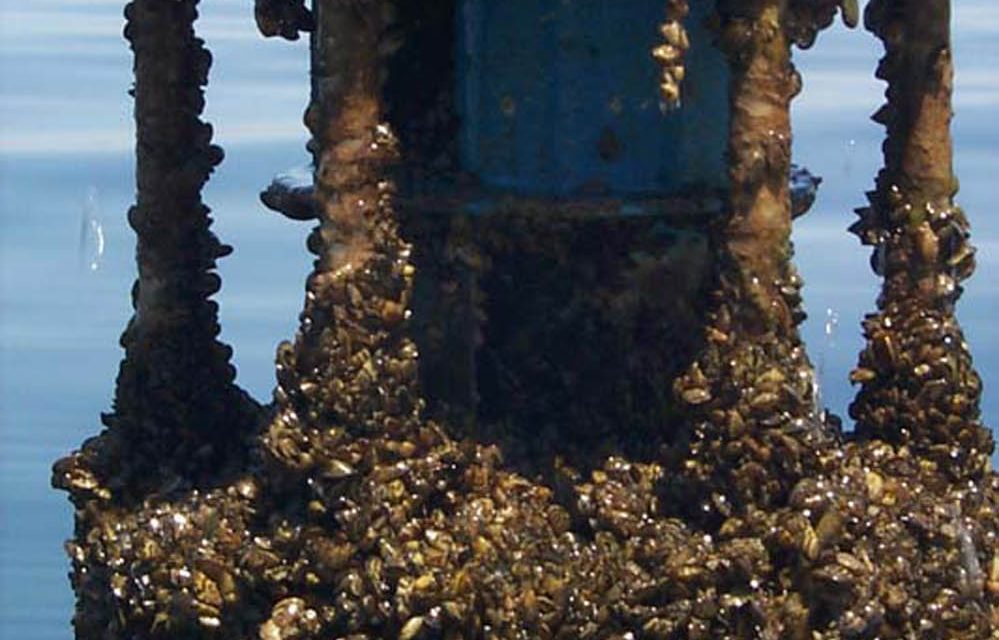
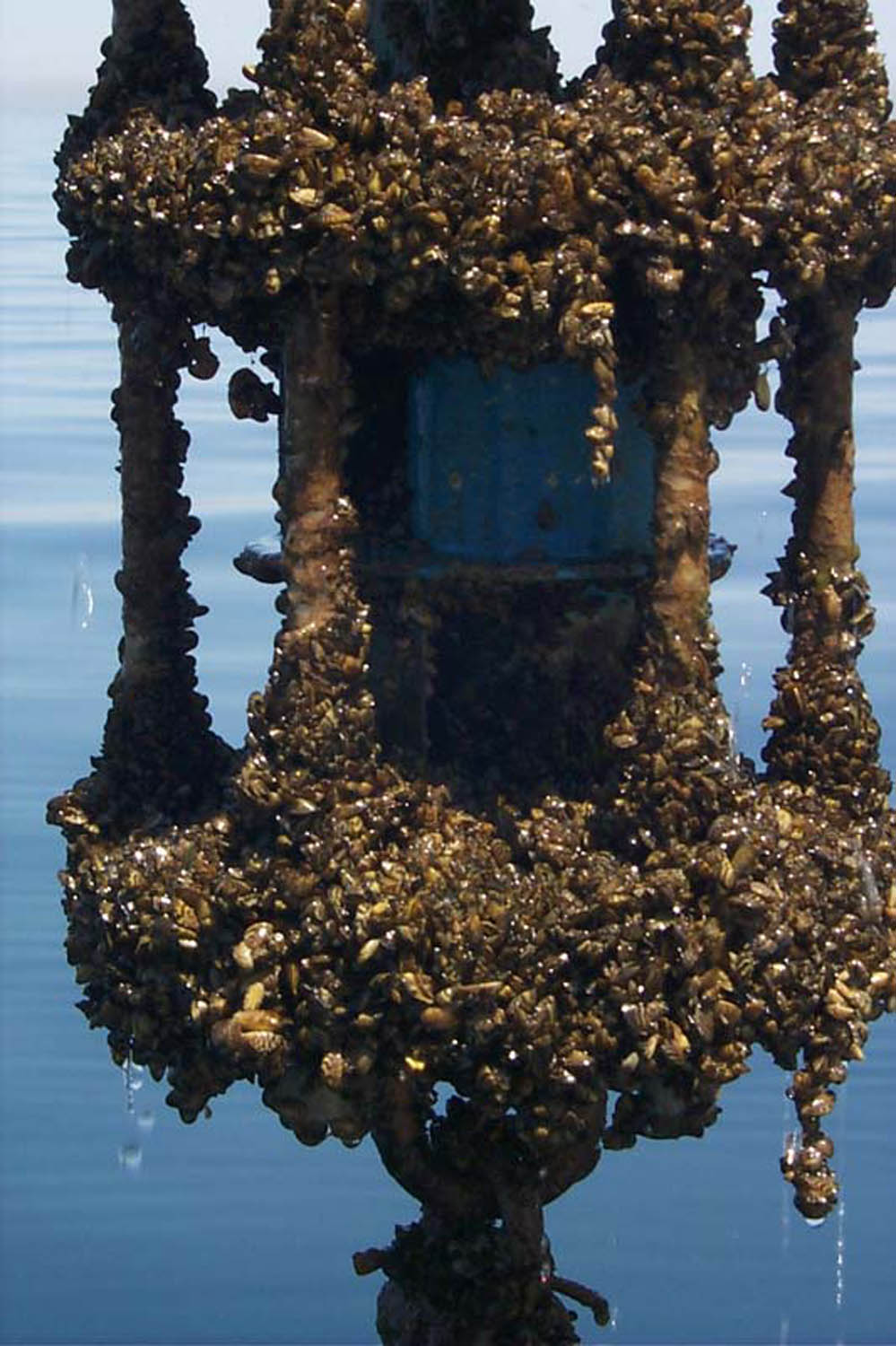
Zebra mussels encrust a current meter retrieved from Lake Michigan. Mussels cover every imaginable surface in the water once they infest a waterway. They are spread by careless boaters, but Canada lacks federal regulations needed to stop them at the border. (U.S. National Oceanic and Atmospheric Administration)
The interception by Osoyoos border officials last month of a boat encrusted with invasive quagga mussels should be a wake-up call for everyone.
It would only take one boat carrying zebra or quagga mussels to enter one of the Okanagan lakes and it would spread and devastate our local tourist industry.
The Okanagan Basin Water Board (OBWB) estimates that it would cost $43 million a year just to manage a mussel infestation. But it’s hard to put a dollar figure on the quality of our beaches and lakes and on the tourists who would no longer come here to enjoy them.
Throughout eastern North America and increasingly in the U.S. Southwest, invasive mussels have destroyed lakes and rivers.
They cluster onto water intakes, docks, boats and anything else in the water. Their razor-sharp shells cover beaches. They harm water quality and other wildlife.
These mussels originally reached North America from eastern Europe on larger ships, but they’ve been spread across this continent by recreational boaters.
While most boaters are conscientious and have heard the message to clean, drain and dry their boats before transporting them, it only takes one ignorant or careless boater.
It’s the local community that will pay the biggest cost of any mussel infestation, but it’s the senior governments in Victoria and Ottawa that have the power to take action. And they’ve been slow to act.
The biggest challenge is at the federal level where bureaucrats in the Department of Fisheries and Oceans (DFO) have been slowly bringing forward new regulations under the Fisheries Act that would prohibit the importation of invasive species.
Stakeholder consultations on the new regulations were conducted between November 2012 and April 2013, but the process has been mired in redrafting and documentation ever since.
DFO is unable to provide a time frame for when the regulations will be completed, and even then, there is still a further period for public comment.
Clearly there is no sense of urgency on the part of the federal government.
The problem is that without these regulations, officials with the Canada Border Services Agency (CBSA) lack the legislative authority they need to stop and turn back contaminated boats at the border.
Mussels have now reached Lake Winnipeg in Manitoba, so infestation from the east is possible, but the most likely source is the lakes of the U.S. Southwest.
In last month’s incident, a CBSA official at the border was alert and caught the mussels. Fortunately the driver was co-operative and allowed provincial conservation officers to decontaminate the boat. In this case too, the mussels detected were dead, although larvae can live in other parts of the boat.
Without the federal regulations, however, we can’t count on being so lucky next time.
Nor can the provincial government get off the hook. To their credit, they have enacted laws against launching mussel-contaminated boats into B.C. waterways. But they haven’t followed through with funding for inspection stations or enforcement.
In this area, there are just three conservation officers and a supervisor based in Penticton, and B.C. lacks the kind of inspection stations that have been implemented on highways in states such as Idaho and Montana.
Once our lakes are contaminated, it will be too late to turn back the clock. The federal and provincial governments need to wake up now, before it’s too late.