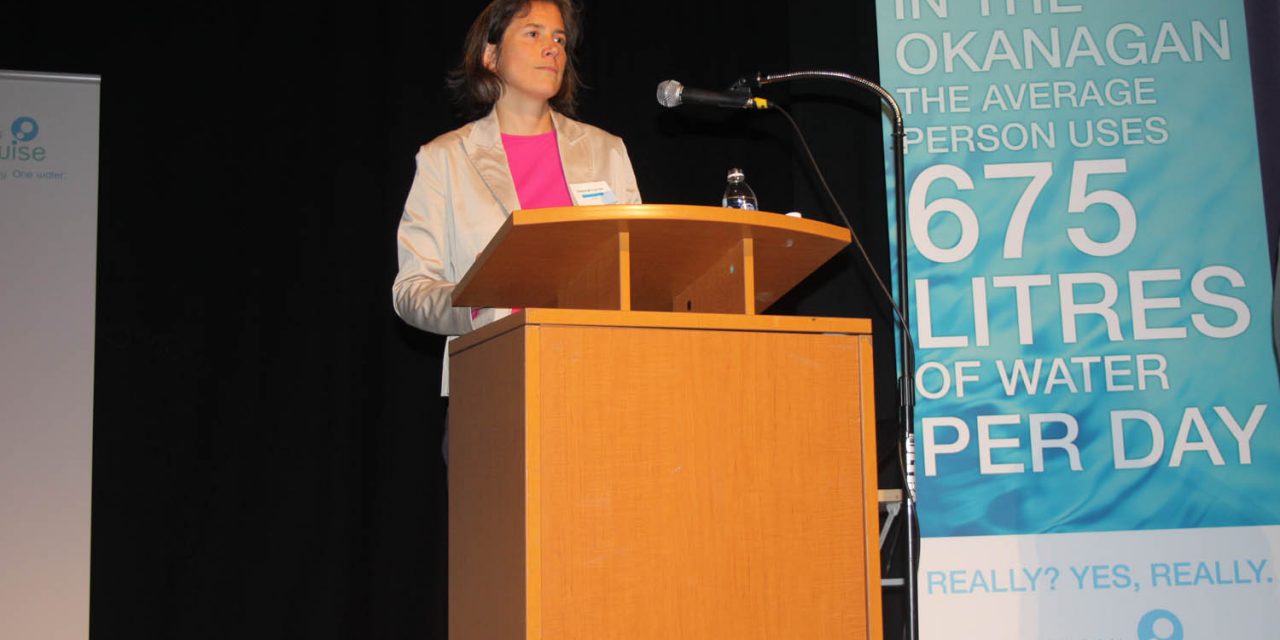
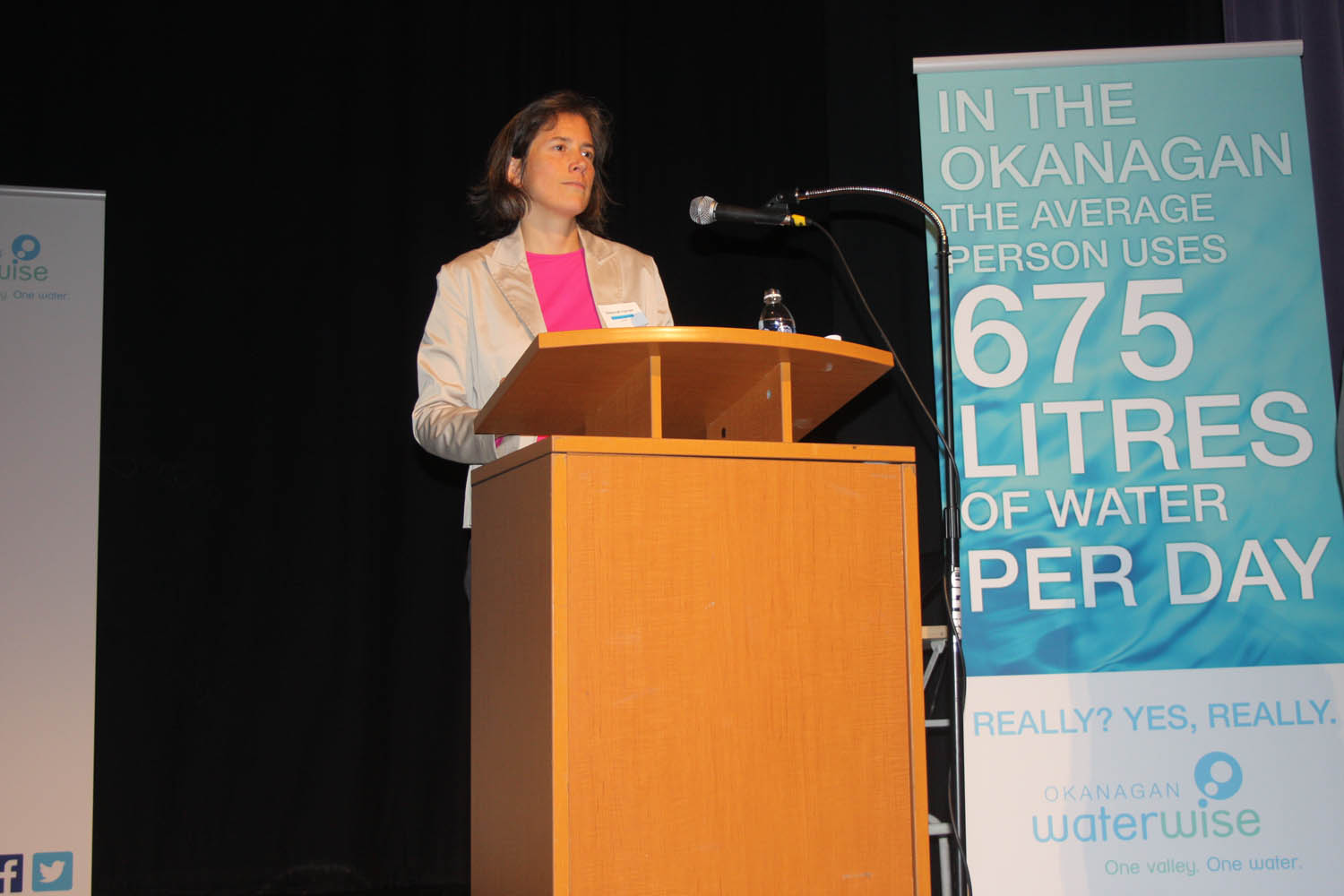
Dr. Deborah Curran, an environmental lawyer and professor at the University of Victoria, presented the keynote address at the Okanagan Basin Water Board’s annual general meeting last Friday at the Rotary Centre for the Arts in Kelowna. Curran said the province is bringing in a new Water Sustainability Act for the first time in more than 100 years and urged municipal leaders to take charge and form regional water strategy policies and procedures in the coming months. (Keith Lacey photo)
Municipal leaders from across the South Okanagan can take the lead and form sustainable water strategies in the coming months or do nothing and have the provincial government impose legislation that might offend and upset residents, said a renowned expert on provincial water issues at the annual general meeting of the Okanagan Basin Water Board (OBWB).
Dr. Deborah Curran, a municipal lawyer and professor in Environmental Law and Sustainability at the University of Victoria, provided the keynote address at this year’s OBWB general meeting at the Rotary Centre for the Arts in Kelowna on Friday.
Curran was asked to speak about the impact and implications of the province’s new Water Sustainability Act (WSA) and its impact on local communities, as well as the implications that follow from this summer’s Supreme Court ruling granting land title to B.C.’s Tsilhqot’in First Nation.
The province has made it very clear that it would like municipal leaders to take charge and formulate regional strategies for all key water-related issues, said Curran.
“I want to make this very clear … you have to decide whether you want to have the province impose orders and legislation or have a regional strategy to deal with all key water issues,” said Curran.
Water issues are particularly important in the Okanagan Valley as residents here use more water per capita than anywhere in Canada and there is a limited water supply in many areas of the region, she said.
“Water impacts everyone – and it impacts every local government,” said Curran. “From ensuring there’s enough, to dealing with flooding. It has to be taken seriously. Being proactive will reduce liabilities and will be central to decision-making.”
There are four things local governments need to be aware of, said Curran.
“One, the Water Sustainability Act is moving towards groundwater licensing,” she said. “This will affect local governments since many communities use ground water and also the regulations will impact surface water licensing.
“Two, the act recognizes the need to meet ‘environmental flow needs’ – or water for fish. In the future, water licenses may be changed to meet water needs of fish. Three, aboriginal rights and title are likely to have implications for water entitlements. And four, they need to be aware of the importance of negotiation with other users and rights holders. The trend for water disputes is to negotiate by having everyone cut back and develop water sustainability plans. Negotiating water use in a regional context – in the Okanagan and elsewhere – will win out at the end of the day.”
The new WSA, which won’t be fully implemented until next April, will be the first comprehensive government document relating to water issues in B.C. in more than 100 years, said Curran.
After the act is implemented, all water license holders will be given 30-year limits and the government will have authority to review and impose changes, which hasn’t been the case in this province’s history, she said.
“These licenses will be subject to review after 30 years and can be altered and revised, which has never been done before,” she said.
Under the WSA, Regional Districts across the province must consider water use allocation and quality issues in their official community plans and consider key water issues when developing key growth strategies, said Curran.
“If there is a development being proposed in a water scarce area, the province could limit the number of residences in a subdivision,” she said.
The recent Supreme Court decision relating to aboriginal title rights states clearly that First Nation people have inherent rights to accessing clean water for drinking, fishing and pursuing their traditional way of life, which affects municipal leadership and community development across the province, she said.
“There are now processes in law to grant injunctions against federal and provincial decisions when it comes to aboriginal title issues,” she said.
The best advice she could give to municipal leaders is to form regional water strategy boards made up of councilors, mayors, senior administration and residents to look at long-term water sustainability issues, said Curran.
These boards would formulate policies and procedures to deal with important issues such as drought management, access to a consistent water supply for the agricultural industry, ensuring and protecting groundwater sources and much more, she said.
“I suggest you start discussions now,” she said.
She also recommended regional water strategy boards consider hiring a part-time hydrologist to provide best advice on all key water issues.
Curran said any local government that doesn’t become actively involved in long-term water strategy does so at its own peril as she reiterated the provincial government will impose rules and regulations that may not be in the best interest of local citizens if municipal leaders don’t take charge and formulate policies and procedures that are in the best interests local citizens.
The issues affecting water supply are different from region to region and that’s why municipal leaders from across the province must become actively involved in the process, she said.
KEITH LACEY
Osoyoos Times