Couple has worked long and hard to bring new apple to the market

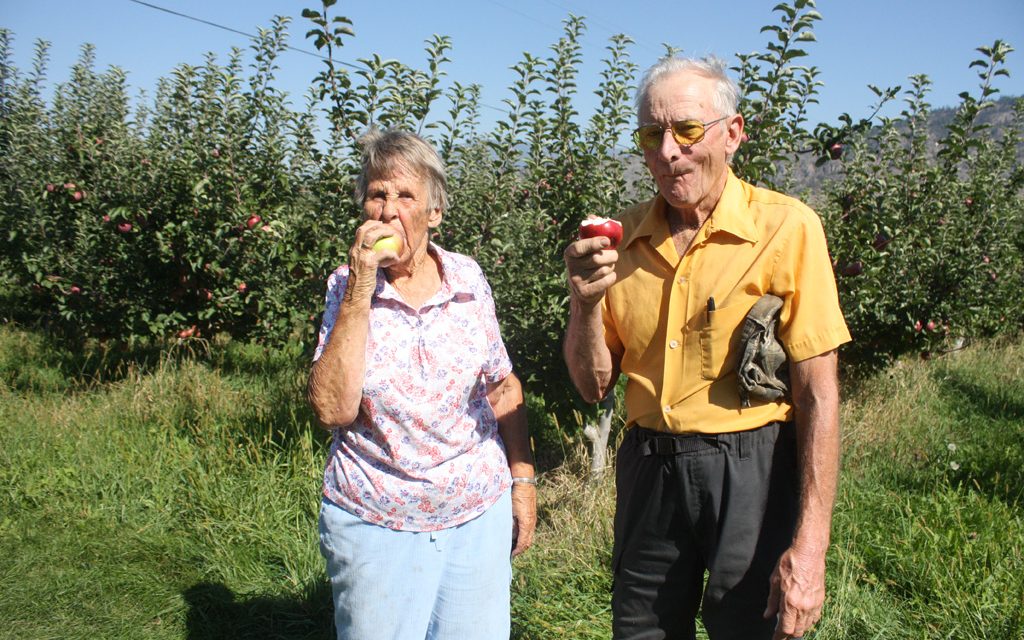
Jean and Dave Evans can’t wait to market their new apple variety, the Okana, to the South Okanagan and the world.
Keith Lacey photo
An elderly couple who have been growing fruit on their acreage located between Oliver and Osoyoos for decades are about to achieve a dream.
For more than 15 years, David and Jean Evans have been working to gain official recognition from the Canadian Food Inspection Agency (CFIA) to introduce a new variety of apple to Canadian consumers.
Within days, that dream should become reality as officials with the CFIA are in the process of approving final certification and granting plant breeders rights, which will allow the Evans’ to officially market their new “Okana” apple to consumers across the South Okanagan and around the world.
“I’ve been working on this for more than 15 years,” said David, 80, who married his wife back in 1956 and has lived on the 11-acre property they still own off of Road 15 since their wedding day.
Besides their large apple orchard, the Evans’ also have a large peach orchard and have been raising a small herd of cattle on their property for more than half a century.
“We’re the only farmers in this region that I know that still are ranchers and fruit growers at the same time,” said David.
They are also the co-owners, along with their son, of Testalinda Equipment, which rents and repairs farm equipment.
Evans tasted an apple from one of the trees on his property more than 25 years ago and knew he had tasted something different.
“I took a bite and knew this tree was producing an apple unlike any other on our property,” he said. “That’s when I started to experiment.”
After years of experimentation to try and develop this new variety, the CFIA informed the Evans a couple of weeks ago there has not been any objection to their application and a certificate will be issued allowing them to market and promote the Okana variety across Canada, said David.
“The industry needs a new apple,” he said proudly. “There are far too many apples being patented that do not have the confidence of packers and do not have consumer confidence. A lot of these varieties can’t be eaten because the public at large don’t like them and they have to be used to make apple juice and other apple products. The Okana is different. It’s sweet and it’s fully coloured and it comes from a beautiful tree and people seem to love the flavour.”
Like any new variety that is introduced to the marketplace, Evans developed the Okana variety through years of experimentation.
“I used a budding program where you take the bud off of one tree and plant it on the shoot of another,” he said. “Then it grows, if you know what you’re doing, and you move on from there. All of the trees that have been grafted into the trees where we’re growing these Okana apples have all come from the original tree on our property.”
Similar in size and shape to a Spartan apple, the Okana is sweet instead of tart, has better and more rounded colouring and is more appealing to the average consumer, said Evans.
The curvature of the main axis of the leaf of an Okana apple is medium to strong whereas it is very weak on a Spartan, he said.
What makes the trees that produce an Okana apple most unique is the outwards attitude of the leaf in relation to the shoot, he said.
“The leaves are all turned upwards and are very strong and very pretty,” he said.
The trees are uniform in size and picking an Okana is extremely easy, he said.
“It doesn’t take any effort at all,” he said. “You just reach up, grab the apple, give it a quick twist and it falls off easily.”
Evans discovered an Okana tree on his property in his orchard among rows of Spartan trees back in March of 1998. The original tree was grafted onto Fuji, which was then grafted on rootstock.
Starting in 2005, over 900 trees of Okana apples have been grafted onto rootstock.
Evans said he came up with the name Okana as a tribute to meeting his wife back in high school.
“I was laying in bed one night when I was in high school looking through a yearbook and something about an Okana Queen was mentioned,” he said. “I thought of my wife and I really liked that name and it stuck with me ever since.”
The CFIA conducted tests and trials on the Evans’ Okana trees last summer.
There were a minimum of 10 plants per variety, spaced approximately three metres apart in the rows and 3.6 metres between rows.
A letter sent to the Evans in early August confirmed the CFIA was willing to grant a patent for the Okana apple.
“The examination of the application for plant breeders’ rights for the variety was published in the January Plant Varieties Journal released,” states the letter. “The variety is eligible for grant of rights as no objections have been received in our office. “Please confirm that the variety denomination is as it should appear on the certificate for grant of plant breeders’ rights and that the certificate should be in the name of David G. Evans. In addition, please confirm that no Canadian trademark has been applied for, will be applied for, or has been received to the denomination or any part of the denomination. “Once rights have been granted, you are obliged to use the approved denomination when advertising and marketing propagating material of this variety.”
Evans said he’s very proud to have developed a unique variety of apple for the Canadian market.
“We did all of the horticultural work on our own and filed all of the paperwork on our own,” he said. “It has been a long haul, but we’re very excited. I think this is one of the best apples to hit the market in a long time.”
His wife agrees.
“It’s a really nice piece of fruit that tastes great,” Jean said. “We’re looking forward to other people eating it.”
Keith Lacey
Special to the Chronicle