 Unless the provincial government brings in appropriate measures to stop invasive mussels from entering Okanagan waterways, local taxpayers should not be on the financial hook.
That warning is contained in a position statement on zebra and quagga mussels approved last Thursday by the Okanagan Basin Water Board (OBWB). The board represents regional districts and municipalities throughout the Okanagan.
“The OBWB will not accept responsibility for the long-term treatment, mitigation or control of zebra or quagga mussels if the province fails to enact appropriate prevention measures and consequently the species are introduced,” the OBWB said in a resolution attached to the position statement.
This is exactly what happened when Eurasian milfoil invaded the Okanagan lakes, said the statement, drafted by James Littley, office and project manager for the OBWB.
The program to control milfoil has cost Okanagan taxpayers more than $10 million over the past four decades, while the province has contributed less than $8 million.
There has been no provincial funding in the last 15 years, leaving local taxpayers on the hook, Littley wrote.
The OBWB estimates that the cost of managing an invasion of mussels would be about $43 million annually.
“While AIS (aquatic invasive species) prevention is clearly the responsibility of the province, the milfoil program has shown that there is no appetite at the provincial level for long-term control and management of these species once they are established,” Littley wrote. “The position of the province is that once these species are introduced and cannot be eradicated, the responsibility falls on the local government to provide control and mitigation. There is no way to eradicate an infestation of these species. If they get here, local governments and local taxpayers will be on the financial hook.”
On March 31, the provincial government announced $1.3 million over three years to fund three roving inspection and decontamination stations as well as public awareness.
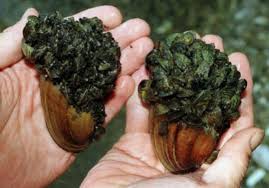
Recreational boaters who fail to decontaminate their boats after using them in infested waterways are the main cause of mussels being spread. Zebra mussels have reached Lake Winnipeg in Manitoba and quagga mussels have reached a number of waterways in the U.S. Southwest.
The OBWB, however, says the recently announced provincial program doesn’t go far enough.
They are calling on the provincial government to establish permanent, mandatory inspection stations at each of the five main highway border crossings from Alberta.
The OBWB is also calling on the federal government to finish the process of empowering the Canada Border Services Agency (CBSA) to prevent mussels being introduced via border crossings from the U.S.
The OBWB wants CBSA inspectors to apply the Uniform Minimum Protocols and Standards for Watercraft Interception Programs for Dreissenid Mussels for every boat crossing the border into B.C.
This, said Littley, is a flowchart of questions posed to boaters that could result in a quick inspection if the boat has been in infested waters.
Federal regulations under the Fisheries Act that would empower border inspectors to stop and detain infected boats have been mired in bureaucracy for years, but now just need to be published in Canada Gazette Part 2 in order to be enacted.
A spokesperson for the federal Department of Fisheries and Oceans (DFO) was unable to say when those regulations might be enacted.
“Work on the regulation is continuing,” said David Walters, DFO media relations, in an email. “In terms of the legislative process, it would be premature to speculate when the regulations would come into force as all comments received from the public are currently being considered before policy directions are finalized and revisions, if needed, are made to the regulations.”
Littley said the OBWB has heard the federal regulations could be adopted in May or June.
“Hopefully that happens,” he said. “But we’re not holding our breath given how long it’s taken in the past.”
Littley acknowledged that OBWB and local taxpayers might still be on hook if mussels invade, despite the resolution warning the province local governments won’t take responsibility if the province doesn’t enact appropriate prevention measures.
“The board recognizes that in the long term we may be on the hook,” said Littley. “Realistically we don’t have the authority to say we’re not going to do it, but what we’re saying is there should be no reason for us to have to accept responsibility if the province didn’t do its job. It’s a political statement to say ‘Get your act together.’”
Richard MCGuire
Special to the Chronicle