By Sebastian Kanally, Times Chronicle
The RDOS approved a 10 agri-tourism building for one farm, double what their bylaws allow for a property of its size.
At their April 3 meeting, the Regional District of the Okanagan-Similkameen (RDOS) agreed to support an application to approve the construction of 10 agri-tourism units on the property at 325 Road 20, south of Oliver, despite questions about its validity and consistency.
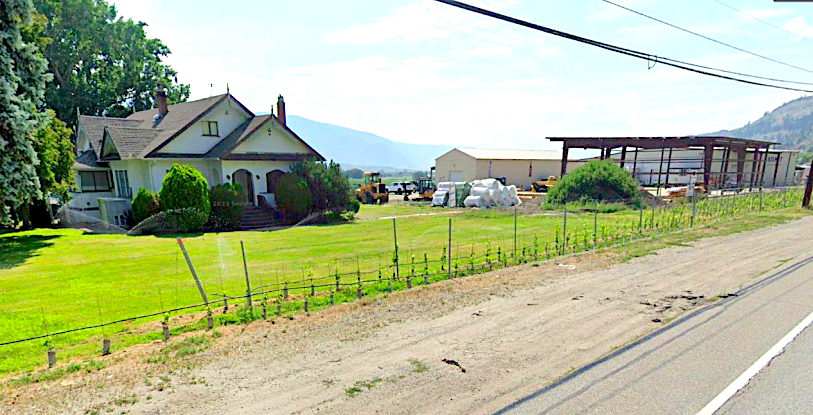
The property is 5.17 ha in area and is on the southeast corner of Road 20 and Highway 97. The property has a vineyard, a winery, and an equipment storage building.
The property is entirely within the Agricultural Land Reserve (ALR). Under the RDOS relevant bylaws agri-tourism is included as an agricultural use for “value added” or supplemental income.
The owner also owns a property across the highway, at 4114 Highway 97.
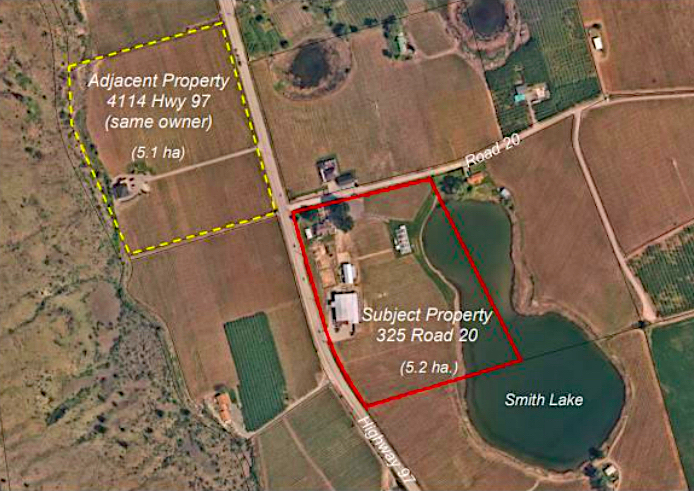
Map showing the proximity of the two properties which are separated by Highway 97.
RDOS photo
The application stated that the owner was willing to “transfer development rights” from that property across the road to the subject property. Since both would be allowed to have five units separately.
But in the recommendation to the board, RDOS staff did not include a covenant on the other property and chose to consider the merits of the application “solely on the subject property”.
Matt Taylor, Director of Area “D” Okanagan Falls took issue with this: “I struggle with this one a bit, where we are not putting anything on the adjoining title.
“To me they don’t really seem like adjoining properties, they are on opposite sides of Highway 97 and at present our zoning only provides for five units, and we are giving the guy 10, I just don’t see why we wouldn’t put the covenant on the other property or change the zoning.”
Tim Roberts, director of area “G” Keremeos, also questioned why the RDOS would not have something saying that it’s tied to the other property.
“We are looking at them kind of together, and that kind of makes sense . . . if they turn around and sell one half now, you have got this large facility on a smaller piece.”
“We run into the same thing with footprints to agricultural land now, where you can accumulate the footprint from multiple properties then put it into one, but then if you sell off those properties you end up . . . with a two-acre piece that is completely covered in concrete and buildings.”
He continued to say that these types of examples end up with an industrial complex that’s not connected to agricultural land.
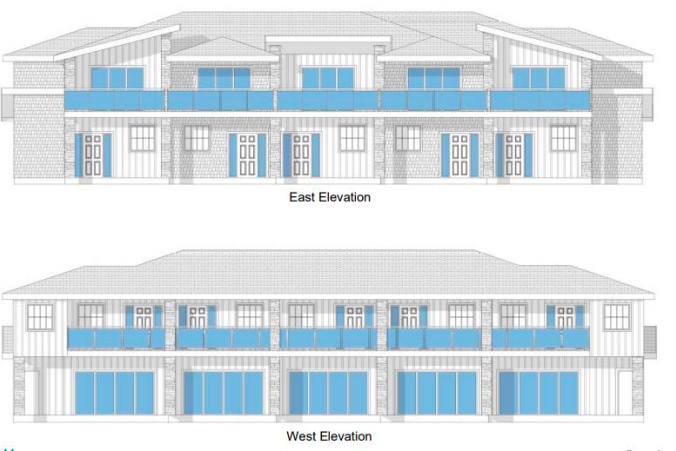
Artist’s drawing of the planned 10 unit agri-tourism structure.
RDOS photo
Chris Garrish, planning manager for the RDOS explained that these concerns were part of why the RDOS staff made the recommendation they did.
He explained “we do appreciate what the application said in this instance that they have an adjacent parcel nearby and that they are willing to transfer development rights from but from our perspective we chose to look at it solely in the context of the subject parcel recognizing that the other parcel may change and if it was sold, future property owners might ask for that restriction to be removed.”
Taylor continued to ask what was different about this application in order for them to be granted double what is allowed in the bylaws.
He asked RDOS staff, “Would the current owner be allowed to put a five-unit agri-tourism unit on that (other) property, or ask for a 10 unit?”
Doug Holmes, Mayor of Summerland, had his concerns about the application as well, but he brought attention to the fact that these agri-tourism units are allowed as supplemental income for farms.
“To me the principle of only allowing five, is to ensure that it is supplementary income as opposed to the primary use of the property, for me it begs the question if a ten-unit still ensures it remains a supplementary income initiative and doesn’t become the primary purpose of that property, what is that magic number then if ten is okay for this property then?”
“If ten is okay for this property, then why don’t we just change our bylaws to allow ten if we are all comfortable with ten on a typical farm, or is there something special about this property that allows ten where other farms should only have five?”
Garish explained that staff don’t usually suggest changing the bylaws because of one property, but they can bring options to the board. No one answered whether there was anything special about this particular property.
Julius Bloomfield, Mayor of Penticton, brought up a larger issue about the inconsistencies between the RDOS bylaws and the ALR requirements.
In the ALR requirements, a 10-sleeping unit agri-tourism accommodation is allowed on a property under eight hectares, but in the RDOS bylaws, it is not.
“It’s a concern around the farmers about the disparity between zoning of the regional district or the municipality and the differences between that and the regulations within the ALC and there is some talk about wanting to make sure those regulations are aligned; it removes confusion from a property owner when they are dealing with two different sets of administrations and as Director Holmes just mentioned why not change the bylaw to reflect what is essentially within the ALC regulations.”
The motion passed with only one Roberts not voting in favour of the application.