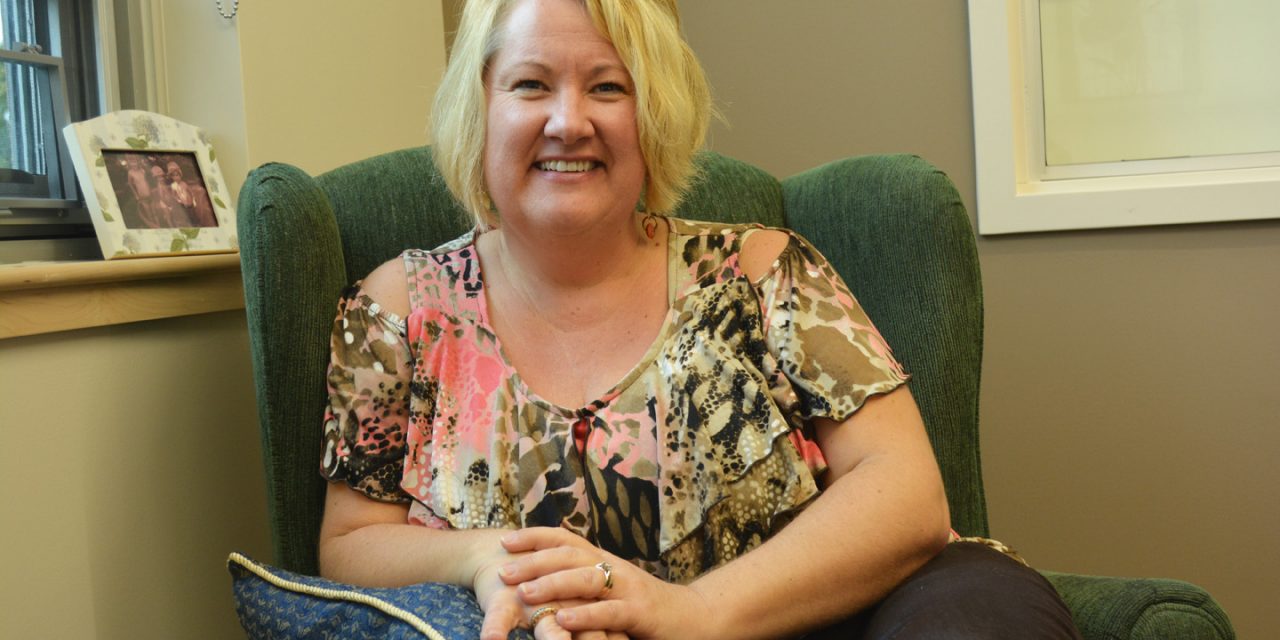

Tamara Aspell is the new executive director of Desert Sun Counselling and Resource Centre. Photo by Lyonel Doherty
It’s been six months since Tamara Aspell assumed the position of Desert Sun Counselling’s executive director.
It’s not surprising she still faces a learning curve when you learn that she oversees 13 different programs covering every age from infants to seniors.
Aspell was a guest speaker recently at the Rotary Club of Osoyoos, where she talked about those 13 programs and how they affect the communities of Osoyoos and Oliver.
The programs deal with such difficult problems as family violence and counselling of women, men, youths and children who are often dealing with past traumas.
But one of Aspell’s biggest challenges is obtaining the funding needed to operate these programs in the community.
Desert Sun Counselling and Resource Centre, a charitable, not-for-profit organization, maintains locations in Osoyoos at 8307 72nd Avenue, just west of the bottle depot, and in Oliver at 762 Fairview Road.
They also maintain a short-term shelter for women and children fleeing from abusive situations.
While addressing family violence is certainly an important part of Desert Sun’s work, it is by no means the only one. Other programs are directed at parents and young children at one end of the age spectrum up to seniors at the other.
Less than two years ago, Desert Sun took on the Better at Home program, formerly known as CASI Osoyoos (Community Action for Seniors’ Independence). That program helps local seniors to stay longer in their own homes by providing them with services that help them with day-to-day tasks.
Also for seniors, the Computer Tutor program operated at the Oliver Library uses teenagers to give free lessons to seniors to help them cope with basic computer skills and information technology.
“Probably our bigger programs are women’s counselling and children’s counselling,” Aspell said in an interview following her Rotary talk. “We have a program in each community for a total of four.”
Other programs such as Parent Connection and the Community Kitchen/Garden, however, serve everyone from pregnant mothers to children around age six.
One program that Desert Sun struggles to fund is its men’s counselling program for which it receives no provincial funding and must rely on fundraising.
“We’ve been running that for a number of years,” she told the Rotarians. “That’s on an as-needed basis, so as we have the dollars, we can offer the service. When it starts to get low, then we have to do another fundraiser.”
Aspell observed that the men’s counselling program is an important component in the effort to reduce family violence. Many men, she said, struggle with difficulties they had in their childhoods which now affect their relationships.
“Unresolved trauma, childhood abuse, sexual abuse, neglect, alcoholic parents, isolation, poverty – all of that,” she said, are among the childhood experiences some men carry with them through life.
The program helps men to communicate and increase their emotional capacity, she said.
“You increase empathy and you’re increasing communication and compassion. You hope that lives are changed, everybody’s,” she added.
Men’s counsellor Paul Edwards agrees that the program helps to address family violence.
“It’s easier to talk about stopping all family violence,” he said, adding he often finds counselling helps men to understand how they’ve used power and verbal or physical aggression to get their needs met.
“I tell a lot of my clients there are no monsters in the room,” he said. “There are just people trying to relate to one another and some of us do it really poorly and some of us do it horrifically.”
Edwards said he typically sees men for between four and 10 one-to-one sessions and the counselling is free.
For women and children experiencing threats, intimidation, violence and abusive situations, Desert Sun operates the South Okanagan Safe Home Program and a Women’s Crisis Line, operating 24 hours, seven days a week.
The crisis line number is 250-485-7777 or toll free at 1-877-723-3911.
Sometimes women call directly to seek help, but sometimes referrals come when a woman is in the hospital after receiving injuries.
In such cases, a hospital social worker may try to connect with the woman, but there is often resistance from the woman to talking about where the injuries came from and what is going on.
Aspell said she is sometimes called by the hospital in such situations and she sends a safe home worker to build a relationship with the woman in the hospital and get her into a safe home if appropriate.
“Our safe home staff have been doing the work for a long time,” she said. “Some of them have been through similar history and have similar stories. So they’re pretty intuitive at assessing what is going on. I think there’s a level of empathetic listening and a non-judgmental component that needs to come with building a relationship with the woman. Each woman’s story, although it has its similarities, has its unique inherent qualities.”
Rarely, she said, does intimate partner violence take place in isolation. Usually there are other things happening such as an eviction notice, poverty, children being apprehended or a mother trying to support children and parents.
The safe home project currently has a staff of six who rotate, working part time.
Some are retired people and others are working in other jobs and only work for Desert Sun when they have time, Aspell said. Some have been with Desert Sun for most of the almost 10 years that the program has operated.
The shelter, which is a one-bedroom apartment, allows a woman to escape a violent situation and decide where to go next. And sometimes that means returning home.
“If that’s what they feel they need to do, we support them,” said Aspell. “Successful intervention isn’t always them leaving to go to mom’s in Saskatoon or their uncle’s up in Kitimat. It’s really case specific and a lot of times it’s better the devil you know than the devil you don’t.”
When women decide to return home, they are given guidance on risk assessment and how to avoid escalating situations, making sure that they’re ready to leave the house at a moment’s notice.
Safe home workers know about all the resources in the community and the South Okanagan. They work closely with police and other agencies.
At Desert Sun, you never know ahead of time what’s going to happen.
“You think December and January might be busy and they’re not,” Aspell told the Rotarians. “Then March just ended up in overload and why this is we just never quite know. March was a gong show.”
Richard McGuire
Special to the Chronicle