
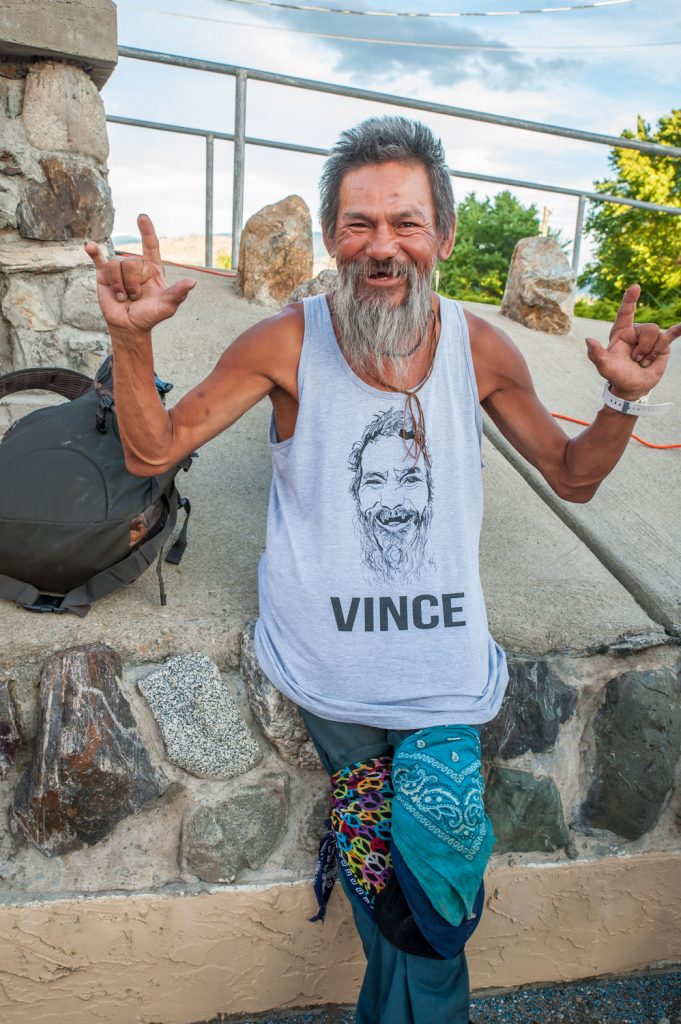
Vince Sam is the most recognizable homeless person in Osoyoos. (Richard McGuire photo)
Town of Osoyoos council is looking for a community group or coalition of community partners to work with them to find solutions to homelessness issues here in Osoyoos.
During a discussion following a staff report presented to council on Monday, members of council made it clear they are willing to be part of discussions relating to homelessness, but it’s going to take a community-led coalition to tackle all of the related complex issues.
Council voted unanimously in favour of a motion “that council agree to be a participant in a community-led process to address homelessness in Osoyoos.”
Coun. C.J. Rhodes said the entire issue of homelessness is very complex and must be addressed with a team approach.
All indications are there are only a handful of homeless right now in Osoyoos, but the Town does have bylaws in place that deal with what residents can and can’t do when they don’t have a permanent address.
“Our bylaws are very similar to others” in other municipalities across B.C., said Rhodes.
Mayor Sue McKortoff agreed that a committee of local residents needs to be formed to tackle the homelessness issue and members of council would gladly participate as part of that committee.
A staff report prepared for council stated there is no building in town that would be appropriate to house a homeless shelter, but recommended council agree to be a participant in a community-led process to address the issue.
At the Nov. 6 Committee of the Whole meeting, council heard a presentation from Brenda Dorosz, a founder of the Osoyoos Gift Cupboard, on the issue of homelessness in Osoyoos, in particular trying to find an outdoor place where well-known local resident Vince Sam could place his tent and possessions.
Council directed staff to bring back a report on the issue of homelessness.
A staff report by Janette Van Vianen, the Town’s director of corporate services, stated the specifics of Sam’s case should be dealt with in a closed meeting to protect his privacy.
Van Vianen’s report read on Monday said the the Town’s Parks and Community Facilities bylaw does allow for the homeless to camp in local parks as long as they abide by a strict set of rules and guidelines.
“A homeless person must not place, secure, use or maintain in place, in a park, a structure, improvement or overhead shelter, including a tent, lean-to, or other form of overhead shelter constructed from a tarpaulin, plastic, cardboard or other rigid or non-rigid material … except between the hours of 7 p.m. one day and 7 a.m. the next day when Daylight Savings Time is not in effect and between the hours of 8 p.m. of one day and 7 a.m. on the next day when Daylight Savings time is in effect.”
A homeless person must also not “at any time, in a playground, sports field, footpath, a road within a park, environmentally-sensitive area, or any other area within a park that has been designated for an event or activity under a valid and subsisting permit issued under the authority of the bylaw.’
The bylaw further gives the Town the right to remove any tents or camping equipment found in contravention of the bylaw with the items being stored for up to 30 days, plus a seizure fee of $35 and storage fee of $2.50 per day being charged to the owner and this fee must be paid before the equipment is returned, she said.
A provincial court case relating to right to life, liberty and security of the person is satisfied under the Town’s current bylaw, according to Town lawyers.
“It is their opinion that our bylaw is a reasonable and balanced solution,” she said.
“We also ensured that the language in our bylaw was such that it only allows the homeless, which is defined as a person who has neither a fixed address nor a predictable safe residence to return to on a daily basis, to set up temporary shelter and not those such as summer transient workers who are not homeless, but who have a residence somewhere else to live.”
The question as to what services the Town can provide for its homeless population remains and the Town currently does not own any facilities that would be suitable for a homeless shelter, she said.
“A homeless shelter should be manned and that would require trained resources as you would not want to have untrained volunteers dealing with the unknown,” she said. “This might be better served through a community group that has the resources to secure grant funding to help support such an endeavour.”
Homelessness is a complex issue in that several factors must be considered, including washroom facilities, whether a structure or just a place to camp is required, need for trained personnel and volunteers, she said.
“In many communities the size of Osoyoos, this is addressed through the work of a local non-profit group which initiates community resources to address this issue,” she said. “The municipal government is seen as a partner and not a direct service delivery agent.”
The staff report recommends council agree to be a participant in a community-led process to address homelessness in Osoyoos.
Members of council and staff said they are hopeful one community agency or coalition of community partners will approach the Town to form a committee looking at homelessness and its ramifications.
KEITH LACEY
Osoyoos Times