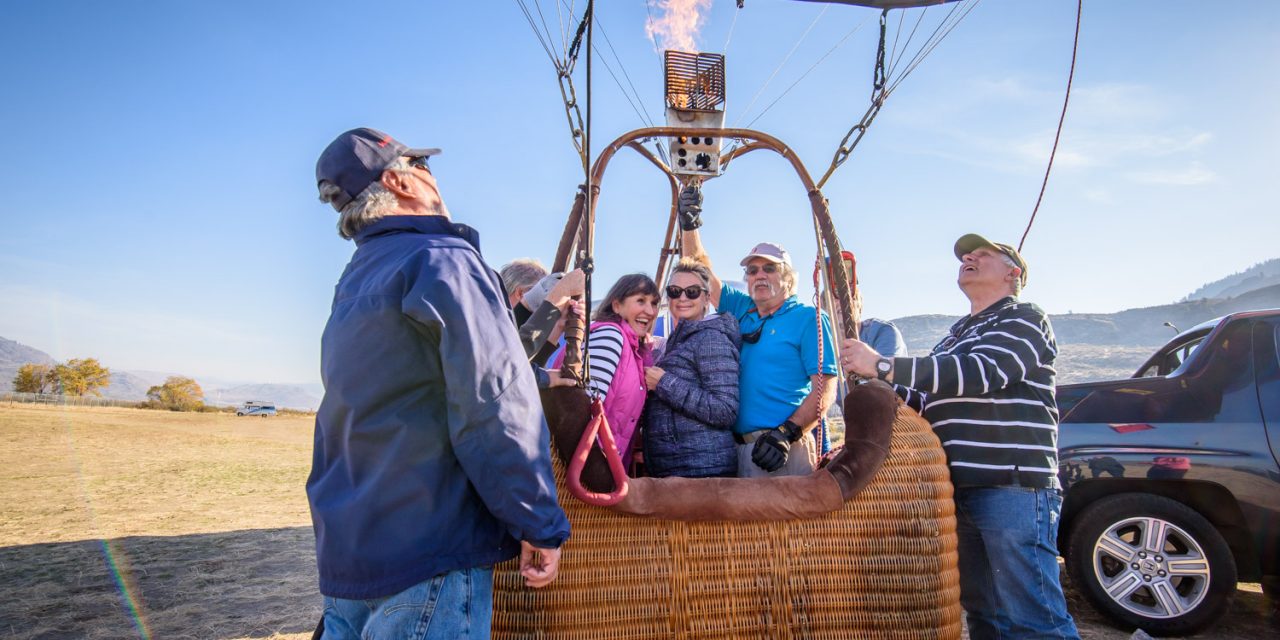

Hot air balloonist Garry Lockyer inflates his balloon at the Osoyoos Airport to take some friends from Osoyoos Cottages on a flight. With a light wind blowing from the south, he planned to fly northward, away from the U.S. border. (Richard McGuire photo)
It’s a sunny afternoon in October and Garry Lockyer is at the Osoyoos Airport directing some friends as they help to inflate his hot air balloon.
He’s planning to take a couple neighbours from the Osoyoos Cottages on a flight up the valley.
There’s a breeze blowing from the south, ideal to carry the balloon northward, away from the U.S. border.
Using a powerful fan, they blow air into the opening at the bottom of the balloon. When the balloon reaches a certain level of inflation, Lockyer turns on a propane tank and fires flames into the balloon. Soon it is standing upright.
Before it is fully upright, Lockyer and his two female passengers climb into the basket. Finally the balloon is released and it gently rises over the building used by JF Kustoms.
The passengers wave and take phone photos as Lockyer uses the burning propane to heat the air in the balloon, causing it to rise higher as it floats away to the north.
The previous day, Lockyer was guest speaker at the Rotary Club of Osoyoos, where he described the hot air balloon passion that has gripped him since 1977.
At the time, Lockyer was living in Calgary, but he had no idea that city was a hot spot for balloonists.
It took a business trip to Chicago for him to be bitten by the bug.
Lockyer didn’t get to fly that time, but with some colleagues, he joined up with a hot air balloonist from Houston and a local balloonist and he assisted with the essential jobs of inflating the balloon and “chasing” or following it on the ground.
The ground chase is necessary, Lockyer told the Rotarians, because it’s very unusual for a balloon to be able to return to its starting point. Often the pilot is only able to pick the landing spot after the balloon is in the air and the pilot has a chance to assess weather patterns.
Back in Calgary, Lockyer met up with local balloonists and helped them chase balloons. Soon after that, he experienced his first flight.
It was a flight across the city of Calgary and to the northwest over the university.
But rather than be awed by the magnificent vistas of the city and surrounding landscapes, what intrigued Lockyer the most was the mechanics of the balloon’s flight.
“I’m a technical kind of guy as you probably figured out,” he said in an interview. “I was more interested in how the balloon was constructed, how did it fly, did I really want to learn to fly.”
And that fascination got him started in competitive ballooning, where his skills were pitted against other balloonists from around the globe.
In 1986, he was the Canadian champion. That was his best performance, but he’s competed at the championship level in numerous other ballooning events in North America and around the world.
He’s also been a jurist at various balloon festivals.
Using diagrams, Lockyer showed the Rotarians the types of tasks balloonists have to do in competition, flying to selected targets.
Then one of the Rotarians asked an obvious question – how do you steer?
“There are no controls on the balloon that can cause it to change horizontal direction,” Lockyer responded.
Some balloons have “turning vents” which allow the balloon to be rotated, for example to give passengers a particular view or to display advertising on the balloon to spectators below. But these vents don’t control the balloon’s navigation.
The only control the balloonist has is to make the balloon go up or down by controlling the amount of hot air in the balloon.
But balloonists carefully observe the weather, and wind speeds and direction can change significantly at different altitudes.
It could be that 100 metres above ground, the wind is 15 km/h from the west. At 200 metres, the wind might be 20 km/h from the west-southwest.
It can change radically so that at certain elevations the wind will actually be blowing in the opposite direction.
To change direction then, the balloonist raises or lowers the balloon to the altitude where the winds are blowing the right way.
Five years ago, Lockyer and his wife Cheryl, also a balloonist, found a new home at the Osoyoos Cottages.
But while Calgary may have been a mecca for hot air balloonists, the South Okanagan is not so ideal, Lockyer explained. This area has two strikes against it – the U.S. border and vineyards.
At one time, it was a simple matter for a balloonist with the right documents to fly over the border. But that all changed in the aftermath of the Sept. 11, 2001 terrorist attacks. Now even an accidental crossing of the border by a balloonist can have serious consequences. For that reason, Lockyer stays well away from the border and flies on days when the winds are blowing from the south.
The vineyards, he said, complicate the search for suitable landing spots.
Lockyer doesn’t want to make the growers unhappy by landing on their vines, but for him the most serious concern is damage to the balloon.
The vines, he notes are strung with steel cables and lots of posts. And the vines are fairly dense.
“If you have to go down in a wheat crop or a canola crop, there’s nothing there that will hurt you,” he said. “You’ll damage some crops, but you won’t damage the balloon. In a vineyard, there’s a lot of that structure that would just tear the balloon up.”
So how does he know where he can land in the South Okanagan?
“I’ve got a rough idea,” said Lockyer. “I’ve driven around quite a bit and I’ve made a couple of flights where I looked at satellite photos, so I have a rough idea of where the good spots are.”
His wife Cheryl, who has been crewing for as long as he’s been flying, also knows what a good field looks like.
As the balloon rises higher on that recent October afternoon, Cheryl and some of the other cottagers are packed up and ready to chase it on the ground.
Lockyer doesn’t yet know where he’ll land, but with his decades of experience flying and the support of the crew on the ground, he’ll find the right spot.
RICHARD McGUIRE
Osoyoos Times

Hot air balloonist Garry Lockyer inflates his balloon at the Osoyoos Airport to take some friends from Osoyoos Cottages on a flight. With a light wind blowing from the south, he planned to fly northward, away from the U.S. border. (Richard McGuire photo)

Hot air balloonist Garry Lockyer inflates his balloon at the Osoyoos Airport to take some friends from Osoyoos Cottages on a flight. With a light wind blowing from the south, he planned to fly northward, away from the U.S. border. (Richard McGuire photo)

Hot air balloonist Garry Lockyer inflates his balloon at the Osoyoos Airport to take some friends from Osoyoos Cottages on a flight. With a light wind blowing from the south, he planned to fly northward, away from the U.S. border. (Richard McGuire photo)

Hot air balloonist Garry Lockyer inflates his balloon at the Osoyoos Airport to take some friends from Osoyoos Cottages on a flight. With a light wind blowing from the south, he planned to fly northward, away from the U.S. border. (Richard McGuire photo)

Hot air balloonist Garry Lockyer inflates his balloon at the Osoyoos Airport to take some friends from Osoyoos Cottages on a flight. With a light wind blowing from the south, he planned to fly northward, away from the U.S. border. (Richard McGuire photo)