By Richard McGuire
It was a chilly day in a cold month when 33 volunteer observers set out on New Year’s Eve to count birds around Oliver and Osoyoos.
This year 17,720 birds of 100 species were recorded, said Doug Brown, who co-ordinated the 38th annual Oliver-Osoyoos Christmas Bird Count.
Although the number recorded is well above the 36-year average, it’s the lowest count for total numbers and species since the turn of the millennium.
But that may be a reflection of people more than birds. Brown said two groups bowed out at the last minute due to illness, and that left some areas unsurveyed, even though there were 10 more volunteers this year than last.
Also, because much of Osoyoos Lake was frozen, many birds moved to the north basin where they were missed by the count.
Still, Brown said the Oliver-Osoyoos count was once again the best in the B.C. Interior – slightly ahead of Kelowna and Penticton in terms of species counted.
“For the second straight year, our most abundant species was the Bohemian waxwing with 3,042 birds found this year,” said Brown. “The Bohemian waxwing flocks often perch in the tops of cottonwoods or poplars before descending to feed on berries such as mountain ash and juniper.”
The European starling was second with 2,656 birds followed by the Canada goose with 2,346.
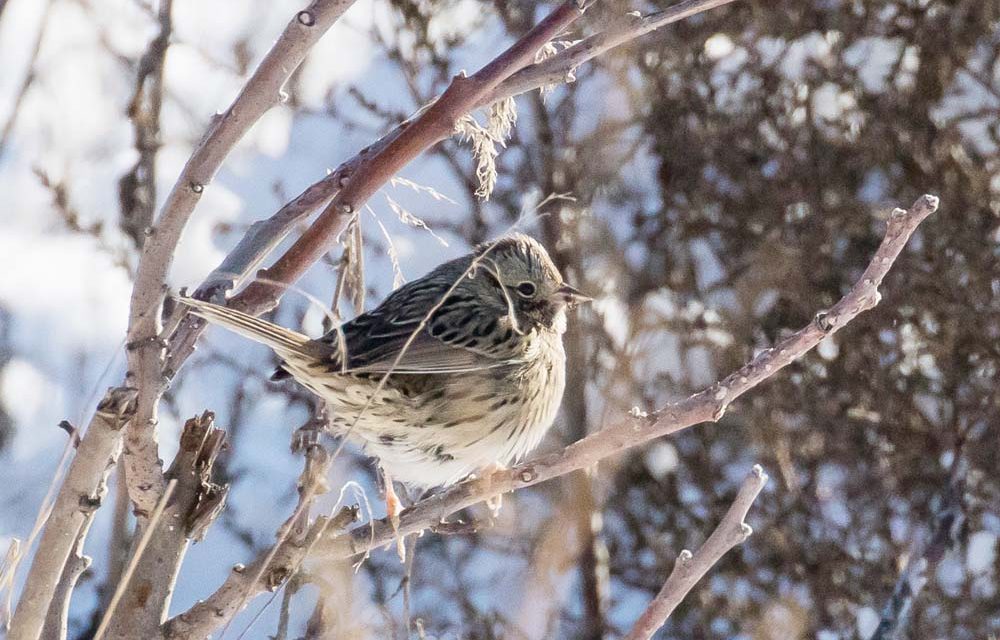
Several less common birds were spotted this year: the snow goose, wood duck, long-tailed duck, Thayer’s gull, black-backed woodpecker, yellow-rumped warbler, fox sparrow, Lincoln’s sparrow and western meadowlark.
But Brown said none of these was a major surprise because they’ve been observed here in the past.
“There wasn’t anything really super rare this year,” he said.
Two species often seen in the past were missing this year: the belted kingfisher and the ring-billed gull.
The first has only been missed five times in the 38-year history of the local count and the second hasn’t been missed since 1996, said Brown, who diligently tracks the historic record of the birds spotted on Excel spreadsheets.
The bird count provides insights into changing patterns of bird migrations due to such factors as climate change, loss of habitat and introduced species.
This year far fewer gulls were recorded, but that’s likely due to the freezing of the lake, Brown suggests.
But Brown has also been noticing the rise of some species, one being the Eurasian collared dove, which has only recently been introduced to North America.
This year 403 of these were counted – second only to a slightly higher 425 in 2013.
“When you consider that basically 11 years ago there was zero, that’s a huge increase,” said Brown, noting that it was first observed here in 2006.
Record high numbers for the rough-legged hawk, 19 in total, may reflect more of these Arctic breeders being pushed south by the cold.
Brown describes some of the less common birds as highlights.
Four snow geese were seen flying over Osoyoos Lake for only the sixth time in a bird count.
Two male wood ducks were also seen on the lake.
A Thayer’s gull was seen along the Okanagan River south of Road 22 and a black-backed woodpecker was spotted in the burn on Mount Kobau.
The Oliver-Osoyoos Christmas Bird Count is part of the longest-running wildlife survey in the world, said Brown.