By Don Urquhart, Times-Chronicle
The Nature Trust (TNT) of B.C. is aiming to expand its existing conservation property on the east side of Skaha Lake which safeguards important territory for Bighorn Sheep.
To do so the conservation organization needs to raise $100,000 by February 14 in order to purchase the lot from a private individual. In reality, it need only raise $50,000 as a single donor has offered to match donations up to $50,000.
The acquisition of the property, known as Skaha Lake Eastside – Lot 1 will enable the expansion of the TNT’s Skaha Lake Eastside Property Complex, located south of Penticton in the Regional District of Okanagan-Similkameen.
Lot 1 will add 32.9 hectares to the existing conservation complex, which is adjacent to the McTaggart-Cowan/nsək’łniw’t Wildlife Management Area.
While the original parcels were purchased in 1988-89 this particular acquisition has been in the works since 2019, according to Nicholas Burdock, Okanagan Conservation Land Manager.
The property is within a priority area for TNT as well as being a national priority area, Burdock said.
He also noted that expanding an existing complex of conservation lands “expands the resiliency of those conservation lands” which can then be managed and protected for the target species such as Bighorn Sheep.
The 6,491-hectare Wildlife Management Area was established primarily for the protection and management of Bighorn Sheep habitat while adding “important foraging, lambing and escape terrain for this iconic species.”
Bighorn Sheep, a ‘blue-listed’ species meaning they are of special concern, depend on a variety of habitats to maintain a healthy herd. In the summer they graze in higher elevation grasslands and open forest, near rocky bluffs.
In fall they descend to lower elevations for mating and spend the winter in low elevation grasslands, mature open ponderosa pine or Douglas-fir forest, rocky bluffs, and dry, open rocky areas.
Their winter habitat must include rocky ‘escape terrain’ – cliffs, slopes or dense forest patches – to avoid predators.
Spring is lambing season and they return to the same birthing places each year, on steep rocky bluffs and cliffs near grasslands.
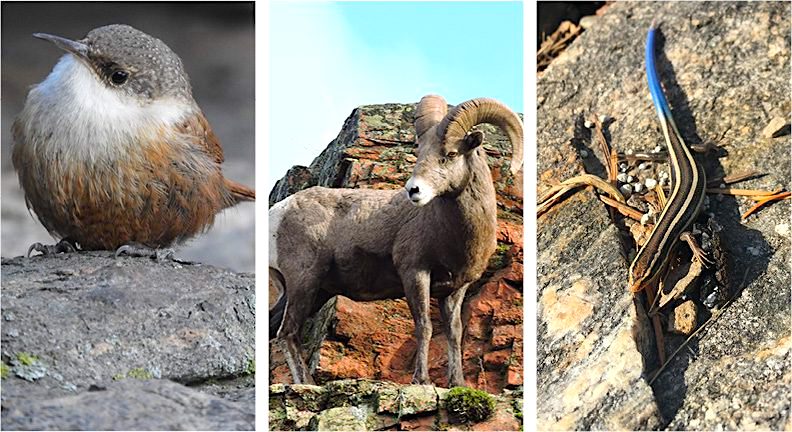
Left to right: Canyon Wren, Bighorn Sheep, Western Skink
The South Okanagan with its rolling native grasslands is a ‘hot spot’ for biodiversity, and is one of the most at-risk regions in Canada, according to the TNT. But natural areas within this region have been extensively fragmented and degraded by human development and agriculture, it warns.
“We’ve seen some issues affecting that species in the Okanagan and in B.C. over the last little bit with blue tongue and some other issues where we’ve had some die-offs occur. So it’s important to have these areas to recover and build back when they are facing these sorts of issues,” Burdock said.
This property is one of the last undeveloped benchland areas on the east side of Skaha Lake, Burdock underscored. “You’ve got vineyards and development and the city of Penticton to the north, housing and development to the south, so the pressure is on, on this side of the valley for natural areas.”
Loss and fragmentation of their grassland habitat along with forest encroachment, and increased human activity in rocky habitat during lambing season (such as rock climbing), have disrupted their lifecycle and reduced populations.
They are also susceptible to diseases carried by domestic sheep and goats, according to TNT.
Protecting this habitat will also protect a variety of other at-risk species including four species listed under Schedule 1 of the Species at Risk Act: Pallid Bat, American Badger, Lewis’s Woodpecker and Western Screech Owl.
It will also benefit several federally listed at-risk reptiles occurring on or near the property as well. These include the endangered Desert Nightsnake and the threatened Western Rattlesnake and Gophersnake deserticola.