By Lexi McFarlane, Times Chronicle
The Town of Oliver Council got their first look at a unique clean energy initiative during a recent committee meeting.
The HomeZero Collective, founded by Amandeep Singh, was presented to Council during the August 25 Committee of the Whole meeting. Having worked as part of a partnership with the City of Vernon since 2021, HomeZero has so far operated on a pilot project scale, being tested on 11 homes in Vernon. The collective is, however, nearing the Capital Project stage, Singh said during his presentation.
Multiple sources of funding have helped HomeZero run this pilot project, including an $850,000 federal contribution. Provincially, BC Hydro has chipped in $263,000 towards the initiative.
The objectives that the pilot project and HomeZero aimed to address were the high cost of retrofitting homes for clean energy, and the complexity of such upgrades. Additionally, the HomeZero team, composed of eight people from different career paths, sought to address the issues of an “inadequate workforce” for home retrofit projects.
Results showed a full retrofit of a single home was calculated to cost $55,000 during the pilot project. While the “whole house” retrofit approach was shown to have a high price tag, several benefits emerged from the pilot project.
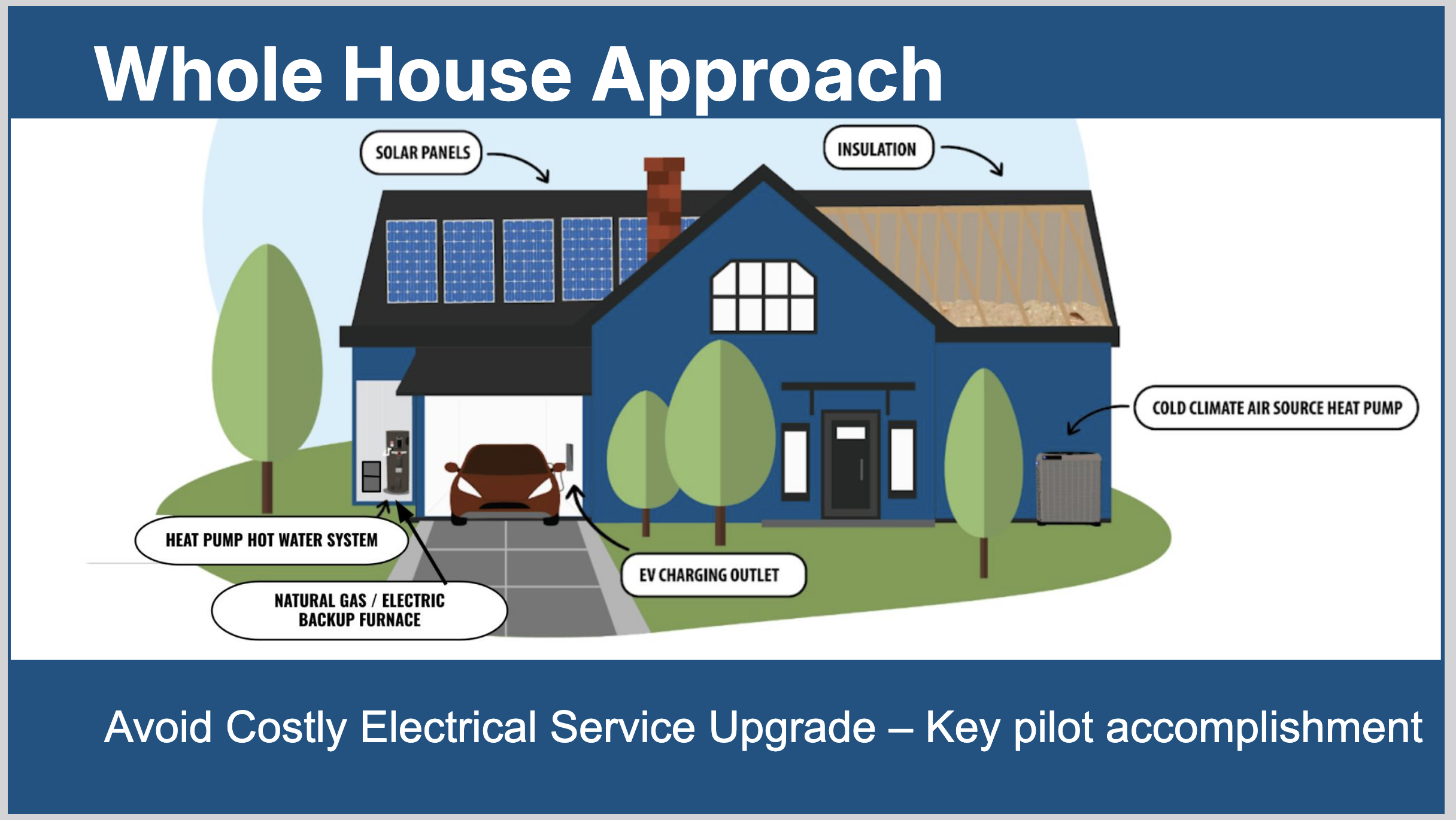
The pilot project and HomeZero aimed to address were the high cost of retrofitting homes for clean energy, and the complexity of such upgrades.
The modifications made to homes were overall streamlined, and took just four days to perform. The significantly lower energy bill, with annual savings of up to $4,000 listed as a result, also made the option more appealing to homeowners.
The pilot project’s selected homes varied in age range and specs, to present a balanced approach to the clean energy initiative. Results for greenhouse gas emissions reductions were shown to not vary dramatically between different houses.
Councillor Aimee Grice appreciated that a program like this can include more historic homes.
“I live in a home that could definitely benefit from a program like this, (being) built in the late 1930’s,” Grice said.
Her question focused on whether or not energy rebates would be applicable to HomeZero project homes.
“All the rebates that are applicable to the homeowner from the province, or from FortisBC, (those) are all presented to them, so that the whole process is streamlined for them to apply for these rebates,” Singh explained.
Councillor David Mattes wondered about the loans included in financing the project homes, and whether they follow the home or the owner who signs on to HomeZero.
“There is a way to connect the loan to the property with a statutory right-of-way,” Singh said. “And this has been done in the Okanagan, in a few communities.
“Essentially, what that does is when the home sells, and the statutory right-of-way kicks in, on title, the loan can transfer to the next homeowner when the sale of the home takes place.”
A question from Councillor Petra Veintimilla centred around the ask for additional funding from HomeZero.
“The ask from FCM this time around is $5 million, with the goal of retrofitting around 500 homes, so that works out to $10,000 per home,” she noted, asking how that would relate to the $55,000 cost.
“In the next phase, our costs will be a little bit lower,” Singh said. “Some of the $5 million will be used to further break down the cost (from the current number).
“Our goal is to bring down the cost enough, so we’re coming in at about that cost-neutral space, where your monthly cost before the retrofit, and after the retrofit, are similar.”
Mayor Martin Johansen wanted to ensure the cost-savings evaluations for homeowners can be trusted to be mostly accurate.
“I think homeowners (would) need to go in, eyes-wide-open type of thing,” he said, “because they are borrowing a significant amount of money with a significant payback, and if those savings aren’t realized, they could be on the hook for additional dollars they weren’t expecting.
“So just wondering how robust the business case is, put together for those homeowners.”
Singh said that HomeZero follows the standards and projection methods in place to get the best cost-savings model for each house.
“(The) assessment develops an energy model, which projects the cost. It’s not super-accurate, but it’s at an (acceptable) level; it follows the federal standard from Natural Resources Canada.”
Other results the pilot showed are that homeowners are willing to pay above cost-neutral in most cases for the overall benefits, and that they want to be part of a community solution. The Post-Retrofit Financial Outlook was also noted as being well-received by homeowners.
Councillor Terry Schafer approved of the work HomeZero is doing.
“I wish (this) was around when we retrofitted our house,” Schafer said. “We got a ground-source heat pump and solar panels, but yeah, we could have benefitted from a program like this, and I’d be happy to support what you guys are doing.”
A letter of support was drafted by Council, with Councillor Veintimilla putting forward the motion. The letter was approved unanimously.